
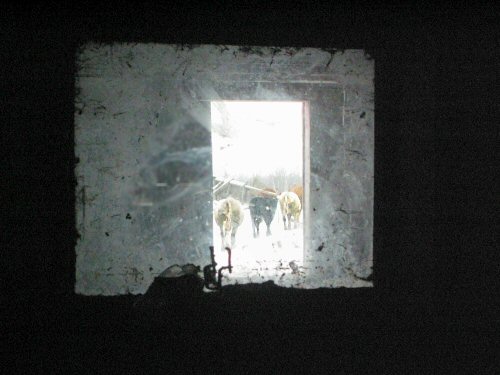
A rear-end view of the cows leaving the barn has become a familiar every-morning sight. For the last few weeks, since the weather took a turn for the freezing, I’ve been walking through the dim lower barn, toting buckets of warm water and feed, on the way to the chickenhouse. In nice weather, it’s easier and more pleasant to walk outside through the barnyard. This route has the advantage of no wind and no icy patches. It’s a bit of a winding road: into the minimally heated well pump room (heated so the pipes don’t freeze) where the 40kg (88lb) sacks of feed are stored, out the inner door into the dark and chilly lower barn, head down past the empty milking stalls (from dairy farm days), straight towards the window into the loafing barn where the cows come in at night, hard left, down another stretch between pens, unlatch a side door, head outside for a short walk, and it’s in with the chickens… A new daily routine for my first winter with the birds.
Fieldwork
The goats
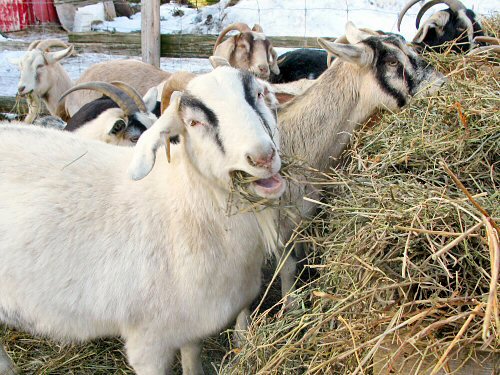
Haven’t been paying much attention to the goats lately, so I checked ’em out for a while this morning. They have absolutely no problem with the cold, eating hay and hanging out pretty much as usual. Of course, serving them is a lot more work when it’s freezing, lugging buckets of hot water from the main barn, since the pipe to the convenient goat barn tap is frozen. I did goat chores for a winter, but right now, it’s Bob’s thing. Oh, well. :) This gang of girls has had the same line-up for the last couple of years, and some I’ve known since birth… Familiar faces. A couple even have names…
Road to the Chickenhouse
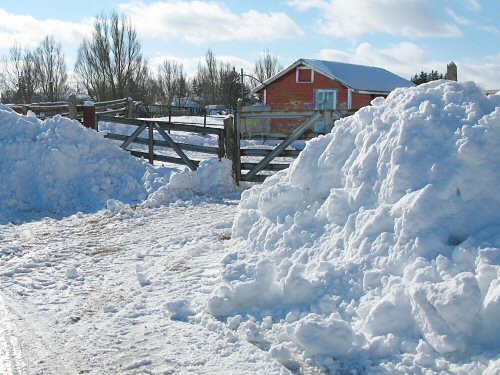
In bits and pieces, with no one storm to take the credit, the snow has been steadily building up. Regular barnyard clearing is fully underway, by blade-on-truck and then the big tractor, with snow banks appearing in all the usual places, like the ones that form the winter laneway leading to the Chickenhouse…
Stacking cages

The backdrop of snow turned the puzzle of sorting tomato cages into a bit of abstract art. I don’t use these exclusively, most of the 500-600 plants each year are tied to stakes or sprawled. But the cages get used, too. After every season so far, I’ve been determined to move beyond these lightweight wire gizmos to a more robust tomato support solution, but come spring and the transplanting rush, I end up with even more of ’em. They work great for the first eight weeks after transplanting, but once the toms really get going, they’re kinda useless, too short and not strong enough to hold up the plants. At the end of the season, they have to be hacked and torn out of the tangle of dead toms. And then, they have to be bent back in shape and stacked, tossing the ones where the rings have broken from the spines. I’d left this last little task till today, and now it’s done: the before (above) and after, around 200 cages, stacked and ready to store. Next season, something new!
Frozen chokes harvest
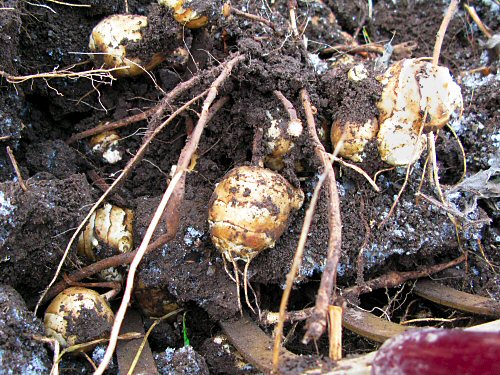
Despite the six inches (15cm) of snow on the big garden, fieldwork goes on. Today, I harvested about 30lbs (13.5kg) of Jerusalem artichoke out of the partially frozen ground, just to be sure planting stock is around over winter in case I need it. Since we don’t have a root cellar or walk-in cooler, storing crops in the ground as winter comes along is a risky but useful alternative. There’s still lots of carrot, parsnip, and some more chokes out there. Until the ground is frozen several inches or more down, it’s possible to harvest, although too much snow can make the whole thing a little crazy. Once thoroughly frozen, I’ve found carrots get killed off and thaw to mush, while parsnip and chokes withstand freezing just fine, staying alive and available again in spring. So far, though, everything’s still cool for digging. You can see the ice crystals in the frozen crust (above), but below that, it’s all cold, friable soil and plump, healthy choke tubers…
Veggies in snow
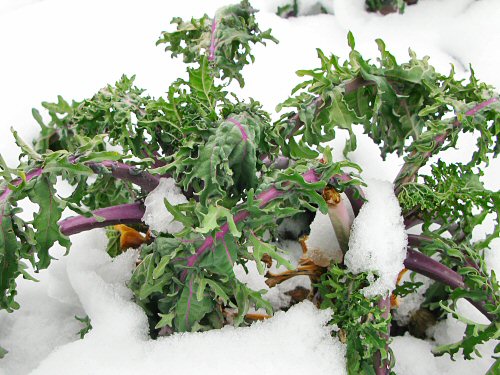
Every season there’ve been hardy veggies left to the cold and snow, and this season, it’s a record quantity, with nearly 2,000′ (610m) of broccoli, cauliflower, cabbage, and kale that mostly started sizing up just as the farmers’ market finished at the end of October. It seems like a waste, but it’s only a typical garden gamble on the weather (I was trying for an extra, really late crop). The risk was clear back in August, and we didn’t get enough sun to push things along a tiny bit quicker. We did harvest a lot of the Red Russian flat-leaf kale (above), for a good four weeks, and one round of 1-2 lb (450-900g) cabbage (a nice size for a meal for one or two). And there’s been a lot of personal-use picking in November. The rest is a giant farm lab experiment, more exploration of the snow-on-veggies effect…
More than the snow, the many nights of extreme cold (-15°C/5°F) that came with it this year really blasted these guys, wilting them and burning leaves and buds. So, none of the crops are too firm or pretty, BUT, they’re still alive: for the most part, there’s good color and texture. The kale, always super-hardy, did the best from a let’s eat some perspective, with good texture and great taste. The broccoli, while a little wilty on the stems and burned on the buds, also tasted great, fresh and flavorful. The cauliflower did the worst, the heads really damaged by the freezing and thawing, too mushy for me to bother with a taste. (Eating raw was fine, but how would this all cook up? We may see…) We’d already reaped most of the filled-out cabbage, so the rest aren’t going to go anywhere from here…
What’s all this odd information worth? Not much, I guess, I’m not planning on deliberately planting for snow harvests. But checking things out is always fun, no experience goes to waste, and there is at least one advantage to knowing there’s still good eating out there: the laying hens will be feasting on a fabulous greens buffet for a while!
Snow carrot harvest
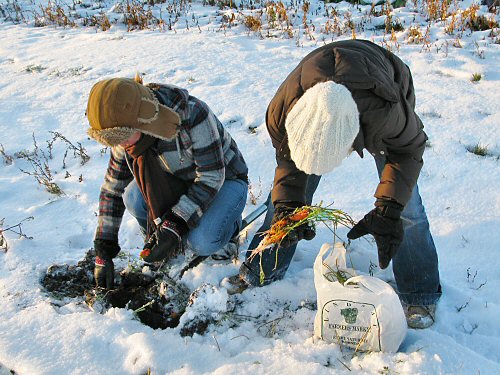
What’s a little snow when there’s crispy-sweet CARROTS buried under there? Lynn (the new Celebrity Farmer) and Raechelle headed up the field late this subzero afternoon, digging forks in hand, and scored sackfuls of Nelson and Napoli, no problem. It’s been well below zero (32°F) recent nights, and for the last couple of days as well, but the ground isn’t nearly frozen, and the layer of snow, fresh from overnight, actually acts as an insulator and helps soften it up. For now… The season’s not over until we SAY it’s over… :)