
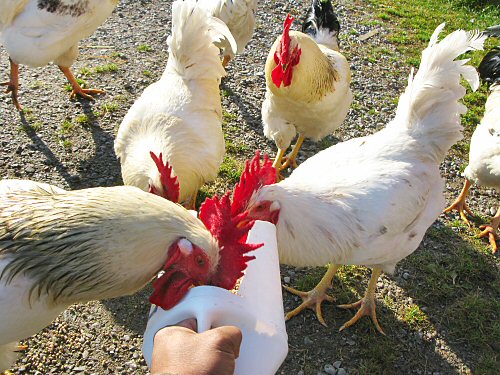
Eight of the Frey’s Special Dual Purpose roosters are still around, in fine form, roaming the farm. Clearly, I have yet to kill them! Not even one… We’ve been eating chicken often since summer, but there’s still a good supply of fat, frozen White Rocks. Meanwhile, I imagine the meat on these guys getting tougher by the week as they run around and do their thing: turning on one another in brief, furious bursts, digging deep, bowl-shaped holes, hopping on goats, sitting on fences, crowing at all hours, scratching and pecking. It’s a little out of control, but also fun to watch, and they haven’t done anything really bad so far (one has grown quite mean and somewhat vicious, though, and menaces or even attacks people—he’ll be first to get it in the neck! :) They’re truly free-range, they’ve put on impressive weight strictly by foraging, which includes stealing some of the goats’ grain, but mainly involves bugs and whatever else they find in the fields. Most mornings, they get a little scratch, or some of the girls’ feed. Sometimes I’ll hand-feed ’em for a few minutes, for no real reason, but maybe to keep ’em feeling safe with me, and easier to catch down the road…
Fieldwork
Bringing in the pump
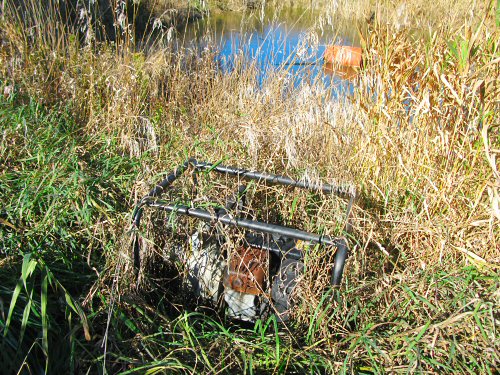
The trusty 6hp irrigation pump was dutifully hauled out to the pond in May, and never seen and barely thought of since. Besides priming it when it was first set out, it had zero use this year. That’s what happens when you get many inches of rain a month, every month, for an entire season. I could’ve brought it in a lot earlier to save it from some weather beating, but today was the day (and it’s a pretty rugged, all-weather pump). So, into the Kubota compact tractor’s loader bucket, and back to the drive shed. Test run for a while, drain the water, and it’s away for the winter!

Farm video
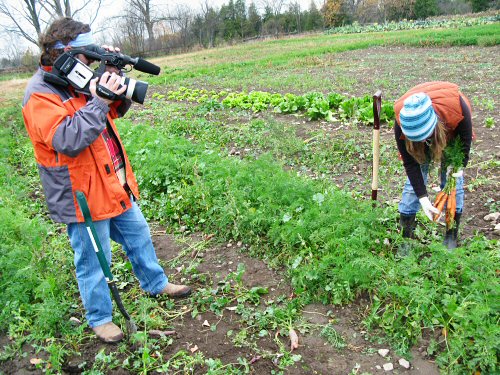
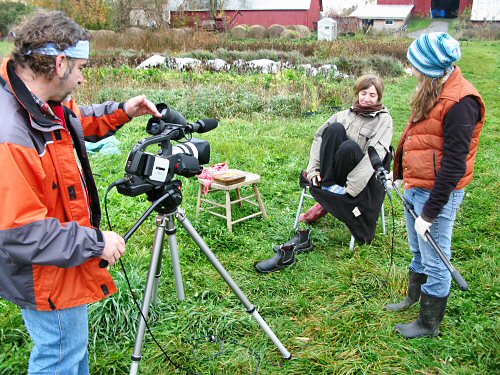
A bit of unusual activity in the field today, a mini-video interview! Raechelle and Lynn brought their friend David, who brought some video gear. The whole thing was casual, the video being mainly to record our impressions of tiny farming for a possible magazine article. Still, with the tripod and the boom mic, a certain “we’re on TV!” flavor hit the field for a couple of hours. We each did a sit-down interview (it was fun watching Lynn rustle up sound bites to describe the simple pleasures of…fieldwork), then David taped some atmosphere: digging carrots, chasing chickens,… And we had cake! Earlier this season, we had our own, self-styled, TFE version of a photo shoot for a newspaper article. Now, this! Are we becoming increasingly…media-friendly?! ;)
The incredible shrinking harvest!
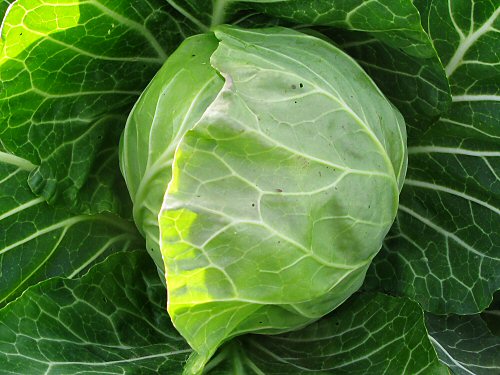
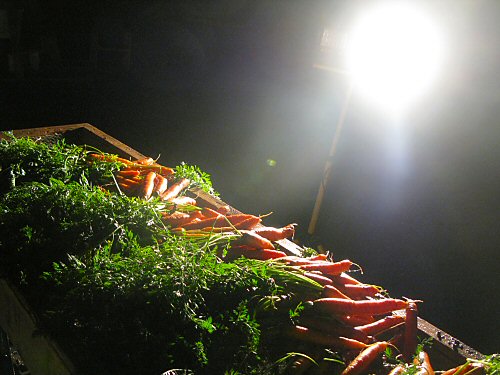
The Friday harvest is shrinking. This is the second to last of the year, and the last for CSA members, and we’re down to mainly root veggies. Some of the last cabbage planting has firmed up, and we’re picking them as “baby,” about 1-2 lbs (450-900g) each (multiplanted, the yield is good, the size really convenient for cooking, and the taste quite fantastic). And there are beets, carrots, parsnips, plus onions, garlic and other storage crops. And some lettuce… As the harvest gets shorter, so do the days, and I’m out rinsing beets and carrots after dark once again. Try not to get wet when it’s COLD…!
Night work
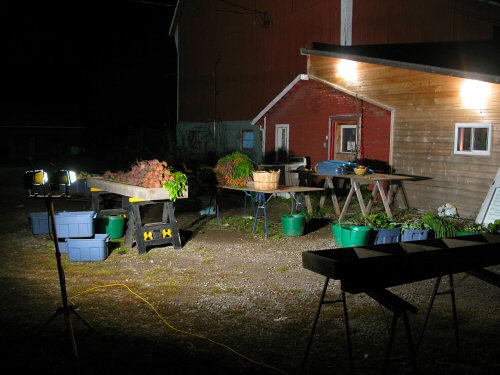
In the fall, post-harvest work doesn’t necessarily end when the sun goes down (it’s dark by about 7:30pm right now). Actually, this year the fall Friday harvest has gone great, with Lynn, Libby and usually Michelle knocking things off in the field by around 5pm, with only bundling and rinsing to go. But I’ve been wrapping up with the crew by 6, taking a break, and doing whatever’s left on my own…later at night. It’s something I’m used to from the first few seasons, when the mainly solo harvest usually went straight through until 11pm or midnight. Tonight was the first time I’ve hauled out the light stand this year. It’s around 10pm, the two lights specally installed on the side of the Milkhouse for this purpose are on (they’re both regular 100W bulbs, the full plan is to install floodlight fixtures), and there are twin 250W all-weather halogens on a stand. It’s not perfect lighting, but quite enough to get the job done without stumbling around. Tonight is a quick set-up to rinse carrots and beets. Full-on post harvest lighting includes a second light stand, with both set higher up and beaming down, and floodlights properly positioned, to give pretty good 360° coverage of the work area, and enough illumination to watch the mud wash off…
Cold-weather harvest
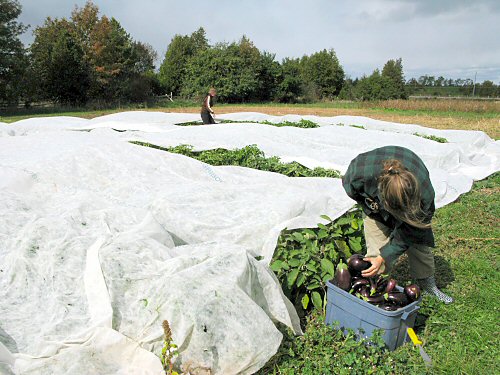
Some days now, the temperature is in the +/-20°C (50°F) range, and nights hover around the freezing point—not that cold, but comparatively so when other days shoot up to summery highs. I’m now keeping the row cover permanently on the eggplant and peppers, they’re no longer out there to grow—not enough sun—the field is now simply a convenient storage system. Picking from under cover, pulling back only as much as necessary, we take what we need for and leave the rest. There’s probably two more week’s worth of sweet and hot peppers, and at least another week of baby eggplant to go after today…
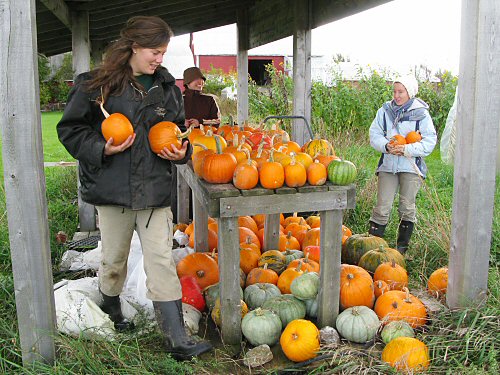
Bundling up a bit kinda seems to be the general choice. Libby and Lynn are in winter outerwear mode, down to insulated rubber boots, while Toshiko, who finds it colder here than at home in Japan, keeps warm with layers. Seasons change…
Digging up potatoes
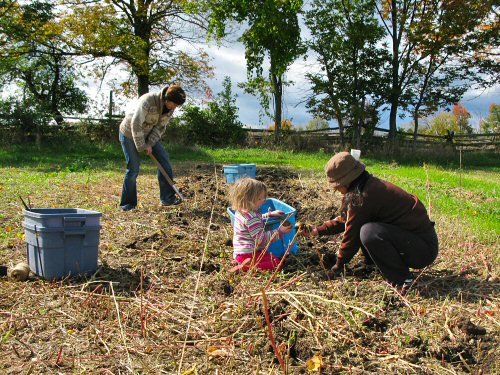
There’s still about 1,000′ of potatoes to dig, a few Yukon Gold, lots of Kennebec, and maybe a bed of Chieftain. This time around, it’s a bit of an unconventional approach. Some beds were kinda…weedy, so a week back, I mowed them all down. Now, the trick is to find the rows. Once a couple of plants are located, I run twine between stakes at either end to mark the row for easier digging. Michele and Toshiko were today’s crew, with young Violet checking things out. Simple fieldwork for a pleasantly cool fall day…