
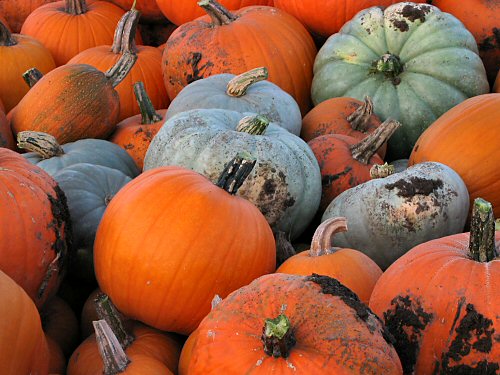
A leisurely late afternoon harvest yielded one trailer and one tiny tractor bucket piled with pumpkins. I didn’t count—there’s more to come—but I’d guess around 70. Pumpkins don’t have a big market value here just yet, but they’re fun to have around and they generally come through with little care. These guys received absolutely no irrigation and suffered somewhat for it, but they managed! The varieties: Connecticut Field and Neon for the bigger orange ones, Snackjack and Small Sugar for compact (3-5 lb), CSA share-ready selections, and Jamboree for that bit of difference (they’re the greenish-grayish ones). We’ll clean ’em up and lay them out on the nicely roofed farm stand to give the stand a bit of a purpose for fall!
Harvest
Unruly heirlooms
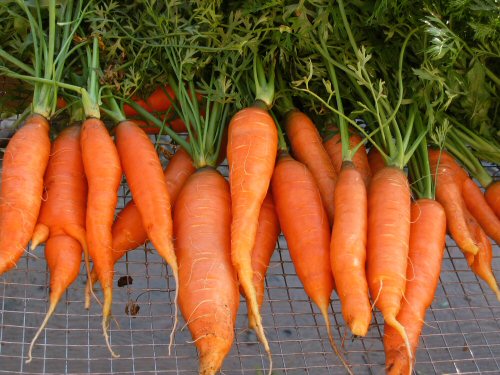
Left to their own devices, these heirloom Touchon carrots grew all over the place, an assortment of shapes and sizes. They’re in a bed where the mid-summer germination was spotty, and uneven spacing no doubt had a lot to do with it. Compared to our other mainstay carrot, the generally uniform Nelson hybrid, Touchons definitely show a lot more individual carrot character… As a trained-from-birth first-world consumer, I guess I’ve tended to automatically favor uniformity in many little things, like…carrots. On the tiny farm, that training’s being undone!
Little bundles for market
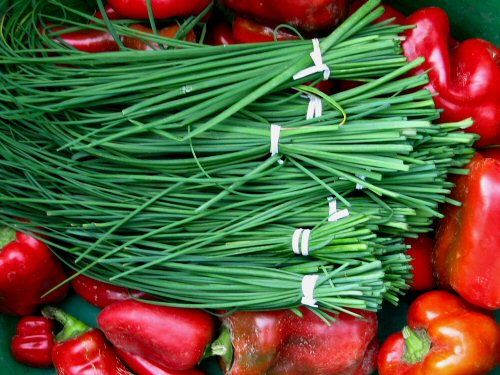
As things slow down in the garden and crops finish for the year, there is more time for really tiny harvests of this and that. Fifteen bundles of chives, a couple dozen small but tasty red peppers—little hauls like these add variety and incremental sales at the farmers’ market stand. I imagine you can afford to spend time on this kind of thing only on a really small, hand-cultivated farm. The veggie line-up for today’s market: carrot, mesclun, potato, onion, garlic, beet, summer squash, tomato, green onion, parsley, a few eggplant, peppers, cabbage and cauliflower, a little spinach and chives…
Cabbage and cauliflower
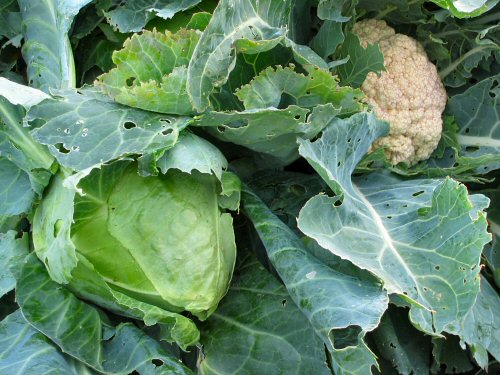
A pointy English cabbage (Early Jersey Wakefield) and a hybrid 55-day cauliflower (Early Dawn), side by side on the harvest wagon—not too common a sight! The main crop brassicas (broccoli, cauliflower, cabbage, kale,…) are easy to grow but harder to maintain when conditions get rough. Vicious flea beetle attacks on seedlings (and occasionally, when they really swarm, on mature plants) last from spring well into August. Floating row cover is a must. This in turn makes weeding difficult: either the weeds build up under the cover, or there’s a whole lot of uncovering and recovering to do. Then, the effects of regular drought can be brutal on big brassicas, and our spot irrigation doesn’t always keep up with their thirst. When more permanent drip irrigation is in place, the brasscia situation will get a lot better (next year!). Right now, every successful haul is a particular pleasure!
Mesclun, mesclun, everywhere!
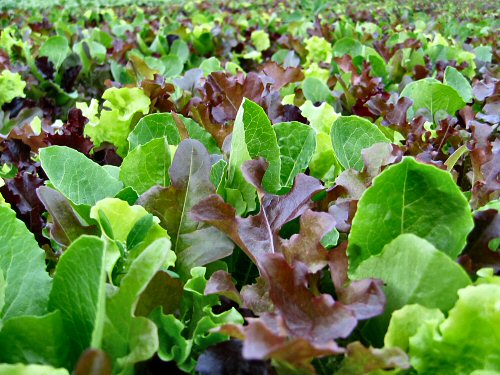
As I check things out for the Friday harvest, it’s mesclun, mesclun, as far as the eye can see. Well, as far as fits in the camera’s eye, held down at leaftop over three new 50′ beds. But it feels like a whole lotta mesclun, after a month of tight supply of this mainstay tiny farm crop. After one really poor succession planting (the seventh of the season), things got steadily better. Now, we’re on a healthy second cut of five beds that look set for even a nice third trimming, and these new ones have sized up in time for harvest tomorrow… Sweet!
Screen table
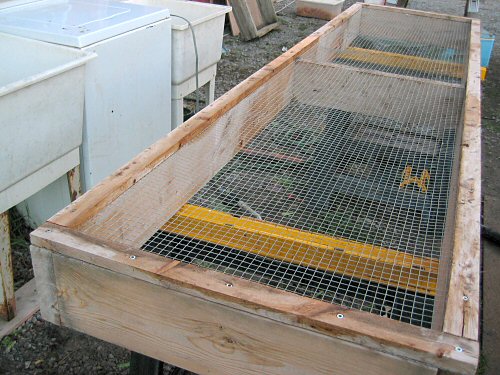
The new screen table was this year’s big addition to the washing up section of our little post-harvest processing area. Building it earlier this year was quick work: some 2×6 and 1×2 lumber, screwed together, with 1/2″ hardware cloth sandwiched in as tight as I could get it. Hardware cloth is the mesh of choice because it’s welded where the wires cross, so leaves and the like don’t get snagged the way they would in plain woven screen, like chicken wire. Positioned on sawhorses close to the washing machine and tubs makes it easy to pluck crops out of the water and onto the rack to drain. Simple, inexpensive, and one of my favorite bits of harvest gear… The last couple of harvest Fridays have been more work for fewer people, as part of the summer crew left at the beginning of September. With the days getting shorter as well, it’s the first time this year we’ve been finishing up the sorting and packing after dark! This week: mesclun, beet, carrot, spinach, radish, kale, tomato, potato, a few cauliflower and broccoli, squash, hot and sweet peppers, and onions and garlic from storage…
Four shares on the table
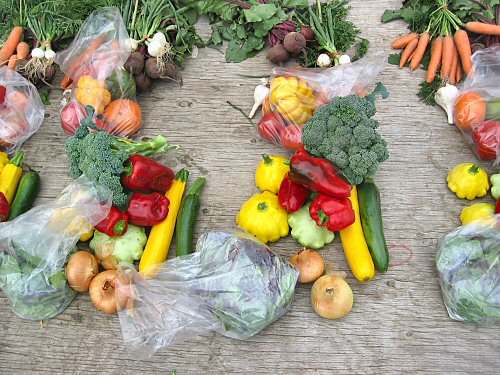
After the long holiday weekend, I did a quick new harvest for the handful of usually-on-Monday CSA shares. We have three CSA pick-up days, Saturday, Sunday and Monday, and harvest for the last two can be mostly combined on Sundays. With kinda cool and cloudy weather today, veggies could be left outside on the table for a few minutes—in full summer heat, they’d quickly start to get toasted. I’ve tried to reduce PLASTIC to a minimum (tiny farming has somehow made me averse to much packaging, especially with plastic). The tomatoes need to be kept together, they’d be crushed if let loose in the final shopping bag. And the greens, well, no other easy solution (I’m looking into reusable cotton salad bags that could be put in the fridge, another future project; I’ve moved to paper bags this year for potatoes). As for the shopping bags, I’m considering reusable tote bags, two per shareholder, that could be swapped empty-for-full each week, but the extra BAG MANAGEMENT I know would be fairly, let’s see…time-consuming. Details…