Big beets

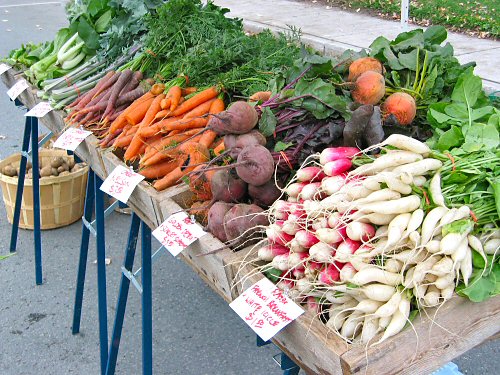
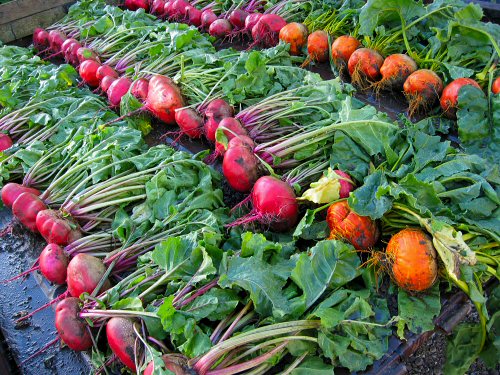
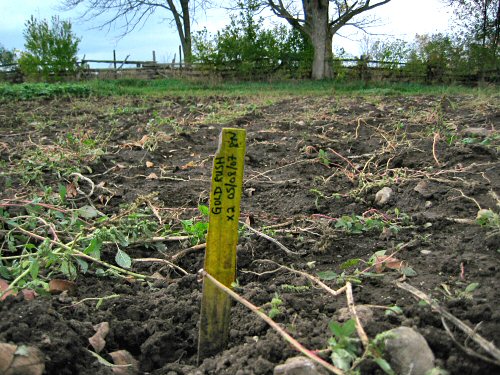
Something excellent and hard to pin down happened with the last planting of beets: they became HUGE. This was the fourth planting of the season, around mid-July (see them on the left), and the seedlings got caught in the near drought, although they were around the top of the irrigation list and got a decent share of water. In mid-September, the steady, plentiful rains started, along with continuing warm weather, but that was well into their growth (they’re all 50-60 day varieties). And thinning was good, though just the usual. Whatever the cause, all of them—Scarlet Supreme, Golden Detroit, Bull’s Blood, Chioggia—blew up, most weighing in at 1.5-2.5 lbs (700-1100 gms). Maybe I don’t get out enough (to check out other people’s produce around the country and the world :), or maybe more irrigation would do the trick, but to me it’s somewhat of a mystery how these got to double and triple size. I’ve tasted them all, raw and cooked: they’re firm, tender, with great color and flavor. Smaller beets are more convenient for some purposes, but these big guys are versatile and…easy to harvest and pack… Two to a beet!

After the harvest

Finally, today, no more potatoes in the ground! After a near-pristine potato patch for much of the season, field priorities got switched around and pigweed had its turn with the taters. Eradicating the weeds before digging up the last 50’x50′ section seemed to take forever (but was actually a few hours spread over the last couple of weeks). Anyhow, this last haul is about 200 lbs (91 kg). It’s not much when you can buy a 50lb (22 kg) bag of great, unsprayed, unwashed potatoes for $14CDN at the farmers’ market. But in my crop mix, it makes sense. We harvested somewhere around 1,000 lbs (454 kg) this year. In the usual 1-2 lb bags, some sold at a by the pound (not bulk!) price, and the majority used for CSA shares, that works out just fine… Of the Yukon Gold, Norland and Gold Rush, YG performed the best, from small, early, supertasty new potatoes to a good amount of nicely big mature ones—they’re not for storage, but who stores a pound!

Winter squash

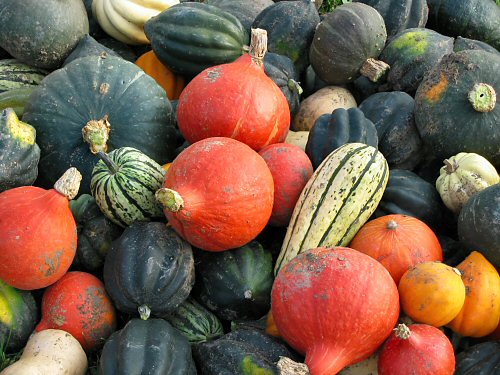
The Friday harvest finally included winter squash, and a tiny little harvest it was. These guys were on their own when it came to water, we just didn’t have time and gear to irrigate—given a bit of a rain break, they’ve tended to make out. Unfortunately, the timing of this year’s drought caught the plants later on in the season, late July into August, as they tried to fill out. Bottom line: super low yield and small squash this year, drip irrigation a must…next year. In any case, we did get enough for two rounds of CSA. Typically, the acorn squash came through best (Table Ace, Table Gold, Cream of the Crop), the butternut (Early Butternut) are…minuscule. Delicata was a first this year, I’m not sure how large they are usually, but likely bigger than this. And so on. Even the usually prolific and reliable, bright orange Uchiki Kuri, a Hubbard-type (Japanese Kabocha), didn’t do so well. Only the Sweet Mama buttercup came through with some decent dry weather size! So, off to the farmers’ market with an assorted 50 or so, none for sale, all for the CSA shares!

Autumn harvest action!

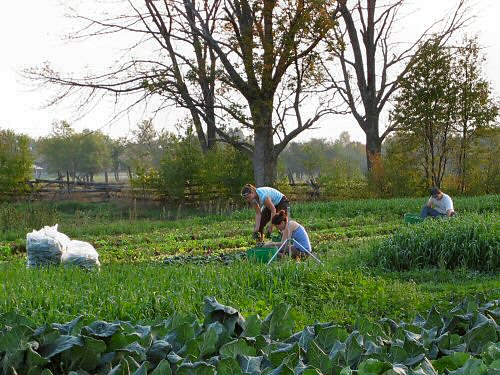
A steady harvest through a warm, hazy afternoon wound up quite early, with just about everything sorted, rinsed and bunched or bagged by around 8:30 pm. Smooth! The end-of-season crew has settled down to Jo, Lynn, Conall and me. Here, Jo and Lynn are harvesting a sparsely germinated but bountiful spinach patch (the second growth leaves are HUGE, fleshy, tasty and tender), while Conall cuts all-lettuce mesclun on the Greens Machine. When not snapping pics, I’m bunching kale in the last stand of brassicas. Filling in between the veggies, lush expanses of oats. In front of Lynn, a sprinkler from the last days of irrigation. The large clear leaf bags are used once for greens harvest, then saved for collecting mulch, or at least, trash. All is in order… It flashed through my mind how over the course of a few short weeks, everyone who came regularly to work in the field started with, in most cases, no experience, and casually transformed into a cheerful, efficient crew. Tiny farming must come naturally!

Rainy day harvest fashion

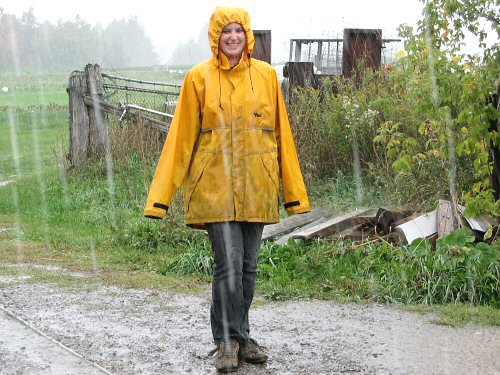
Jo sports a borrowed rain jacket with snap-on drawstring hood, in striking work yellow—perfect protection for a rainy harvest day. Today was probably the wettest harvest Friday of the year, and it wasn’t bad. A couple of heavy downpours kept us indoors for quite a while (snapping farm fashion shots out of the Milkhouse door…), otherwise, a light drizzle for part of the afternoon hardly slowed us down. For the occasional wet work, Conall favors a full rainsuit, jacket and pants, while I so far make do with a hooded rain jacket—I’ll pop inside and wait out the heavier stuff. Lynn arrived after the major downpours. Today’s four-person crew made good time despite the weather. For the record: mesclun, spicy salad greens (arugula, mizuna, tatsoi, red mustard), collards, kale, spinach, radish, carrots, beets, green onion, summer squash, bok choi, tomato and potato (harvested yesterday), and garlic and onions from storage!!

Pumpkins come in

A leisurely late afternoon harvest yielded one trailer and one tiny tractor bucket piled with pumpkins. I didn’t count—there’s more to come—but I’d guess around 70. Pumpkins don’t have a big market value here just yet, but they’re fun to have around and they generally come through with little care. These guys received absolutely no irrigation and suffered somewhat for it, but they managed! The varieties: Connecticut Field and Neon for the bigger orange ones, Snackjack and Small Sugar for compact (3-5 lb), CSA share-ready selections, and Jamboree for that bit of difference (they’re the greenish-grayish ones). We’ll clean ’em up and lay them out on the nicely roofed farm stand to give the stand a bit of a purpose for fall!

Unruly heirlooms

Left to their own devices, these heirloom Touchon carrots grew all over the place, an assortment of shapes and sizes. They’re in a bed where the mid-summer germination was spotty, and uneven spacing no doubt had a lot to do with it. Compared to our other mainstay carrot, the generally uniform Nelson hybrid, Touchons definitely show a lot more individual carrot character… As a trained-from-birth first-world consumer, I guess I’ve tended to automatically favor uniformity in many little things, like…carrots. On the tiny farm, that training’s being undone!