
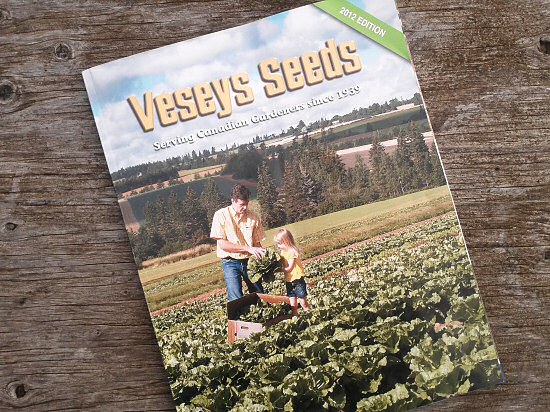
Well ahead of the pack, Veseys takes first new seed catalog of the year. They’re a pretty marketing-oriented company, they get their stuff out early—this actually arrived a while ago, but I only got my hands on it now! Which is fine by me. I haven’t been this, well, EXCITED with that new-catalog feeling in a couple of years. That’s good. There is a lot of proper, well-ahead-of-time planning to do, expectations for 2012 run high! Whatever the weather!!
Planning
Frost? Take your pick!
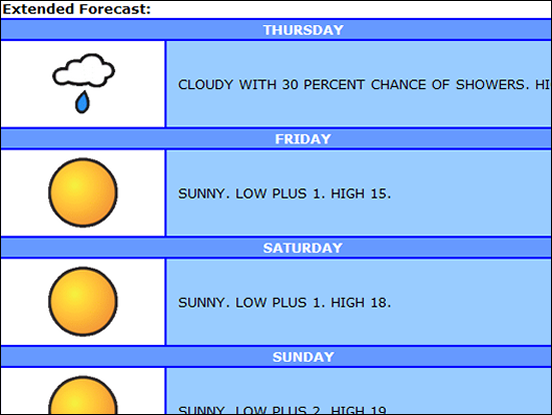
First frost on Friday? It all depends on whose forecast you believe in. Because, as I’ve discovered over time, all weather forecasts are not created equal. The online weather page we’ve used for the last few years is often in sync with the others, but when it comes to cold, it can go its own way, and it’s usually right. Here, we have a low of 1°C for Friday, OR, I can go for a more veggie-friendly choice of two 6°C’s and a 5°C, from three of the big weather outlets. That’s the difference for me between row covering all the tender crops we’d like to save, and…not. There is a pattern: sites like this one that’re based on Environment Canada’s weather service (that’s the Canadian government) tend to be several degrees lower and more accurate. So it’s on with the row cover on Friday, then wait and see!
Reading about building stuff
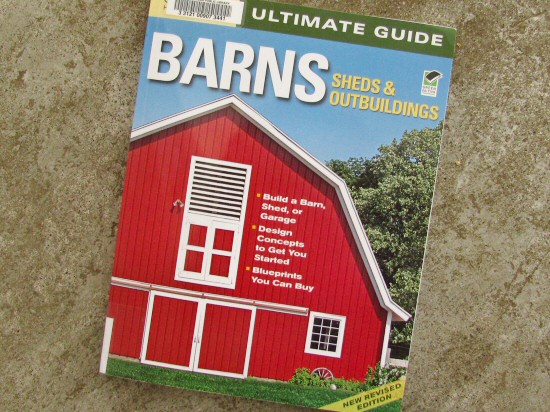
A great chance find at the library, lying there on top of a returned-book cart. This isn’t a book review or recommendation, although Barns, Sheds & Outbuildings is a cool browsing volume, full of clear explanations, instructions, and photos. What it did was remind me, as my year of living mainly in town has its effect, how little most of us (I’m talking about the majority of North Americans, at least, living in cities and towns) have to do with actually building things. And how kinda HELPLESS we are, not knowing how to put together and repair the structures we need. I read somewhere that in the 1950’s, around half of the houses in Toronto (so, I assume, in other big cities as well) were built by the owners. Who’d think of doing that now?
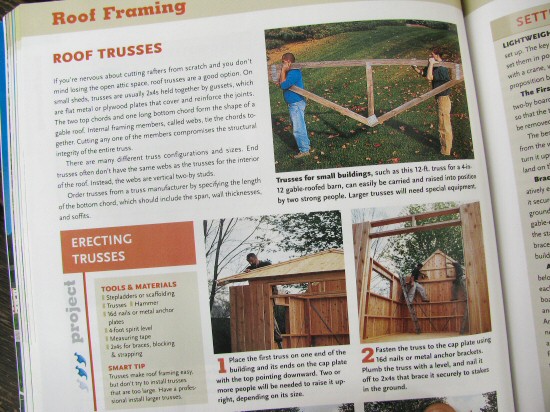
The interesting thing is, like growing food, building basic structures IS NOT HARD. For me, working alongside Bob to put up a wood-framed, winterized, 450 sq. ft. barn extension clued me in to that a few years back. Not a huge project, but it was basically a tiny house constructed to withstand cold Canadian winters. We leveled land and poured a concrete pad, built a concrete block retaining wall, framed, installed a metal roof, windows and doors, insulated and wired…everything. Being warm and dry in the middle of winter inside a structure I knew literally down to the nuts and bolts was satisfying and fundamental. Working alongside someone with old-school farmer skills, following his lead, doing whatever he did, made it…simple.
There aren’t that many old-school farmers left to learn from, but we do have books! :)
Chicken Tractor: The Book
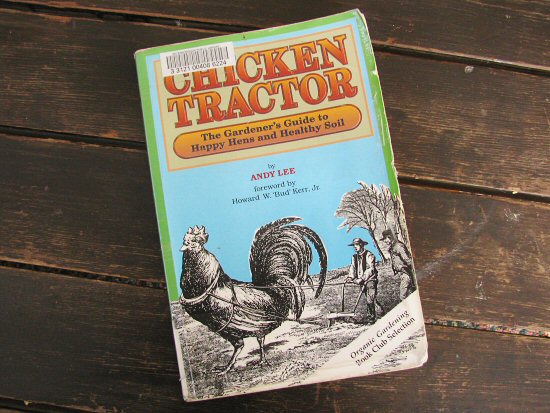
CHICKEN TRACTOR! My book-of-the-moment, a happy find at the municipal library (thanks to Kendall, I rediscovered LIBRARIES a couple of months ago—haven’t held a library card since school days, long, long ago).
The chicken tractor concept is simple, and it’s been chatted about around here quite often over the last few years…but not yet tried. The idea is to provide a mobile enclosure for your chickens, and move them to new sections of land every day or so, rather than keeping them in the usual chickenhouse and yard set-up. The chickens work up a small area of ground and fertilize it with their manure, and then it’s on to the next patch—the birds are always happy with fresh places to scratch and bits to eat, and a large area can be improved in no time. The rig can be any design you come up with that keeps the chickens in, predators out, offers shelter from the weather, and is easily moved. Easy!
Like most good things in smaller-scale farming, the chicken tractor is a startlingly simple and inexpensive approach that offers deep returns on many levels, from food quality to all-round satisfaction. It’s also kind of the EXACT OPPOSITE of high-tech industrial farming gear and methods that make so little sense to me. And the system works for various other farm animals as well, as in well-known (celebrity!) indie farmer Joel Salatin’s chicken-and-beef rotation at Polyface Farm.
So simple, why do you need a book? Well, it’s WINTER around here, all is snow, and reading about growing is the next best thing! In this case, Chicken Tractor, like its to-the-point title, is a perfect example of an energizing just-do-it how-to book, written in enthusiastic, full-on farmer-scientist mode. It’s jam packed with practical instructions and advice, the text assisted by numerous charts and illustrations, with a non-oppressive serving of sustainability philosophy and general food politics worked in, plus chicken trivia (the term “chicken tractor” was apparently coined by permaculture founder Bill Mollison, so now I know).
It’s cool to see this copy so considerately well-worn, although this being the original edition from the mid-1990’s, maybe it hasn’t seen that much use. It was published in 1994, quickly followed in 1998 by an “All New Straw Bale Edition,” with the subtitle upgraded from “The Gardener’s Guide to Happy Hens and Healthy Soil,” to the better-keyworded, “The Permaculture Guide to Happy Hens and Healthy Soil.” In any case, this edition is fun tiny farm reading from the library.
Anyhow, so much for the book review, let’s see how well this year’s chicken tractor plans actually fly! :)
Best laid plans begin here!
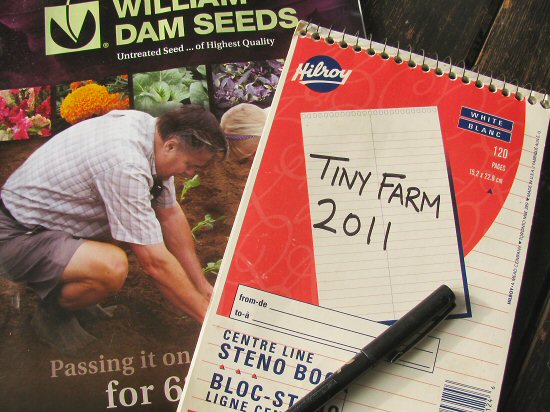
There’s a new tiny farming season just around the corner, and I’ve got my plans plans plans plans…
Well, this year’s Plan is actually WAY more laid-back and simple than that may sound. It’s my ninth consecutive year of full-time small-scale organic veggie farming, and this will be my FIFTH start-up on land that’s new to me (3 in the last 2 years, it’s been interesting times). At this point, I’m kinda used to it, and able to be real streamlined and minimal, economical and quite efficient.
This year, I’m still planning to grow just about everything in the way of garden veggies that can possibly do well in our mid-May to mid-September average frost-free Zone 4 (US) climate, but I’m majorly adjusting the relative quantities, growing more of some crops, and way less of others. I’m also concentrating my seed purchases mostly with one main supplier, and more carefully considering the number and selection of varieties than ever before. Among other big but simple changes from the past.
You could say I’m operating on a “the more you know, the less you need” principle. It’s pretty fascinating. When you let go of one whole set of concerns and details, all kinds of new thoughts, approaches, ideas come flooding in…
To underline the more-is-less point to myself, rather than starting as usual with a brand new planning notebook, I took my very first steno pad, from Year 1, way back in 2002-2003, ripped out all the used pages (saving them, of course, for the wayback machine), and began with a thin new no-waste Tiny Farm 2011 clean slate!
The tiny farming adventure continues. Stay tuned… :)
Bigger gear…
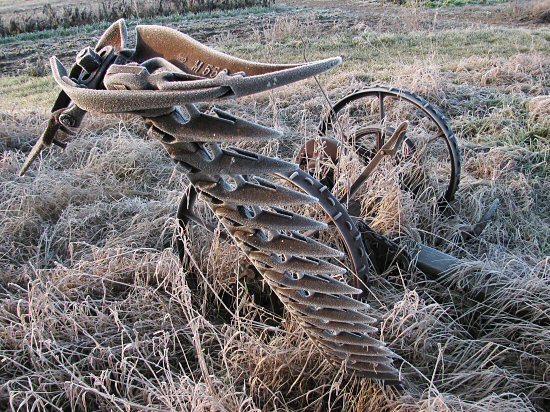
Thanks to the comments on yesterday’s blog post, this piece of old farm gear, lying abandoned in the field for who knows how long, has been ID-ed as a sickle bar mower. Yet another in a long line of bigger equipment I’ve seen but not used in my tiny farming career. I suppose the main job of this mower was in making hay, something I’ve barely considered. Why? Because it belongs to “another scale” of farming. There’s small-scale—tiny farming, on one or two or three acres—and then there’s mid-size, and then, BIG.
This idea of SCALE has been on my mind quite a bit, lately. More and more people these days seem to want to get back to the land and start farming, and the farming they want to do is usually of the tiny variety. Like what’s pictured on this blog. Small-plot growing is understandable, accessible, hard work, economically tough, genuinely community-building, fun…all of that stuff. Big tractors and combines and other imposing (and EXPENSIVE) machinery don’t figure into the picture. In my few years of market gardening, I’ve only ever driven my Kubota compact tractor, and I know nothing practical about larger scale growing gear.
This is interesting for the simple reason that, if “we” (referring, at least, to Canada and the US) are going to change what we eat, where it comes from, on any sort of large scale, it’s difficult to imagine our part of the world, with its convenient supermarkets and complex food chain, suddenly fed mainly by hundreds of thousands or MILLIONS of postcard tiny farms. Gathering food for tens and hundreds of millions of people from all those tiny farms would be…complicated. So it seems to me, there’s tiny farming and mid-size farming, and figuring out how they fit together. Hmm…
Fresh new garlic ARRIVES!
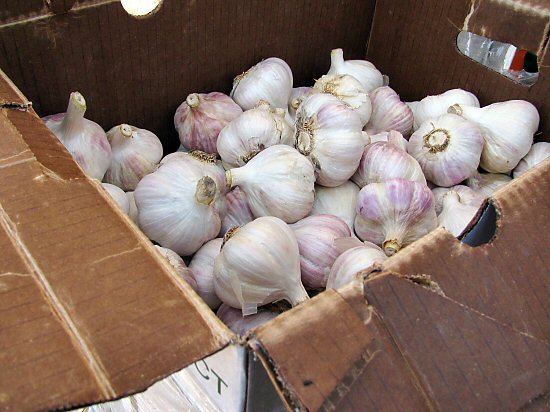
There’s almost no describing how pleased this morning’s delivery made me. Pretty happy! In two sturdy cartons, by FedEx Ground, 80 lbs of certified organic Music garlic, looking so fine! :) This shipment comes from a farmer named Warren, who grows a huge amount of garlic about 200 miles (320 km) from here—I’ve chatted with him about garlic, read his garlic literature, bought garlic from him before, a quirky and fun garlic grower indeed! And you certainly can’t have enough garlic… Possibly the WORST part of this mildly crazy tiny farm transition (moving farms from last year to this) was not being able to plant garlic last fall. On EVERY LEVEL, good garlic is GREAT…and if AT ALL POSSIBLE (it’s easy to grow!), you must have it around at all times! This season’s spring-planted garlic experiment did work out OK, but there wasn’t much of it, in number or in size. Now, we get to go again… Cool!
(By the way, if you’re really into garlic, this is the, um, BEST GARLIC SITE EVER: Gourmet Garlic Gardens! It has everything…)