
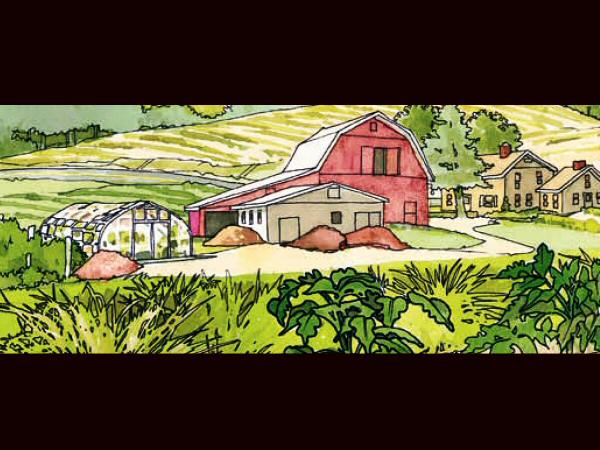
A reminder: Building Soils for Better Crops: Sustainable Soil Management is an excellent, book about soil for growers, free to download, or you can buy a hard copy. Follow the link, or read a bit more where I posted about it quite a while ago. The image above is cropped from the cover, a very specific type of old school farm view and set-up, which happens to be the one I’m familiar with; where you are may be totally different, as may be the soil, but the idea of growing is the same, and chances are this book is useful!
Seed catalog, 2016
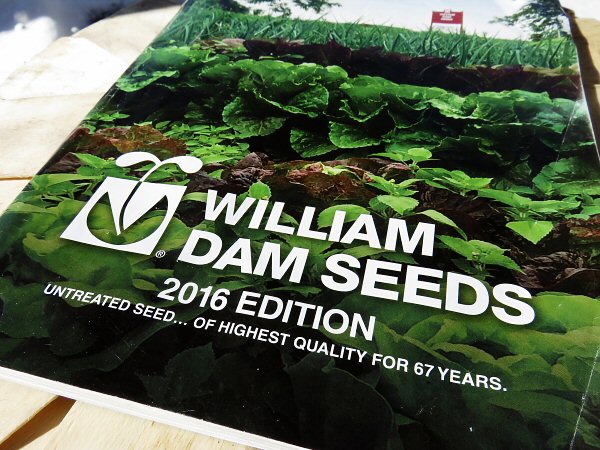
Here’s my main seed catalog for this year. Once again, unlike several seasons ago, when I’d receive a dozen catalogs, order from two main suppliers, and pick up a few things from two or three others, lately, I’ve simplified and get everything in one place. This year, though, and for the second year in a row, there was a crop failure on a variety of mustard that I grow, and no close substitute, so I had to look elsewhere. Which, of course, opened up a world I’d kinda forgotten, the wonderful world of price comparison shopping.
The puzzling thing about pricing is the seemingly bizarre differences in price for the same items between different sources (it’s the same in seed as everywhere else). Some suppliers are clearly overall more expensive than others, so if quality and service are fine, it’s easy to go with the savings. But then, on any one item, prices can vary quite dramatically either way. For example, I found the same variety of mustard at $10 and $17 a pound, and something similar at $50, at three different places, and that’s expected. Less so is that, for just one common variety of lettuce, it’s $33 at my usual place, where the same amount is only $19 at a usually more expensive other supplier.
Yep, I could’ve gone on and on like this, with multiple lists and endless tabs of online catalog pages, like a full-on coupon clipper, looking for the ultimate bottom line big score. Instead, though, I ordered my mustard and stopped! Maybe not the best every-last-penny business thinking for a tiny farm, and tiny farm definitely does not equal big budget, but sometimes at least, for a few bucks, life is too short! :)
Sundown in the hoophouse
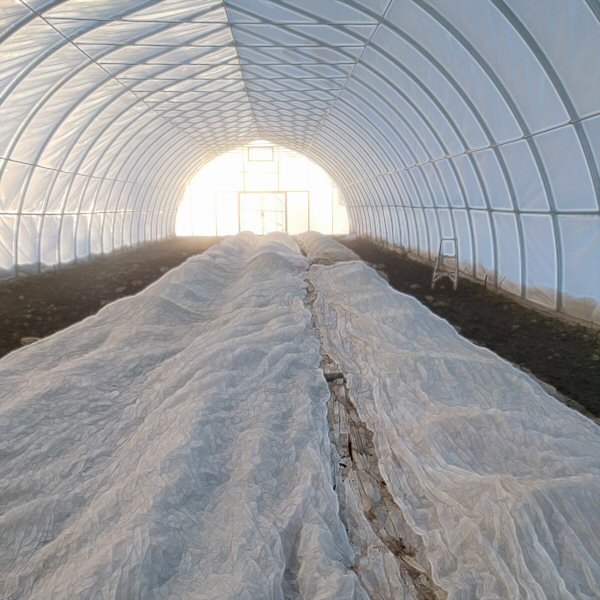
Not your typical postcard sunset, and it’s kinda chilly, damp and mucky in here, even as the temperature outside slides down to an overnight -15°C (5°F). But it’s all about the greens, tucked under a couple of layers of row cover, maybe not exactly cozy with only ground heat to keep them warm—who knows how they’re really feeling—still, well-set to survive another sub-zero night. With that in mind, sundown through 6 mil plastic is a cheery-enough sight to see!
Great gloves get a little better!

How excited can you get about a pair of gloves that you use to work in the field? Quite! Although enthusiastic may be the better word. This style of glove I’ve used for a while, for fall and winter, in cold weather. I wrote about their many fine features a while back—this particular version is the best yet, with the grippy, waterproof coating extending just far enough down the back so that they don’t get wet during normal handling of soggy stuff, while allowing enough open, breathable area so your hands don’t sweat. What more can I say?!
Cold crop lettuce
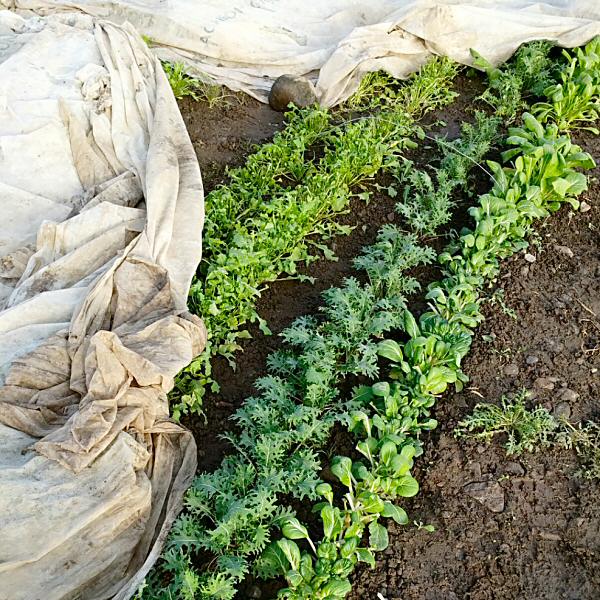
Lettuce in the unheated greenhouse, under a couple of layers of medium-weight row cover, is doing fine so far, firm and tasty after weeks of sub-freezing nights, all the way down to -30°C (-22°F). Now there’s even a noticeable bit of grow-back from the last cut, late December (even the weeds are getting in on the protection, see bottom left). My first full-winter tiny farming experiment continues…!
Wire work
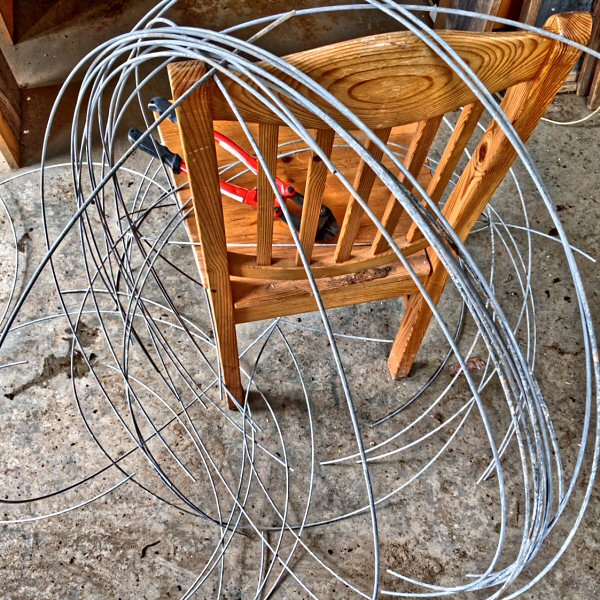
Electric fence wire work, snipping 6-foot pieces of 9-gauge wire for hoops to hold up floating row cover in the greenhouse. Hopefully this wire is stiff enough to do the job, supporting up to three layers of row cover, heavy with moisture from humidity and being dripped on by water condensed on the inside of the hoophouse plastic, or weighed down by ice, when the soaked cover freezes at night. This test batch of about 180′ came coiled, in a circle about 2½’ in diameter, and the built in curve is perfect for stretching slightly to span about 4′ of bed. So, no bending required, it’s all about the snipping!
Spring tilling
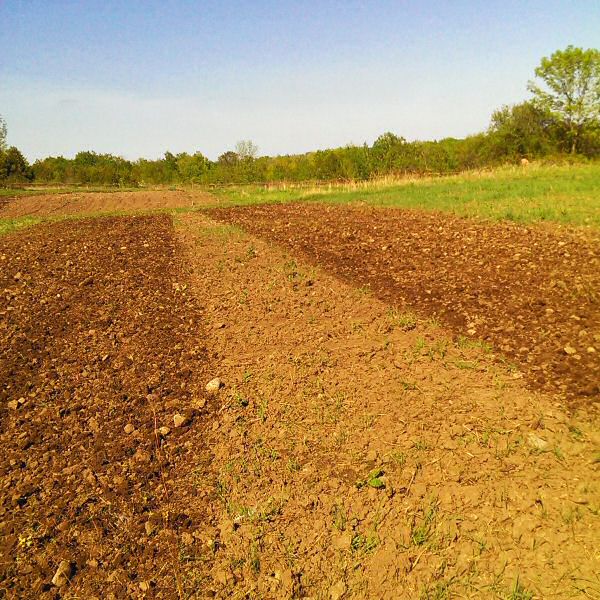
“You see a section being tilled, I see PUMPKINS. Actually, mainly spaghetti squash. And some zucchini.” There’s nothing that says, “Things will be just perfect this time around: well-weeded, vigorously green, prolifically fruitful,” better than a freshly tilled patch!