
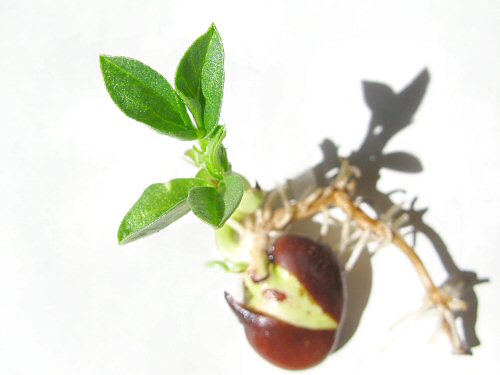
I ended up putting the sprouted fava beans in a pan of water, instead of discarding them after the mini-germination test, and put the pan on a south-facing windowsill. A few days ago, a little natural selection happened: the pan got knocked to the floor, and the kinda brittle main root snapped on three of them, leaving only the biggest, healthiest one in one piece. I put it back in the pan… Amazing what a plant can do, in a few days, with nothing but water and some sun. Tiny hydroponics!
Last-frost countdown begins!
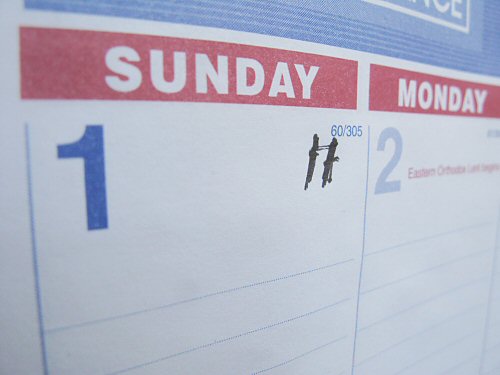
Today I marked the official farming wall calendar with the weekly weeks-to-transplant countdown: 11, 10, 9,… I do this every year, and usually a lot earlier than this! Because so much is kinda, well, UNKNOWN this growing season as far as overall production conditions on the new farm, my reaction is not to overplan and not try to anticipate every last possible potential problem. I suppose the approach varies by the person! Anyhow, having those numbers finally up there on the wall somehow really gets the adrenaline going…
What that “11” represents is 11 weeks to average last frost date, which around here is May 18 (I actually backed it up by one day, to start on a Sunday, just felt like it). This is a pretty arbitrary number, weather conditions have consistently varied SO MUCH in the last few years, last frost is ony a loose guideline. It’s something to base the gambling on.
So, it’s now 11 weeks until the odds are even that there’ll be no more frost, the soil has warmed up sufficiently, and it’s reasonably safe to transplant. From this, I can figure the timing of seed starts.
It goes like this… For tomatoes, I aim for about 6 weeks from sowing the seed in plug sheets to transplanting, so I still have FIVE WEEKS before starting toms. But, I usually want to have at least 100 tomato seedlings ready to go 2 weeks earlier than that, in case the weather’s really good, and for that I have to start in 3 weeks. Peppers I aim for 8 weeks, so that’s start in…3 weeks.
Broccoli, cauliflower and other brassicas are only around 6 weeks, BUT, they’re quite cold-hardy and can be transplanted out 3-4 weeks BEFORE last frost, sometime in the last half of April, so that means the first wave starts in a week or two! Onions and leek can also go out early, and are indoors for around 10 weeks. Some onions are already started, and the rest have to be started right about NOW.
And so on, for around 20 veggies that start as transplants…
The scratchy “11” on the calendar was originally a “7”—at first, I accidentally started numbering backwards from April instead of May. For a moment there, that was a shock! :)
Plug sheets, get ready!
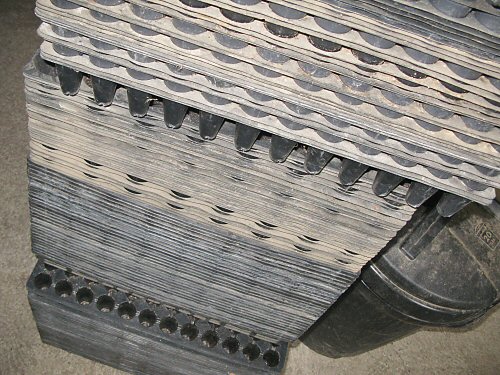
It’s getting near that time when a whole lotta seed gets started—company is on the way for the onions and parsley! I’m still sorting and setting up around here, doing a bit of this and a bit of that every day (an INCREMENTAL approach to the many different things to do on the tiny farm that would drive some people…nuts, but works for me right now! :). On the getting-ready-for-seed-starting front, today I unpacked all of the plug sheets and trays from inside the composting toilet home where they made the farm move. It’s a stack about 5-1/2′ (1.7m) high, still dusty from months of storage on the Big Shelf. It’s a bit of a head rush to imagine all of them being filled, tended, and then moved out to the field in the next three months. Crazy.
South slope waiting
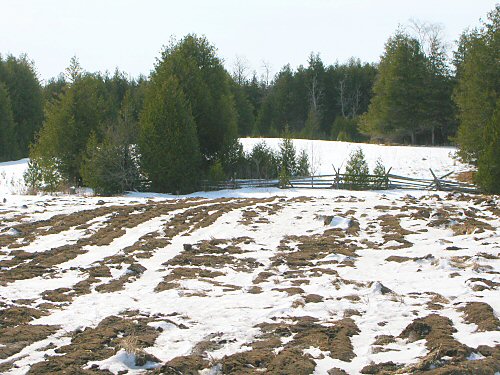
The promising south-facing slope is there, plowed and waiting! After the last melt-off, we quickly went back to freezing temperatures day and night, and more wall-to-wall snow cover. A couple of days ago, a bit of chilly rain cleared things up quite a bit once again. Today, it’s frigid!
Loaded
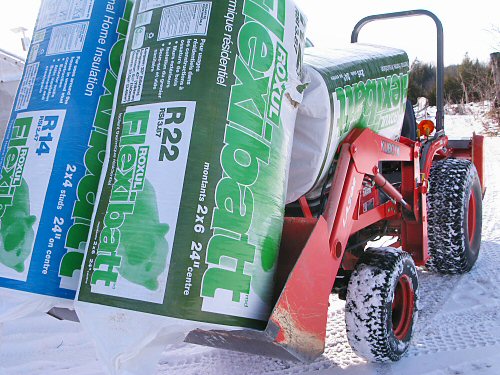
The Kubota compact tractor is a real work horse, it can do just about anything you set it to. On a tiny farming scale, of course. It’s had to winter outside this time around, but it’s been starting no problem, on first try, after the recent battery change. Who knew that a fresh, premium battery could make such a difference (well, many know, and now I’m one of them!)? Today’s beast of burden mission: moving a dozen bales of rock wool insulation—a last bit of the new seedling room—from the lower barn, up a slope, to the upper level doors on the other side of the building. Three trips instead of 12. They’re not particularly heavy, just big and bulky, so no problem wedging them on the hood. When loading up like this, it’s important not to mess with the hydraulic lines that run along the arms and across the front of the loader. Besides that, just pile ’em on!
Parsley pops up
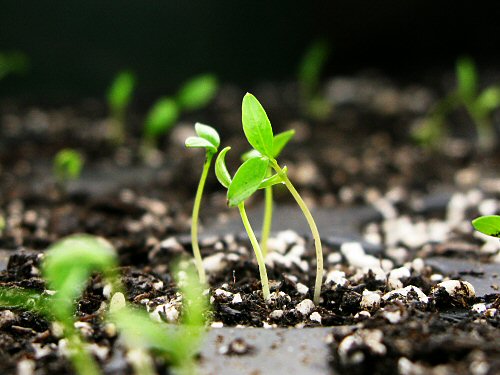
Parsley, seeded 11 days ago, began popping up over the last couple of days, so that’s the second crop of the season, underway. Four varieties this year, two each of flat-leaf (Plain Dark Green Italian, Hilmar) and curly (Forest Green, Green Pearl). They’re 18 cells per variety, in a 72-cell plug sheet, around 4-6 seeds per cell—I’ll eventually thin them down to two. They’ve already started to stretch because they’re sharing a light rack shelf where the lights are set higher to accommodate a tray of onions. Parsley is easy to start, I’ve had no problem with transplants, but my seedlings have always tended to stretch and tangle in the trays before transplant time. Last year, I snipped them back quite a bit so they wouldn’t tie themselves to each other. They seem to like their light strong. These are just early season details that I won’t be much concerned with a little later on, but I’ll see what I can do. I’m gonna hang lights on another shelf for them right now!
Hitting the books: Composting!
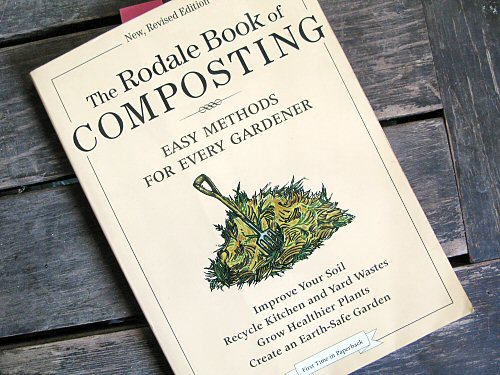
Winters on the tiny farm have always been a time for research and a bit of book learning. My first two seasons were crazy for reading, especially the winter before Year 1, when I had four months to pick up enough, from zero knowledge, using books and the Net, to map out the initial one-acre plot, order seed, get some gear, and “pass” the initial organic certification inspection, in order to start the market garden that spring. That was fun!
Over the last six years, though, a curious thing happened. My original urge to find out how everything worked, to soak up endless technical detail, full of labels and scientific explanations, died down quite a bit—often I’d rather watch a squash decay than read about it…
It seemed more fun to find specific, practical solutions on the farm: how to fix this or improve that. At the same time, I’ve become more and more aware of the growing process as a whole (and really, how relatively little I have to do with it…), not so concerned about its parts. It’s a little hard to explain, though real easy to feel. Maybe it’s just…a phase!
MEANWHILE, this year, Year 7, is a bit of a shake-up. Compared to the old farm, the new farm is pretty bare-bones. One big change: I don’t have the tons of well-aged, almost completely composted cow manure that was available there.
Every year, I made manure-based compost in 50′ (15m) windrows, incorporating crop residue and culled veggies, turning it with the tiny tractor, checking it out, but it wasn’t CRITICAL to fertility. A fall spreading of fine, on-farm, composted manure always did the trick!
Now, with no on-farm animals yet (chickens to come first!), and no prospect of generating huge amounts of manure, compost that relies more on plant sources will be my new friend. Composting and green manure are on my mind.
New necessities require…new learning! So along with everything else over the last 2-3 months, there’s been a more intense hitting of the books, thinking over, chatting, scouring the Net. It’s not exactly like starting over, but it’s definitely…FRESH. I’m excited. More as it happens!