The outhouse updated! This Envirolet composting toilet, the deluxe AC electric model, is possibly the most unusual farm purchase I’ve made so far, mostly because it was quite expensive and I’m not 100% sure why I got it. With a hefty $500 off on special, it was still somewhere around $1,200, which on the tiny farm budget counts as a major purchase (the used John Deere riding mower cost the same, and it does fieldwork!). And considering that you can build a composting toilet for little or no money, from scrap wood… Call it divine inspiration, like: “You must get this toilet”? Anyhow, it’s here, it’s been here since around Feb. 2007 (the special offer was expiring), it hasn’t gone unthought-of or unmentioned,…and it’s finally, slowly, getting installed for this season! The general idea is to have facilities in the field, which is a lot more convenient than heading into the house. Still… These toilets do sound quite amazing: odorless, comfortable, able to compost six months of humanure into a thin layer in a slide-out tray. Models range from no power, to AC/DC (has a fan), to regular AC plug-in (fan plus heater for the coldest days). The more power, the higher capacity, as the fan or fan/heat speed up evaporation: this one is rated for 8 people x 3 “uses” per day. I guess I had visions of LOTS of toilet traffic from the field. And this attractive little waste-handler is quite an inviting intro to personal waste recycling, compared to a hole cut in a board (and you can use these in homes to replace regular flush toilets as well!)… For installation, the original plan was to build an enclosure, but this discarded ice fishing hut came up as a ready-built alternative. Converting it is only a few hours work, but it’s being done in little bits and pieces. First, the rotting door was removed and the frame widened to let the toilet in, the various built-in ice fishing conveniences—bench, shelves—were removed, and some rotting floor replaced. Next step, fitting the toilet’s ventilation pipe through the ceiling. And then, interior decoration! A coat of whitewash for a start… Coming soon!
Sweet potatoes!
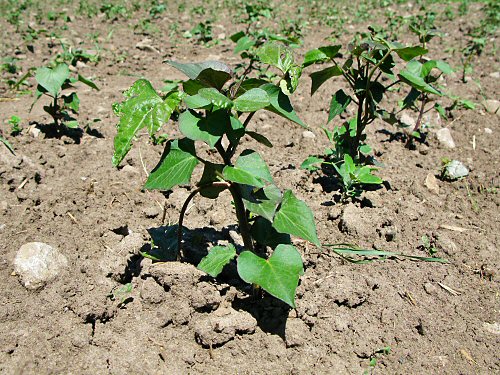
Sweet potatoes are in! They were a last minute addition this year, I was expecting them by the end of May, and then started to write ’em off when I couldn’t get in touch with the grower who was supplying them. But he came through, and they arrived by UPS yesterday, one box with around 1000 slips. Bob P., the sweet potato farmer who sent them, is also here in Ontario, but further south in a microclimate zone near Lake Ontario that’s a lot warmer. Still, they should grow here as well. The variety is Beauregard and they’re started from slips, which are vine cuttings. This is the first crop I’ve started strictly from direct grower-to-grower info, it was great to chat about them on the phone, rather than do the usual new crop…research. And they sound unbelievably trouble-free. Bob’s instructions: stick ’em in the ground with the growing point 2-3″ (5-7.5cm) above the surface, 12″ (30cm) in-row spacing, and as little as 12″ between row, all the way up to 3′ or whatever you like for tractor transplanting and cultivation. That’s it! No watering in, no watering except in extreme drought conditions. Just…weed. Hmmm… I’ll look into them more, but for now, that’s what I did, and there they are. The leaves will probably die off, it’s new rooting that should happen. One mild concern: sweet potato grows best in loose, sandy soil, where here the heavier clay loam is being well-compressed by lots and lots of at times pounding rain. Also, the slips are apparently supposed to be planted within 7 days of cutting, and it’s about a day after that. We’ll see. In 100 days, sweet potatoes? ;)
The Endless Salad…
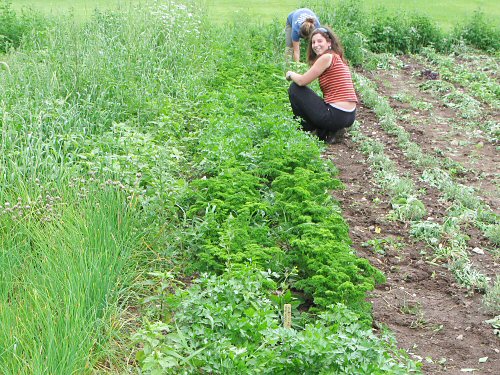
Lunch has turned into a collaborative cooking affair, built around the near-infinite possibilities of the Endless SALAD. Everyone who’s around pitches in: here, Lynn and Melissa chop. We build it from what’s available in the field, plus supplies from the farmers’ market and from the supermarket (with mixed feelings, I’m now buying mostly organic), a variety of raw nuts, and sometimes meat (turkey, chicken, fish, so far). We pick the ingredients, and there can be MANY, by whatever sounds good together. It always works! The salads started last month, when I asked to join Shannon in her vegetarian lunches, and Lynn and Raechelle would fill out the table on the days they were here. This direct connection between growing and cooking and eating and people started last season, with Friday evening dinners after harvest, and the first, occasional all-local-food mini-barbecues, and now it’s become part of everything…
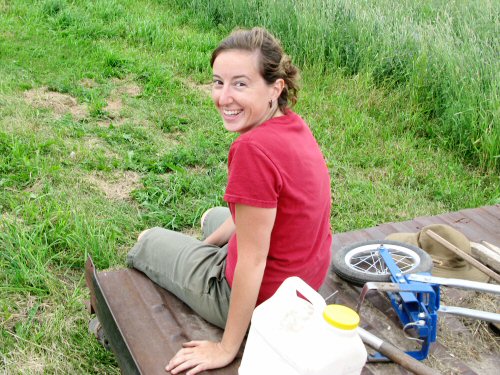
Thinking about it now, this deepening food awareness is happening over what seems like a curiously loooong time, this being Year 6 in the garden. For the first couple of years, I was out in the field alone, spending 10-12 hour days at least six days a week during the main growing season. At the end of the day, I ate TONS of veggies. It was normal to harvest several types of greens for a salad, plus whatever was around for a sauteed side dish, and every three-four days, I’d roast a bunch of root crops. Meat was definitely in there, regular supermarket fare, but almost as a garnish, a small steak or a big pork chop or a chicken breast, on top of a mountain of veggies. I relished dinner every day, partly from the novelty of having grown the better part of my meal, a lot because I has HUNGRY, and mostly, as I remember it, because it simply attracted me: the taste, the super-simple preparation, but also the physical feeling of satisfaction these meals brought. Then, I wasn’t giving much personal thought to nutrition or “local food” or anything like that, it wasn’t a calculated, conscious enjoyment, it seemed simpler, more common sense. During the winters, in between gardens, my old eating habits didn’t change: not much junk food, no instant microwave meals, still, the regular parade of meat-and-starch industrial food type eating, straight from the convenience of the supermarket aisles. It seems a little odd now that this didn’t concern me. Then again, I wasn’t tiny farming to save my health or save the planet, this wasn’t any sort of cause, instead, something I had wandered into, seemingly by chance, that took hold: there was no agenda, only an unfolding path to somewhere cool…hopefully! And then came last year’s people in the field transition. While the garden stayed tiny in size, the intensity increased as really relying on others became a part of it all. Along with that, the food we’re growing has become linked to…daily living, plain and simple, whether it’s sharing meals from the field, or people stocking up on things to take home at the end of the day (not so different from the farmers’ market or CSA, but even more…personal). And this increasingly deeper connection to FOOD, not based on concepts or conscious direction but just on what’s happening, is surprisingly new to me, yet another part of the tiny farm experience, where what should be obvious to us all is revealed in unexpected ways… (Guest photo: Lynn laughing, me tasting, by Raechelle.)
Scaling up the grass mulch
Not the nicest weather today, but good for gardening: not too hot (finally) and not too wet. The grass mulch experiment continues. With all of the recent rain, there’s been good growth, and I’ve cut and gathered quite a bit. Still, the volume of grass mulch available earlier in the season is still unknown, and it takes a lot to cover just one section. Here, Raechelle and Melissa (first time in the field) mulch tomatoes…
Thinning and weeding
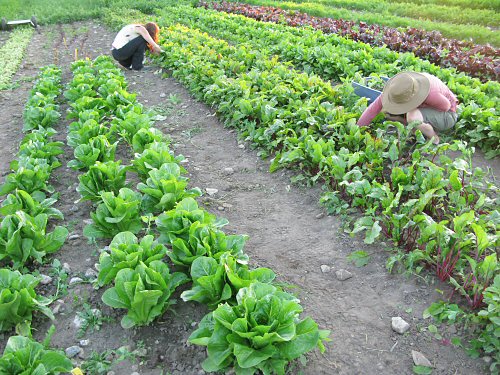
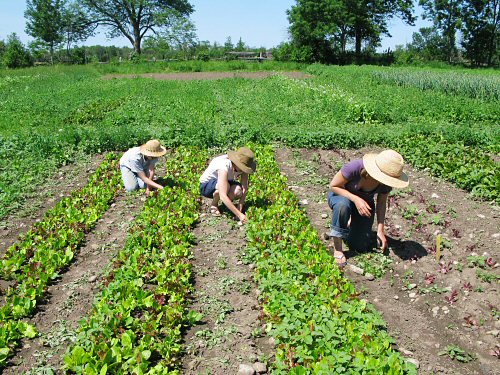
The first beet greens have sized up: lush and looking delicious, they’re ready to harvest. I love beet greens, both raw in salad, and lightly sauteed in olive oil and/or butter (a kind of deluxe spinach). I’ve never grown them as a separate crop, instead, they’re a happy byproduct of thinning the beets—removing the extra plants so that the remaining beets have room to grow. So the greens are both a harvest crop…and a weed. (I guess this is a continuation of yesterday’s post about WEEDS!) As you can see below, with the exception of a few gaps where nothing germinated, the first-planted beets are growing quite solid in their rows, which means a lot of plants have to be removed, maybe as much as 6-8 out for every one left behind (did you know, beet “seed” is actually tiny dried beet fruit containing several seeds?). There’ll be so much from four or five 3-row beds of beets, I won’t be able sell, eat, store or give away all of the greens that’ll pile up, but I can’t leave them in to stunt each other, so at at some point, the thinning becomes…weeding. Funny how that works! :)
Meanwhile, after a quite intensive weeding by hand and hoe a few days ago, the beet beds and paths are in fine shape, with only some growth near the plants that’ll come out during the thinning. (The cracks in the ground are what happens with our heavyish clay-loam soil: it’s not at all concrete-solid, it’s nicely moist, but as the surface dries out, it tends to…crack.) As far as overall weeding, with some quick touch-up hoeing along the way, these beds should be fine till harvest in 3-4 weeks (maybe earlier for some). The increasing leaf cover will keep down weeds near the plants, and the increasingly narrow paths and between-row strips can be quickly walked down with the weed hoe. It should be…sweet! On the other hand, in the potato patch…
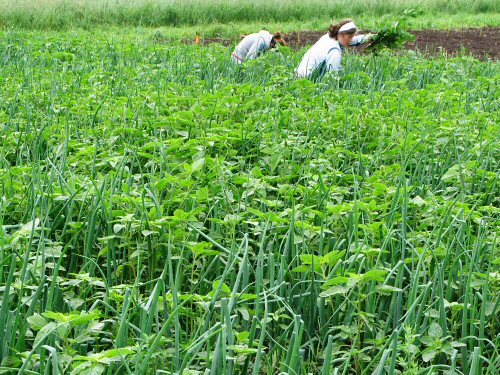
…things have gotten a little crazier. A dense and vigorous mix of mostly pigweed and some lamb’s quarters has carpeted one of the two potato sections. Here, you can see the difference a pass with the wheel hoe makes. On the left, a just-hoed path still looks pretty green. In the middle, it’s untouched and looking a little scary. I’d call this…Stage 2: leave these little guys just a few days longer, and it’ll be a fight to hoe as the pigweed stems in particular will start to get tougher. On the right, a path weed-hoed a couple of days ago (I was on the way through while walking back from hoeing another area)—after a day of sunshine, the cut and uprooted weeds dry up, and you can see how much weeding you’ve really done. There’s still a lot of close work around the plants, but the potatoes are really shooting up now, so once that final weeding is done, the plants will shade out and prevent germination of whatever weed seed’s still near the surface. On the other potato section, the weeds aren’t nearly so…dense. On this one, some of last year’s weeds obviously went to seed, which really increases this year’s population. It almost fee;s like a closed system: what work you get away with not doing now, you eventually pay for later, usually with a little interest…
Crops among the weeds
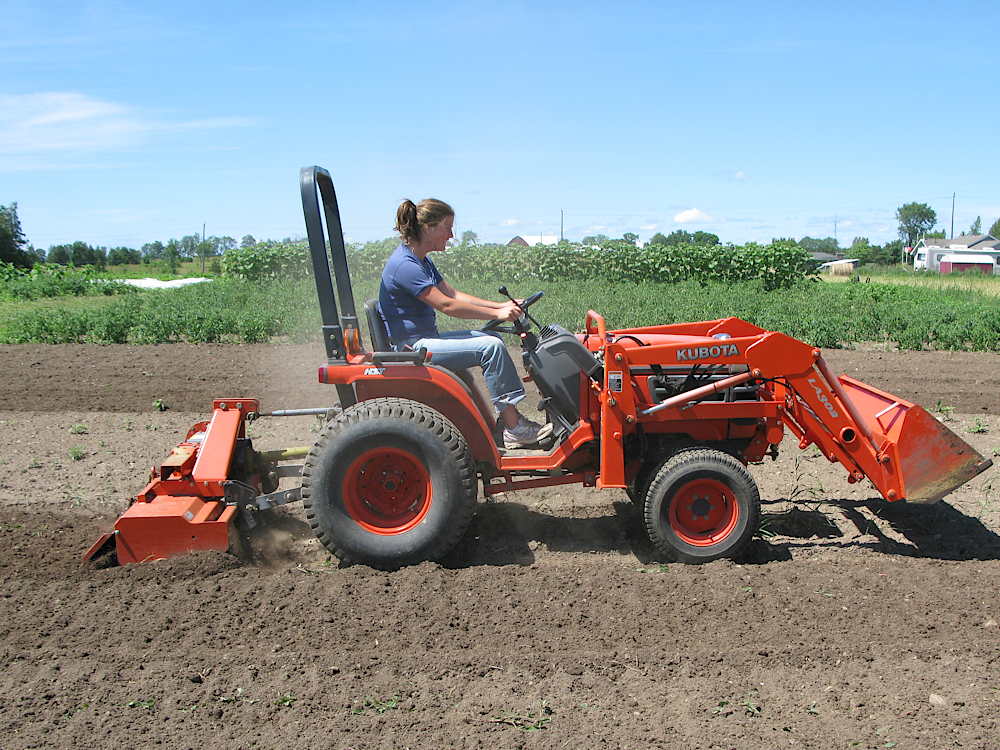
Weeded with the wheel hoe and hoop hoe, the onions looked impressively clear just six days ago, but after a few days of heat and moisture, the tiny weeds that were left shot up to the point where it’s time to do it all over again. Pigweed and lamb’s quarters, along with outbreaks of grass, are working to take over. It may look like a lot was missed. but weeding intensity depends on the crop. With onions, weeds tend to cluster close to the stems, so it usually seems easier to work more quickly and come back again, than spend double or triple the initial time, getting painstakingly close all around each plant (that’s how it seems, maybe not!). With the first section of tomatoes (below), things aren’t so advanced on the weed front, but there’s more grass in this area, and it’s still hard to see the crops in the general green haze of unwanted stuff growing. Hopefully, there will be enough grass mulch ready soon so we can extend the coverage between plants, and then onto the paths. This battle against weeds is the big one. All across the garden, both the veggies and what’s growing with them are at different stages, and require different weeding approaches. Typically, if you’re not using herbicides, tractor cultivation is the quickest way to keep the majority of the weed population down by working between rows. Even then, in-row weeding (between the plants) is still a hand job. It’s a LOT of work, and every few days that a section is not handled, the amount of work required increases as the weeds grow bigger and harder to kill. In a smaller market garden like this, with relatively short 50′ (15m) beds, the tractor is not an option; hand tools and methods rule. The idea is not to keep up this battle year in year out, but to progressively work smarter to reduce the load, through better timing and various techniques: mulching is the most obvious one, but there are lots of things to try. It’s not overnight, but things do improve as you go…!