
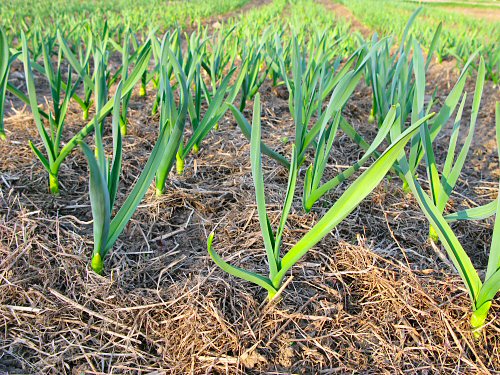
The garlic is looking great, here in unusual shades of green thanks to a bright yellow sunset. They’re doing pretty much the same as this time last year, and the year before. I read somewhere that garlic reproduction from cloves is cloning, so the garlic we’re eating now is genetically identical to the original varieties from thousands of years ago. Dunno, sounds cool and kinda reassuring, even our weird weather doesn’t seem to affect these guys. Gazing over the garlic patch on a warm evening after a satisfying day in the field, it’s almost enough to make me believe that all’s right with the world, and Blue Fox Farm‘s motto, “Farming like there’s a tomorrow” (it’s been running through my head all spring), is just amusingly paranoid wordplay. Maybe… And then I think about filling up the tiny tractor (diesel just hit $1.25 a liter, that’s $4.70 a US gallon, good thing I don’t use much…), and the bizarre weather (from mid-summer conditions in mid-spring, we’re plunging back to way subzero nights in a couple of days), and, well…it’s good to be working in the garden, and the garlic looks great! :)
garlic
Drying out
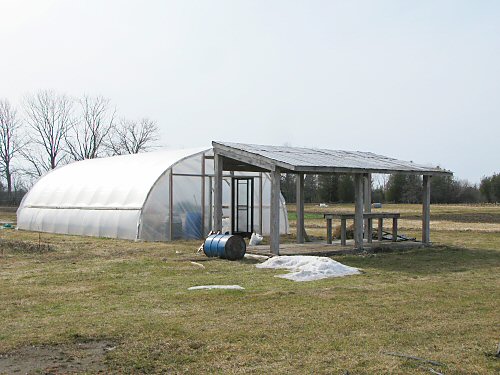
Muted browns and greens are the colors of drying out. The wait for the snow to go is over, now, it’s waiting for the soggy soil to dry enough to till. Until then, there’s not much to do in the field other than walkaround and lookat future things to do. Lots of rock picking, lots of tilling in winter-killed crop residue (kale, Brussels sprouts, etc) and cover crops. Hoses to repair and run. PEAS to seed… I moved a couple of trays of onions and a tray of parsley to the greenhouse today, to see how they’ll do. No reason not to’ve moved all of them out, but, well, the rest can wait a couple more days, it’s supposed to be subzero the next few nights. The giant puddle that had nearly half the garlic underwater was gone by this morning…and the garlic under there was doing better than in the rest of the beds! That’s interesting, probably a combination of them stretching for more light, and the accumulated extra nutrients from being in a runoff collection spot. But it COULD have to do with just being underwater for a while. A discovery? Flood your garlic patch like a…rice paddy? Well, maybe not…
Submerged garlic and root-diving voles
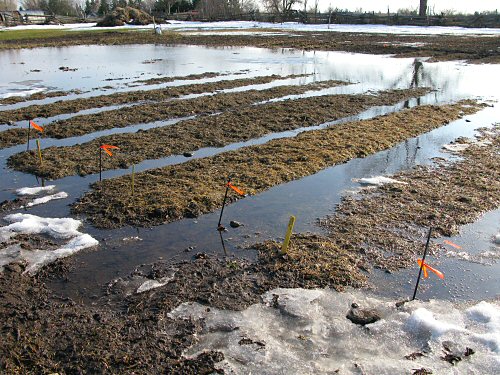
For all of the melt-off’s magical moments—garlic tips emerging and big puddles that look like tiny seas—there are mild melt-off concerns as well. About one third of the garlic beds have been fully submerged for nearly two days now, and may stay that way for 2-3-4 more, especially if it rains tomorrow as promised. (This area usually doesn’t get flooded with runoff, but I should’ve paid attention to the natural gully and not rotated the garlic there, just in case.) I doubt being underwater for a while will affect the garlic, but I don’t know for sure… How long garlic can hold its breath is another thing I’ll soon find out! And elsewhere, I discovered the handiwork of VOLES (it had to be them) in the herb patch. Under cover of snow, they’d neatly excavated 25′ feet of parsley roots, methodically working their way down the double row. These aren’t tunnels, just holes that go down about a hand’s length. Interesting. Another first. And no loss. But could this be population explosion year in the local vole cycle? Last year’s spring lettuce raids in the greenhouse were nothing compared to organized action like this… Good thing they don’t like garlic!
Field wakes up…
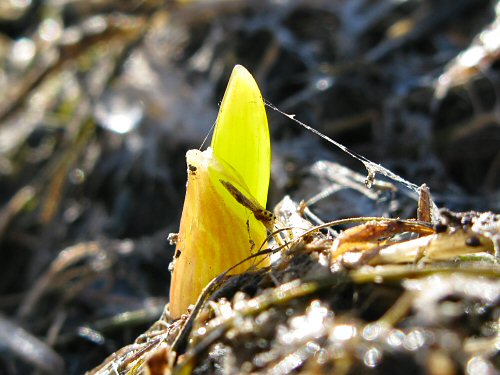
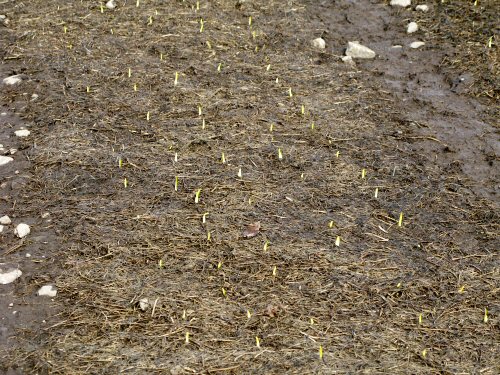
There’s a kind of magical moment between winter and spring, as the snow rapidly disappears and the water runs off. It lasts only a couple of days. Unusual sights are everywhere you look. I watch it closely every year, but this time around, with the blog-and-camera habit by now well-ingrained, I’m appreciating it more. I found garlic earlier than ever, only a few hours after emerging from months buried under snow with little or no light. The color is odd, I’m used to GREEN, but they look healthy, so I guess they need some sunlight to put on a little color. At the lower, south end of the field, the melting snow runoff gathers in a giant puddle, 40 or 50 feet (12-15m) across at its widest, and a few inches deep. This field has good drainage, so the puddle doesn’t stick around long, shrinking by the hour and vanishing entirely within two or three days. This year, the residue of the oats cover crop added a bit of a surreal dimension, as a bleached gold beach, and wavy underwater like seaweed. When you focus tightly and think miniature (like a kid would!), it’s a crazy little inland sea-for-a-day… All over, the little details of melt-off, looked at up close, are entirely odd and gone soon…
A little fieldwork
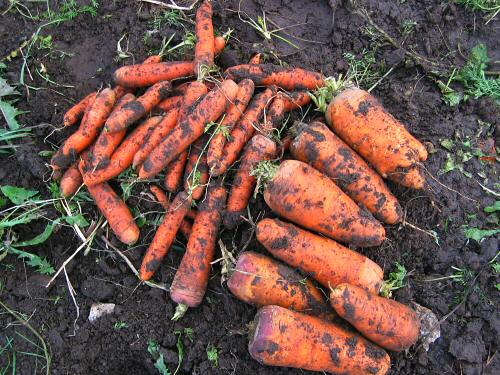
Spent about four hours out in the field. The feeling of calm satisfaction as you head in after doing some work in the garden never fails! I dug up about half a bushel of carrots to see how they’ve done. These are, I think, Nelson and Danvers Half Long (the BIG ones)—the label stakes were out, so I couldn’t immediately check the varieties, it’s not necessarily that easy to tell! They’re mostly in fine shape. On a few, the inch or two exposed above-ground had frozen and thawed, leaving the top tips spongy and mushy, but this didn’t affect too many. I can probably get a couple of bushels! This mid-January harvest is actually consistent with last year, except for the extra 6-7 weeks of RealWinter… I also mulched the garlic, leaving a couple of beds clear as a test (I’m not sure how useful an experiment that is, since I’ll mulch them for moisture and against weeds first thing in spring…). Anyhow, a bit of winter fieldwork…
Official: the garden season really is over
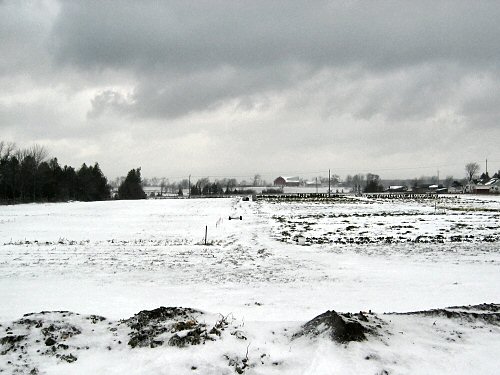
OK, so this garden is really over for the season! Called due to extremely cold, snowy conditions that don’t seem likely to let up any time soon. I’d been counting on one more melt-off, but it’s only been freezing cold and more snow since the fall that covered it all eight days ago. And there’s no let-up in the 15-day forecast… So, I got caught out a bit. There are still carrots under there, that I might not see until spring, and I didn’t finish mulching the garlic (I think I was unconsciously pushing for a side-by-side test of mulch and no mulch, against prudent practice, and now I have one—it will be interesting…). The big experiment (and possibly, gamble) is with leaving the green manure cover crops—oats, rye—over winter, to be tilled in in spring. In the pic, you can see it’s smooth to the left of the main path, and rough on the right (at the very bottom is the composting windrow where the last of the leftovers go). The left side (plus eight sections across the north end, out of sight at the top) is fully prepped and ready to seed as soon as the ground dries out in spring (peas first!). To the right, I’ll have to wait until it’s dry enough to till with the Kubota compact tractor—determined by the weather, this could hold me back a couple of weeks. Or more. After that, again weather-dependent, there’s the minimum wait of a week or two after tilling for the cover crops to break down. But, with two-thirds of the field ready, however the weather goes, it’ll be fine!
Spreading grass mulch
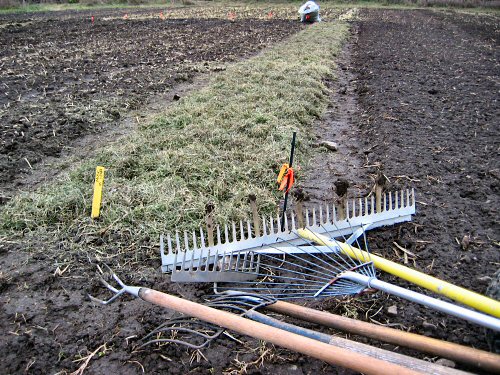
Today, I took advantage of a one-day reprieve from the cold—it was a pleasant 9°C (48°F)—to test the new grass-alfalfa mulch on a bed of garlic. I suspected spreading the light, loosely clumped mix would be more of a chore than tossing around straw, and it was. I first tried dumping it out, but the big clumps took forever to break up and spread, so I switched to pulling it apart by hand. The large bags of mulch weigh next to nothing, so that wasn’t hard, but you wouldn’t want to do it in the wind. Next, spreading it evenly. This proved to be a bit of a puzzle. I started with a hay rake, with three widely spaced tines, but this just slid through the grass, not catching enough to move it around. Out came an unlikely array of other hand tools to try: the compost fork (dark tines, right at the bottom of the pic), the 3-tine cultivator, a regular rake, and a leaf rake with round tines (the wide landscape rake was for marking rows in another bed). None of these worked well. Closely-spaced tines caught too much and cleared areas rather than covering them. I eventually used a combo of the 3-tine cultivator to break up the clumps, then skimming with the small rake to even it out. The results were pretty good, with a fluffy 2-3″ layer down the 50′. But it was delicate, picky work as the grass is very light. There are five more beds to go to refine my method (basically, figure out a better way)! I also planted a final 50’x5-row bed, using up the last of my seed reserve, bringing the garlic total to about 3,000…