Rack built

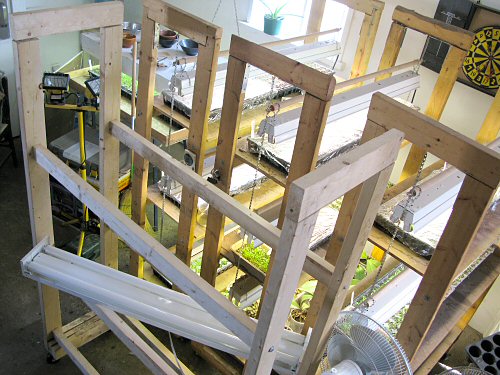
New lumber turns into new grow rack. This adds a fourth to the set, a measure of tiny farm growth. I started with two in Year 1, built another one last year (Year 5). It’s not like the focus here is on rapid expansion…this is the speed of staying tiny! ;)

Although I don’t build these often, it seems to get quicker every time. Well under a hundred dollars of wood, wheels, screws, bolts, brackets, hooks and chains, plus a chop saw, a drill and a couple of hours, and there it is! Light fixtures are extra. In the pic, the shelves still have to go on.

Lying across the middle supports is one of the four old fluorescent fixtures, given to me instead of being tossed in the trash. Not only free, they’re BETTER: these are the overhead lighting type you see in (horribly lit) offices, the tubes are spaced farther apart than in the standard shop lights I’ve been using, the light will spread more evenly over a larger area—for the seedlings, a lot less leaning and stretching…
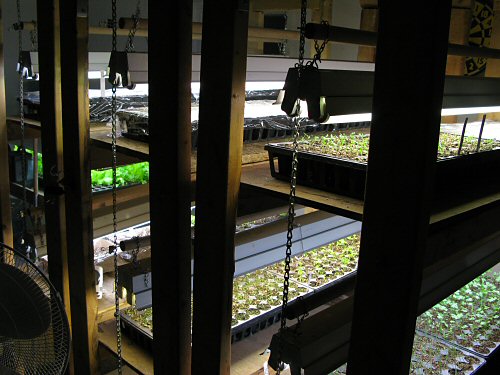
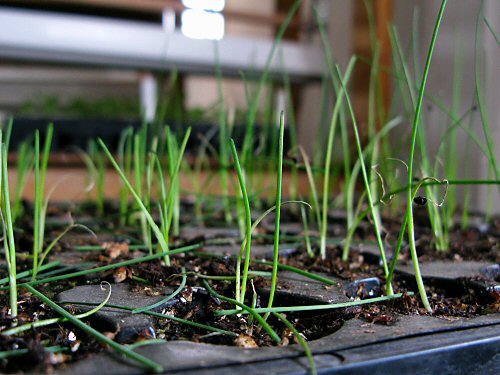
Seedlings continue to grow…

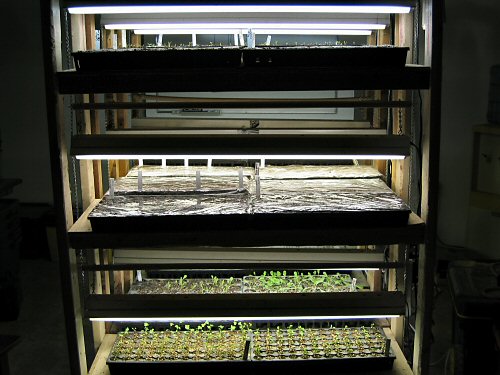
Grow racks at night

Seedling production is on about the same schedule as last year, except there are a few new things on the go: celery, onions, leek, celeriac. The three grow racks aren’t yet full (and there’s a fourth to build), but all that will change in a couple of days, when peppers and eggplant start. This is also when gambling on the weather begins, which at this point affects when I choose to start certain crops. Already, based on the 15-day forecast, it looks like a much colder March ahead than in the last couple of years, and with all the snow cover, a quick thaw towards the end of the month will still mean a few extra days of drying out time. And then there’s April to “consider”—it’s all basically pure guessing, colored by a little wishful thinking. IF there’s gonna be cold and snow for a good part of April, early transplanting will be delayed. So, starting some things in a couple of days, or in a week, or in two weeks, could make a fair bit of difference. If I have to hold things for an extra 2-3 weeks, there won’t be room under the lights as I start more, and out in the greenhouse, given real sun, growth will be quicker and the seedlings will get crowded. And so on, tons of little calculations and gambles… Nothing is THAT critical, but a little more work here, a little crop slowdown there, it all adds up. I enjoy this, juggling increments in the face of the weather, but it could drive some people into quite a state! :)

Trimming leeks

Trimming back leeks is really satisfying. Here, I’m doing the first planting. With most indoor veggie seedlings and my two-lamp fluorescent fixtures, it’s lots of tray rotating and light height adjusting to keep the stretching to a minimum.

Leek can reach all they want: at three inches (7.5cm) or so, I snip them back to about an inch (2.5cm). What could be simpler?! This goes for the onions coming up as well.

With nice low seedlings, the light can be better concentrated across the trays, and cutting back may ensure stockier growth, which is generally a good thing when it comes to seedlings (update: I read a pretty definitive-sounding study that disproved the growing-stockier part; either way, it’s worth trimming just for keeping them closer to the light).

This is the first year of starting both leek and onion indoors from seed (in the past, it’s been direct-seeded leek, and onion sets)—I’ve not actually DONE this before—so there’s the usual slight bit of reservation with trying something new. Seeing is believing. Fun (easy) so far!

Elsewhere, we got what looked like a foot of snow overnight. No problem, no extra work, except the lane, barnyard and path to the greenhouse had to be plowed again…

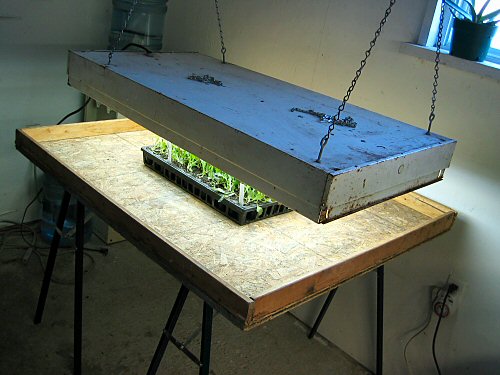
Lightbox suspended

Another seedling room set-up task checked off today: hanging the lightbox. Not exactly a big job—the chains were already there from last year—but having it in place is a big visual reminder in the Milkhouse that we’re heading into spring. The box, given to me two-three years back, has four 48″ fluorescent tubes on 5″ (12.5cm) spacing. Raised up a bit more, it gives pretty good light to the whole tray, which is about 3.5’x4′ (1×1.2m). It’s been a welcome bit of much-needed space for larger seedlings, though this year, with the barely-heated greenhouse plan, maybe it won’t be so critical. I still have to line the tray with plastic, and possibly get round to giving the box a coat of white paint…

Grow lights, on!

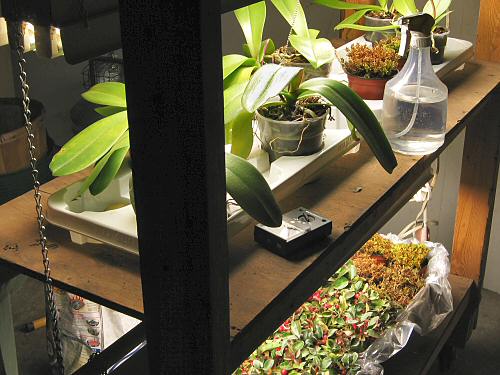
Grow rack lights went on today for the first time this season. They’re only for the rescued houseplants (orchids, wintergreen, heather)—I guess every plant deserves a place in the sun—but, I’ll be starting super-early lettuce soon, a month earlier than ever, for an experiment in planting them out to the greenhouse at the beginning of March. Getting the grow racks ready is another familiar routine. In early summer, I remove the fluorescent light fixtures and the chains and dowels they hang from and store ’em somewhere (last year, it was on the new Big Shelf). For spring, I dust them off, wipe them down, hang them, and a new seedling season begins!

Grow racks at night

Grow racks at night

Plant racks, light stands…I usually call ’em grow racks. They’re filling up now.

Pushed to capacity, the three racks can hold a total of 36 trays, 12 each, or four trays per shelf. So, depending on the size of the plug sheet—I use 38s, 72s, 128s, 200s—I can start between 1,368 and 7,200 seedlings.

Sounds super-efficient. HOWEVER, it comes down to the light. With four trays per double fluorescent fixture, the light is pretty stretched, and a lot of rotating is in order.

Also, most of the fixtures are the old standard T-12 type, where the light is stronger towards the middle of the tube. You can clearly see the difference in growth if you leave trays in the same position for a few days. The newer T-8 type lights more evenly from end to end and uses less power, but I don’t feel like replacing all the fixtures (a couple in there are already T-8).

It’s an ongoing experiment to see which size plug sheet to best start in for each crop, given the light situation. That in turn determines if or how often I need to pot up to larger quarters before it’s time to transplant into the field.

All in all, I’ll get around 2,500 seedlings off the racks this year.