
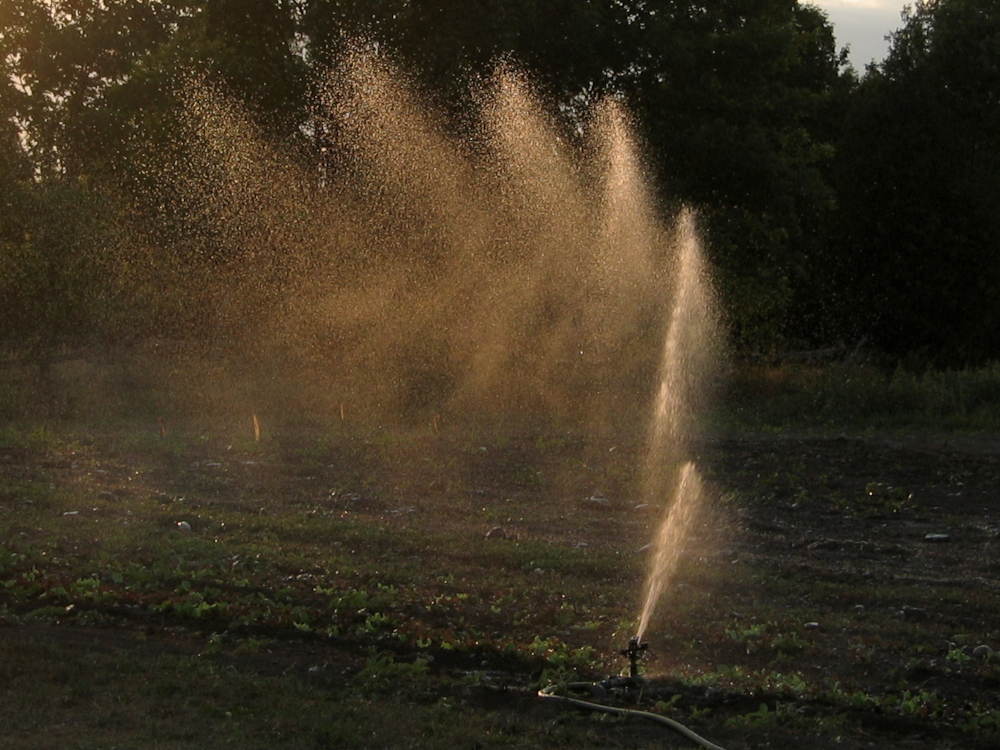
It’s supposed to rain tomorrow… I’m as skeptical as ever, still, as illogical as it is, you figure it’s gotta rain EVENTUALLY, so the longer it’s been, the more accurate the latest “60% chance of showers” forecast must be. Until then, we continue the piecemeal irrigation effort, with a combination of sprinklers and soaker hoses. The pond level is noticeably down, but bottom still isn’t in sight…and it’s gotta rain soon, right!?! :) Here, the latest beds of mesclun and spinach get their daily sprinkle. You can see by the fine mist in the air how easily much of the water can be lost to even a slight breeze, and to evaporation under a hot sun. Still, soaker hoses are only practical for larger standing crops, and pretty near useless for keeping newly seeded beds moist. From the pond pump, we get enough pressure to run four or five sprinklers and have 500′ of soaker hose set up, which means two or three of 40 sections can be covered at once. It takes a couple of hours to put down maybe 3/4-1″ of water. And the majority of days, we have to do early morning and evening sprinklers only, because of wind in the day. So, lots of moving hoses around… Next year, I’ve gotta figure out a drip irrigation solution…
mesclun
Mesclun on my mind
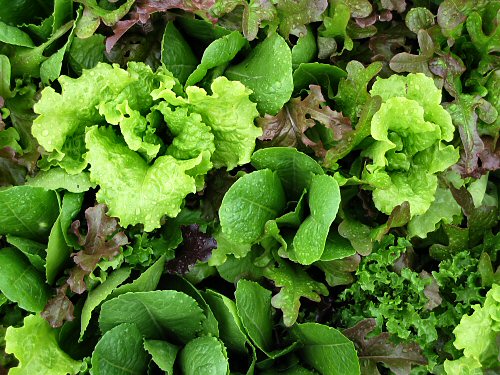
Mesclun remains the mainstay crop on this tiny farm. What I grow is perhaps not strictly “mesclun”, it’s nine varieties of lettuce with no other, more exotic greens—arugula, mizuna, and so forth—mixed in. Also, at times if it gets away a bit, the leaves can be kinda large, making it more of a basic salad mix. Still, it’s all mesclun around here, and this year particularly, we’ve grown LOTS. Salads are popular, and for no reason easily explained, the acceptable price at our farmers’ market is way higher than for any other crop (except, perhaps, blueberries?!). It’s a top seller on market day, it’s dead easy to grow, most of the time, and none of the other, larger local growers bother with it (only one other farm regularly has lettuce). So it’s an all-around winner. Then there’s the big BUT: hot, dry mid-summer weather, when the germination rate is usually terrible, the beds grow rapidly and are hard to time, and the heat can easily turn a fine, fresh-tasting crop into a messier, partially bolted bit of a nightmare. Simply seeding in many extra beds isn’t a solution, because the watering and weeding this would require would be insane. You simply have to keep planting moderately and frequently, and hope for nice weather breaks. Shortages are inevitable, and cut directly into customer satisfaction (expectations, expectations!!). For these reasons, at this time of year, mesclun is always on my mind. For the last couple of plantings, we’ve used…BURLAP for the first few days after seeding, which actually works, reducing watering in time and increasing the germination rate quite a bit. Next year, I intend to finally figure out an even better way…
Farmer in field
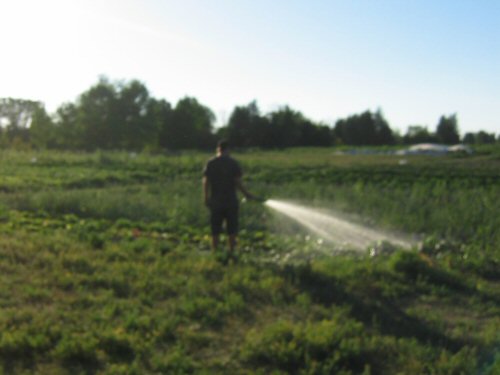
Conall watering in mesclun in the late afternoon. Even on busy harvest Friday, plants need water if they’ve had no rain. Guest photo by Erin, with a different than usual, no less…realistic, view of the field. There’s nothing like being there to see for yourself! I cropped the photo to fit the format, but it’s the original that just catches a certain tiny farm feeling…
Wheel turning
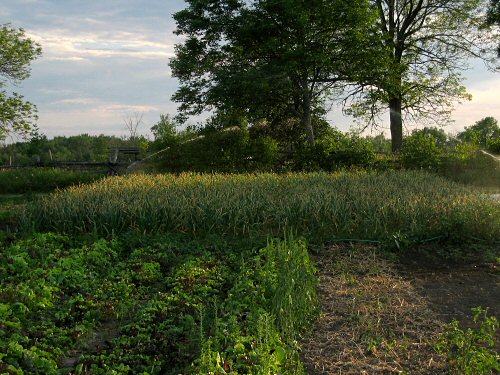
Life moves fast through our short growing season. Lushness and abundance peak and fade quickly into decline. The garlic, so green and promising only a few weeks ago, is already dying back, ready for harvest by month’s end. (Here, we’re splurging on a watering by sprinkler; I’m not sure of effectiveness of this exact timing, but a nice soaking round about now should give those garlic bulbs an extra growing boost during their last days.) In front of the garlic, more crops past their prime. The third planting of mesclun (we’re already harvesting the fifth) has started to bolt, ready to be plowed under. And a bed of arugula that, despite row cover, had been invaded by flea beetles, was chopped down and now lies brown and overdue for tilling in. Wheel keeps on turning…! (LATER NOTE: Watering garlic during its last few weeks is not considered a great idea, but in this case, it didn’t hurt.)
Sort, bundle, bag
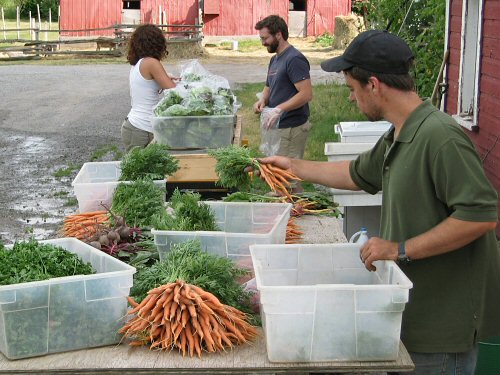
Fridays put this tiny farming system to the test, if we don’t get everything done for market and CSA shares, things would simply…CRUMBLE!!! Rain or shine, Friday is the main day for bringing in the weekly harvest, when we have to pick, sort, rinse, and bundle or bag 60-80 of everything that’s ready for the Saturday farmers’ market (about half of the CSA shareholders also pick up at the market). This week, the veggie selection is still small: beets, carrots, shell peas, green onions, mesclun, parsley. Here, at 6 pm, the picking, digging and pulling part is mostly finished and it’s mainly post-harvest action in the shade of the barn: Erin and Mike (not me, another Mike) bag and weigh just-rinsed mesclun, while Conall bundles baby carrots.
Spin cycle
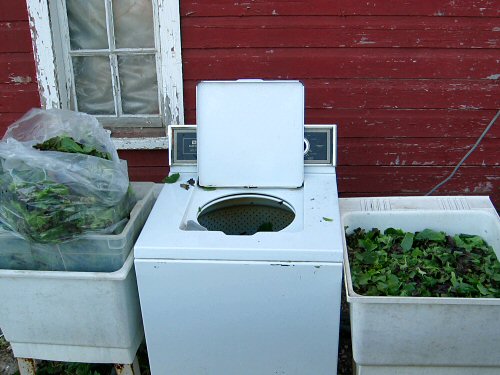
Here’s an important piece of the post-harvest station, the trusty washing machine-turned-salad spinner, flanked by laundry sinks, working on Sunday CSA harvest. The washer idea I read about someplace. When the washer here on the farm started doing odd things to clothes and was heading for the scrap heap, I intercepted it and pressed it into veggie service. With the agitator removed, it’s used on the spin cycle. Good ol’ centrifugal force! The trick to preventing leaves from getting crushed—either shredded (spinach) or veiny (lettuce, other light leaves)—is not to load too much at a time.
The sinks contain cold well water. For the most part, rinsing greens is done to quickly cool them down after being cut in warm conditions (like…a hot afternoon, you can’t always pick your moment). Sometimes, it’s also to wash off dirt splashed up by rain. Rinsing greens for one reason or another happens about 75% of the time during late spring through midsummer. Once the days start getting shorter (yuck…), greens harvests can usually be timed for the cooler evening, and rinsing happens less often. The sinks are also used to rinse other crops when they need it!
Simple, effective!!
Packing station
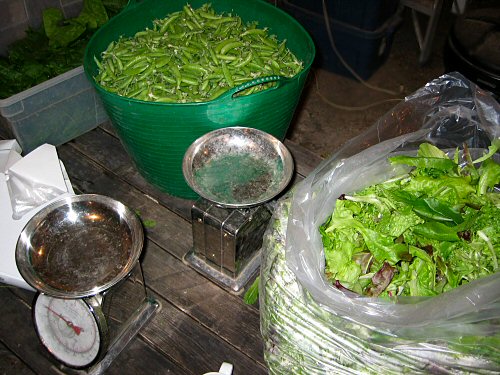
The post-harvest is a simple, straightforward process that has to be done fast since we don’t have a cooler. The set-up is manual and basic. Today, we packed indoors to get out of a stiff breeze that would’ve taken the salad greens sailing (usually, we do everything outside, in the shade of the barn; the indoor option is part of the new luxury of the Extended Milkhouse). There are a couple of 2 kg kitchen scales for the snap peas and lettuce mix. Everything is sold by bunch and bag, not weight, but the scales are useful for keeping things consistent. It’s quite easy to get the right amount by eye, so it’s into plastic bags and pop onto the scale for a quick check. If it’s underweight, add more, otherwise, somewhat over is just fine!