
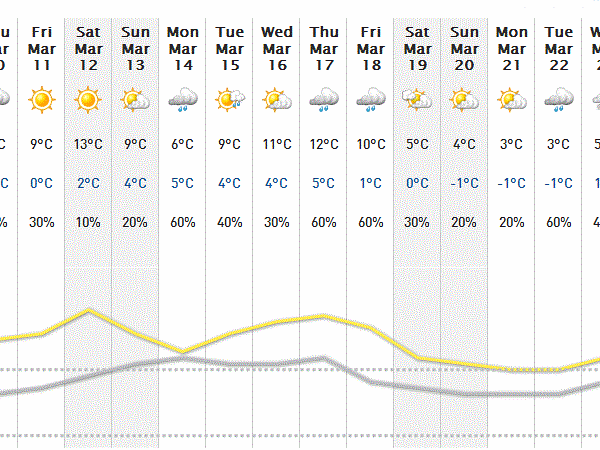
There’s official calendar Spring, and then there’s spring in the field, that ignores exact dates and goes by the weather, marking winter as over whenever the freezing temperatures end. If today’s two-week weather forecast is anything to go by—it is, in this case, when being off by ±5-10°C (14-23°F) either way isn’t a big concern—market garden spring starts now. For the moment, I’m mainly concerned about overnight lows in the unheated greenhouse, and whether row cover is necessary. If it stays above -15-20°C, my safe-with-no-cover cutoff, it should be fine to pull back the covers and let the sun shine in (prepared, of course, to put it right back if there’s a sudden severe dip, which we hope doesn’t happen). Nothing complicated, just a little of the gambling that’s called working with the seasons!
row cover
Sundown in the hoophouse
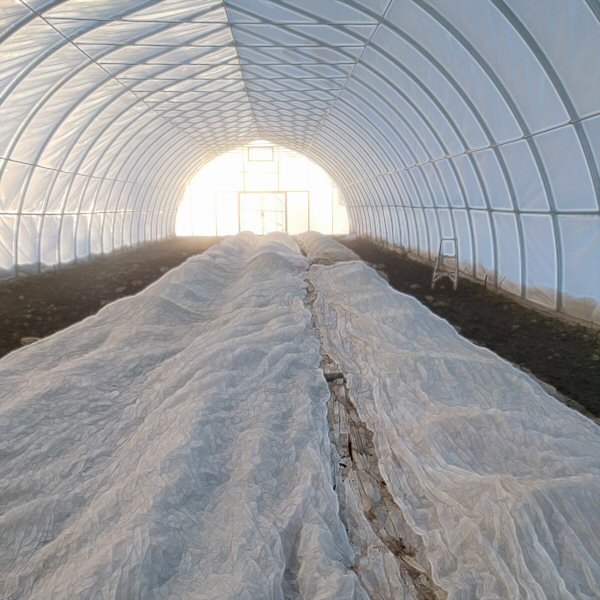
Not your typical postcard sunset, and it’s kinda chilly, damp and mucky in here, even as the temperature outside slides down to an overnight -15°C (5°F). But it’s all about the greens, tucked under a couple of layers of row cover, maybe not exactly cozy with only ground heat to keep them warm—who knows how they’re really feeling—still, well-set to survive another sub-zero night. With that in mind, sundown through 6 mil plastic is a cheery-enough sight to see!
Wire work
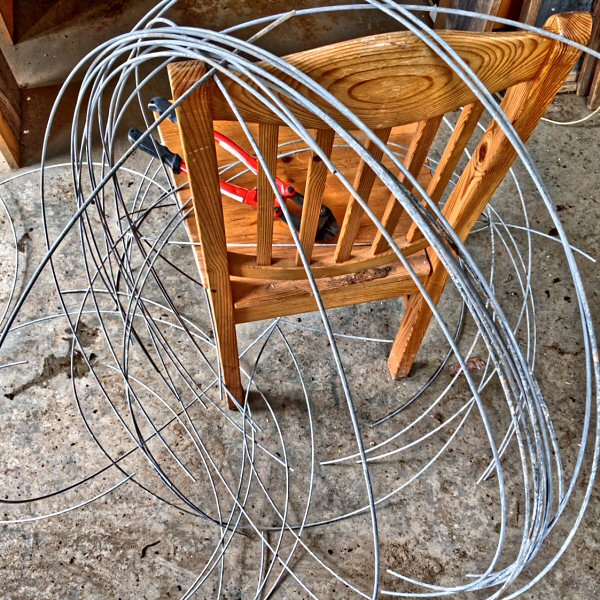
Electric fence wire work, snipping 6-foot pieces of 9-gauge wire for hoops to hold up floating row cover in the greenhouse. Hopefully this wire is stiff enough to do the job, supporting up to three layers of row cover, heavy with moisture from humidity and being dripped on by water condensed on the inside of the hoophouse plastic, or weighed down by ice, when the soaked cover freezes at night. This test batch of about 180′ came coiled, in a circle about 2½’ in diameter, and the built in curve is perfect for stretching slightly to span about 4′ of bed. So, no bending required, it’s all about the snipping!
Working around steel
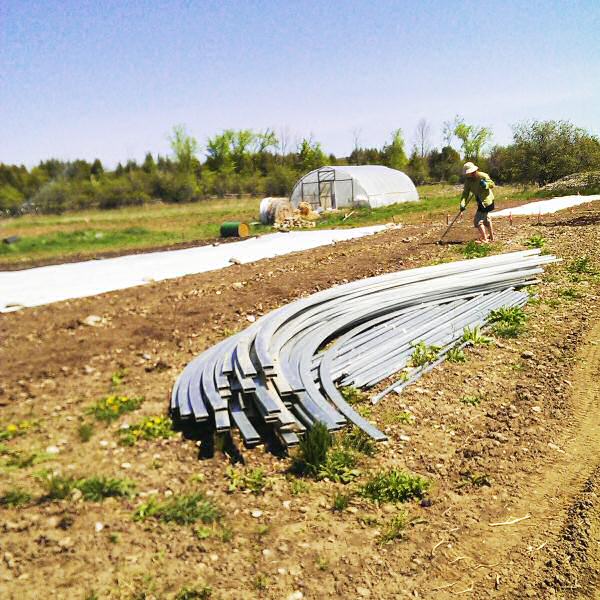
Exactly where it was delivered last fall, the steel for the new hoophouse is kinda in the way, so we’re working around it (it doesn’t look like much in the pic, but it will expand into 30’x108’x16’H of plastic-covered year-round field protection). Beds of brassica greens are already in and protected by row cover from flea beetle attack. Lisa preps beds for more. Spring direct seeding proceeds…
Brrrr… Peppers under wraps
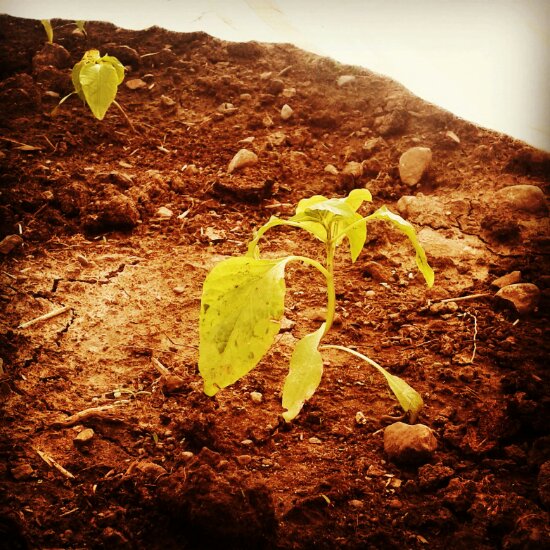
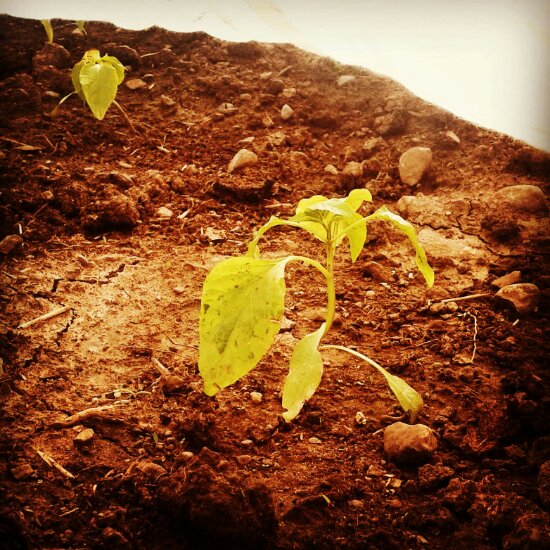
Not the happiest campers after three days and nights of frost protection, peppers and eggplant have one day and two nights more under row cover, if the forecast is to be believed. But the 15-day forecast a week ago was for no more cold nights, so…who knows! We’ve had about a week of frost warning nights so far since the second week of May, which I don’t think I’ve seen before. Normally, the covers would come off during the day, but with everything else to do now, and the kinda elaborate weighting-down-with-rocks setup, it’s simpler to leave it in place till the end…
Shrouded against the cold
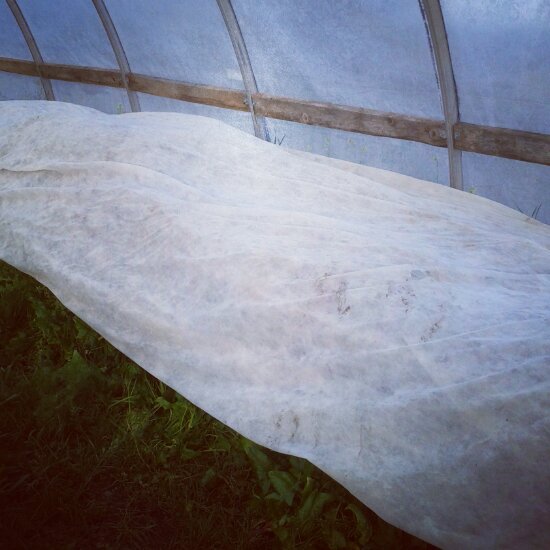
Shrouded against the cold: Not much to look at, but nice for the tomatoes, peppers and other seedlings on the tables underneath. It’s a double layer of medium weight floating row cover, tried and true, a familiar spring sight in the unheated greenhouse, good for a few degrees of protection in the forecast overnight near-freeze. Three days of chilly nights, they say.
Winter greens: the long haul
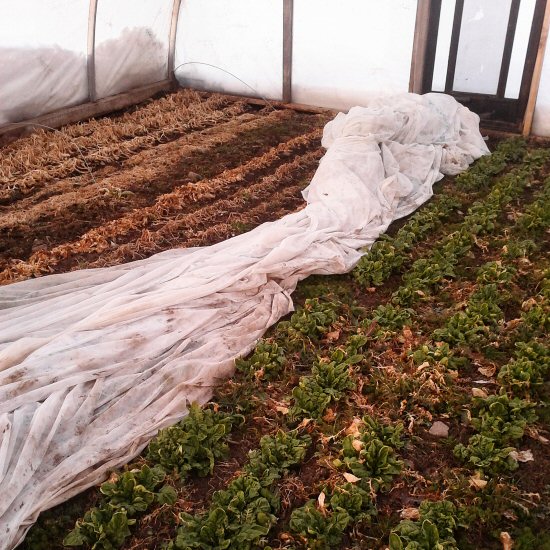
Checking in on the winter greens mini-experiment. These guys have been through six weeks of up and down weather, balmy days well above zero (reaching 60-70°F/15-20°C on a sunny day in the hoophouse) , and many extreme freezing nights. So, how did it all do? The Bloomsdale spinach, uncovered (above), is fine, although after all that freezing and thawing, the taste and texture changes (good to eat, but probably wouldn’t sell). It wasn’t the plan, but this spinach can be trimmed back to see how new growth does in spring. The other beds, all brassicas (tatsoi, mizuna, arugula, mustards), left half uncovered, are completely toasted. Meanwhile, under a single layer of medium-weight row cover, arugula (below) is good, perky and quite tasty. Not the most extensive and scientific testing plan, but combined with the experience of harvesting through December and in mid-January, it’s a solid starting point for next winter’s goal of full-on, unheated winter greens production!