
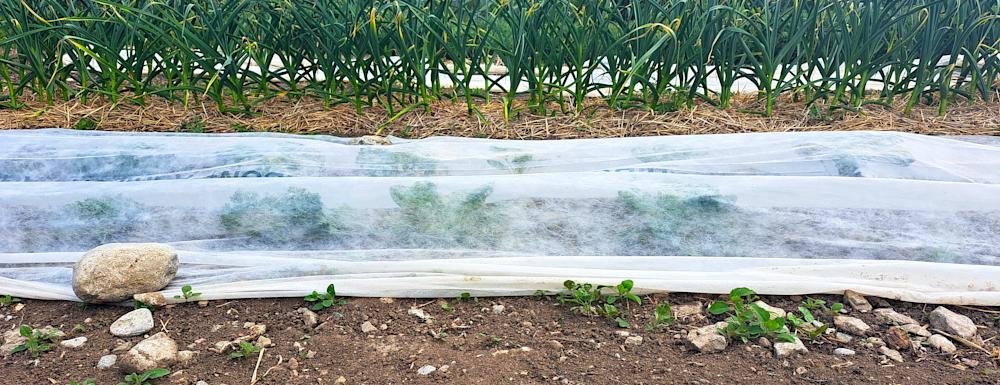
Kale and Brussels sprouts are tucked away under floating row cover (with straw-mulched garlic in the back). This is usually to protect them from flea beetles that can devour the seedlings. This year, unfortunately, it’s also a deterrent to the sudden invasion of groundhogs. Invasion isn’t the right word if we’re talking about numbers, as my best guess is that there are only two doing the damage. Their work, though, is so far somewhat alarming. They have a particular taste for lettuce; they’ve already gone under and through the cover to get a it. But in the last couple of weeks, it seems they’re out to at least sample just about everything. Since last year, and especially this spring, I’ve seen several groundhogs in the general area, which is new and a lot. Last season, there was a little veggie munching, but nothing out of hand. So, to a point, live and let live. This time around, seems like it could get more serious. As far as pests and disease, from year to year, if it’s not one thing, it’s another…
row cover
Summer ends!
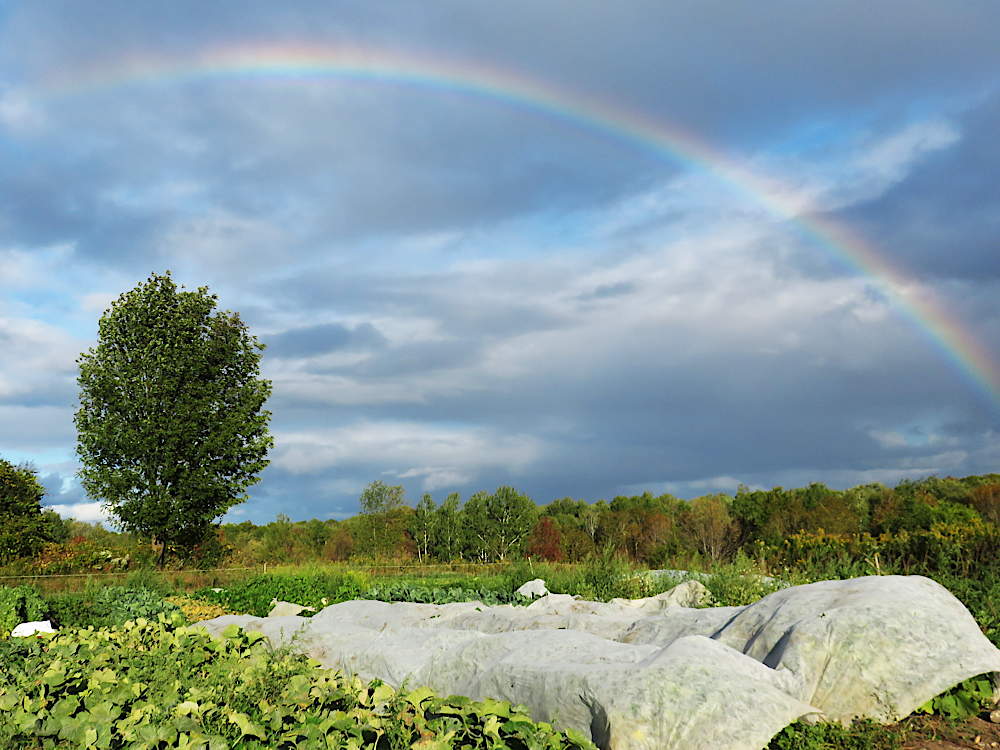
For the last day of summer, a rainbow! The field is looking a bit bedraggled, with some things naturally dying out, some touched by near-freezing overnights, with tender crops row-covered against the possibility of a hard frost. Besides the rainbow, it’s not the postcard look of mid-summer, but what matters most, everything is still producing well!
When to cover
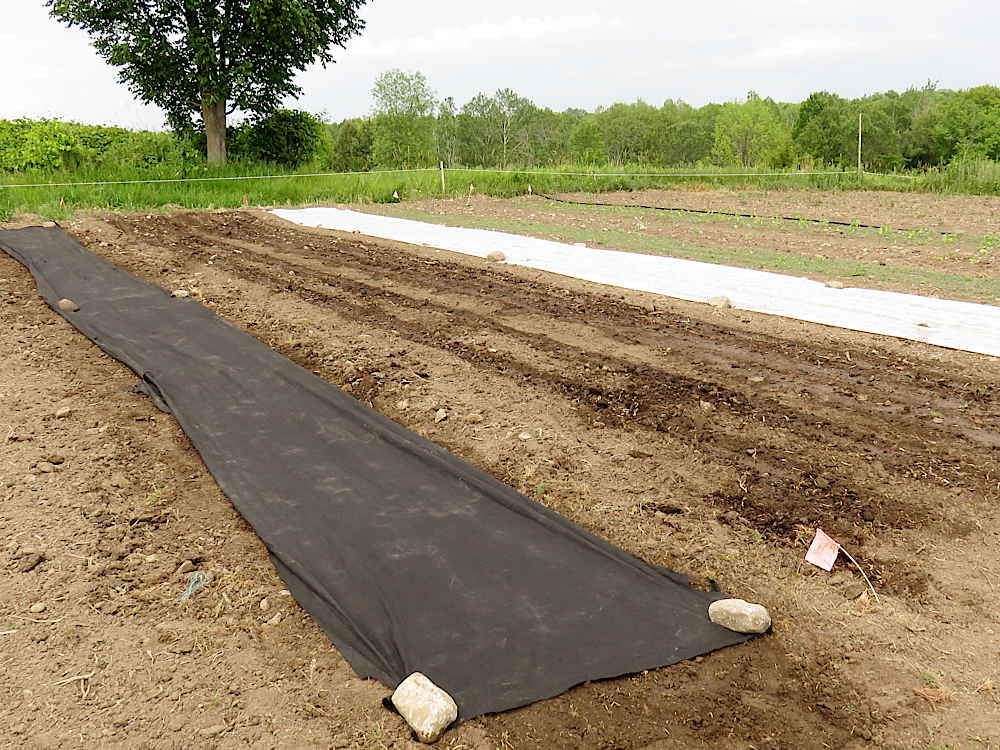
Some crops need to be covered and some crops don’t. It would be excellent if all the vegetables in the garden could bask in the sun together, like a picture-perfect postcard. Which would be possible if it weren’t for pests, and the special conditions some need to germinate. Trusty floating row cover is used here to keep flea beetles chewing holes in the brassica mix—flat-leaf kale, mizuna, mustard, bok choi, and their close cousin arugula, to be harvested as baby leaves for salad. Wee tiny carrot seeds need cover to retain the constant moisture in the ground they need to germinate—I’ve been using black landscape fabric, watering through it as need, for about a week. And some veggies, like green beans and beets, haven’t had insect problems, so they don’t need cover. It all depends!
Fieldwork, tiny farm style
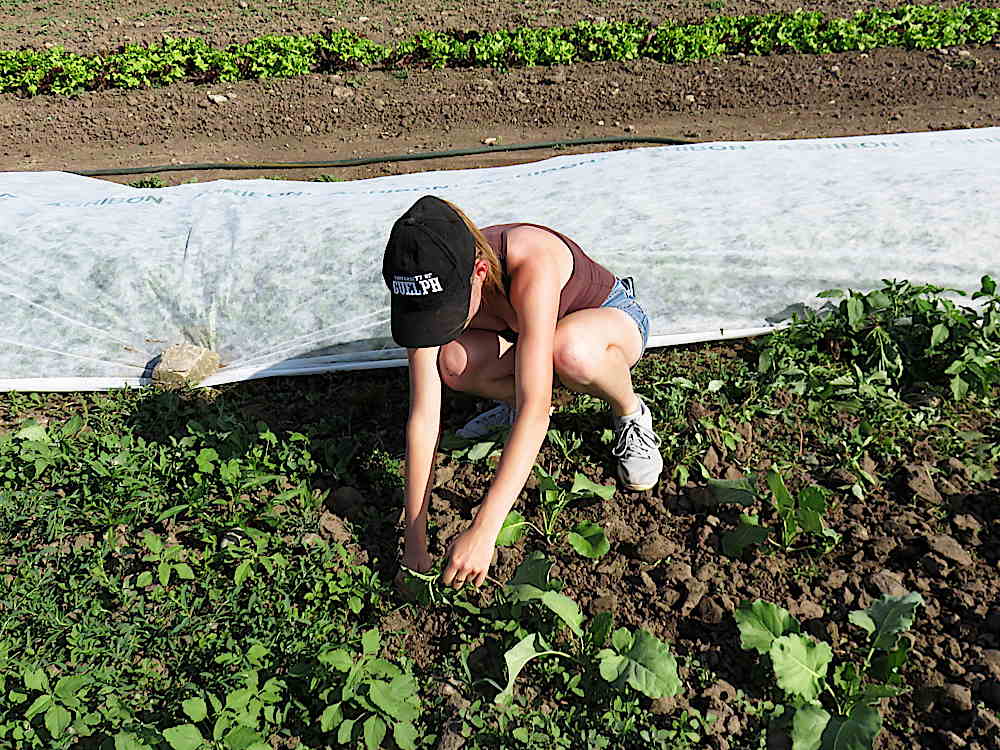
A simple snapshot of hand-weeding brassicas, and yet, a wealth of clues to how tiny farming is done in this market garden. Upfront, can see the weeding before-and-after: give them a few short days, and those weeds would easily catch up to the seedlings. The pulled weeds go around the plants or on the paths, where they do their bit in mulching, that helps keep new weeds from germinating. (Unfortunately, weeds often get bigger: more work, with the smaller tradeoff that they do a much better job as mulch.) Behind Casey, row cover, held down by big rocks that are carefully hoarded for just this use. Without the cover, flea beetles would have already gone to town, perforating the leaves with tiny holes. Further on, a critical water line, a 3/4″ hose off a 1″ pipe from the dug well pump. These are far from from a Big Ag diameters—they don’t deliver a firehose amount of water, but they do get the job done. Besides, there isn’t that much water in this well. The hose is lying on a trodden path, measured out at the beginning of the season to divide the field up into five-foot wide (1.5m), wide enough to take two rows of the bigger plants, like these broccoli and a cauliflower. The tradeoff is, comfortable hand-weeding is often done from both sides, to avoid lots of reaching across, while being a little less…efficient. And then there are open beds, with the clean look of fresh rototilling, ready for more seeding or transplanting. Casy’s fashion choices for fieldwear wouldn’t be mine: too much skin exposed to sun, insects, and spiky thistles—I gave up even shorts ages ago, for long sleeves and jeans—but to each their own. It’s all in the details!
Won’t give in to the cold
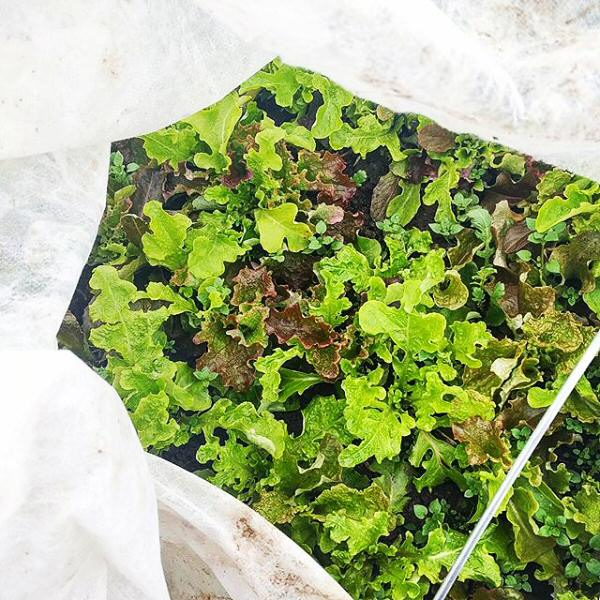
Lettuce, under a hoop-supported layer of medium weight row cover in the unheated greenhouse, is crisp, colorful, and fresh as daisies. This lettuce mix was planted in October, and some of it cut once in December, and now it’s waiting out the winter. Outside low so far: not bad, around -22°C. Kind of the same picture every time – dead or alive – but still always exciting when you’re there… (:
Greens, protected!
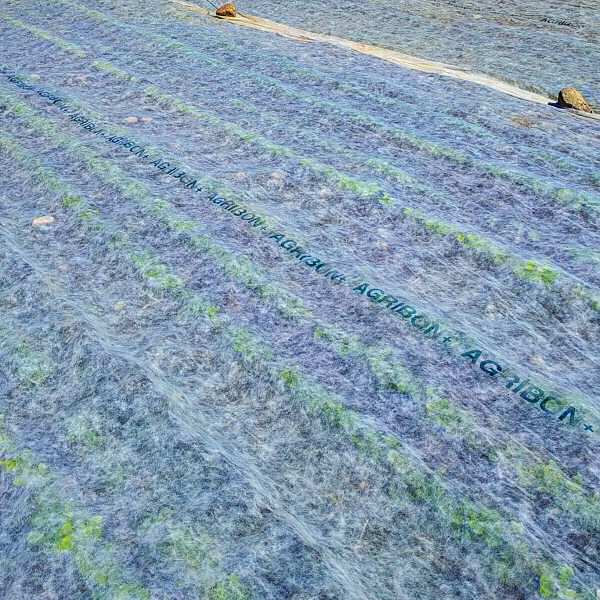
Floating row cover, weighed down and made semi-transparent by water, is all that stands between fine young brassica greens and the scourge of the flea beetle. The cover is placed right after seeding, weighed down by rocks every 12.5′ feet, briefly rolled back for weeding, and progressively loosened as the greens grow—we use 14′ wide sheets on 10′ wide beds. This medium-weight cover has worked as a good all-round solution, offering a few degrees of frost protection, and more durable than a lighter, insect-only weight, which would allow better light transmission (this medium weight one is 85%) and better air circulation, but also be more likely to tear.
Post-winter greens
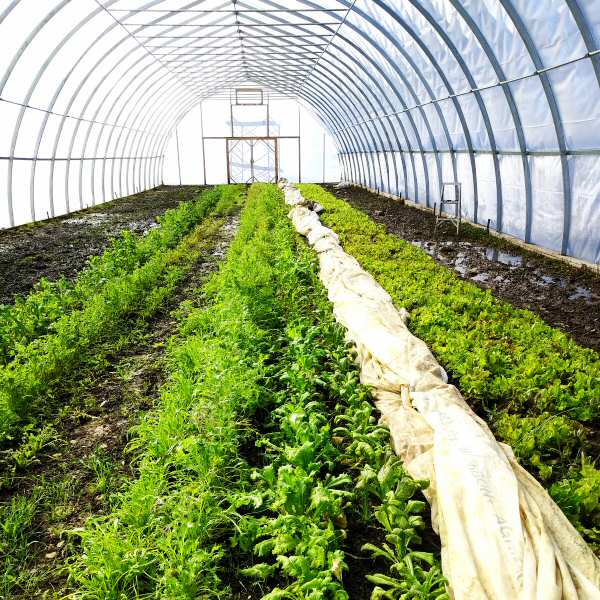
The covers are off and it’s all shades of green! That’s about three months, left to their own devices, living through freezing nights, often around -20°C (-4°F), and a low of -32°C (-25.6°F), under a couple of layers of medium-weight row cover, which means, little light (with the plastic added in, somewhere around 50% of already weak winter sun). Inside, at ground level outside the row cover, the lowest it got on the coldest night was an amazingly not-so-chilly-at-all -13°C (8.6°F). As a simple survival test…excellent!