
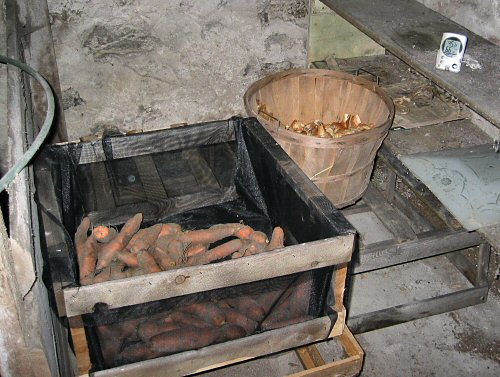
Finally got around to starting to sort out the spot for the root cellaring experiment. It’s in the basement of the house, against the north wall. I thought the floor was dirt, but it turns out to be cracked and rubbly concrete. Oh, well. It’s still fairly warm, around 60°F (15°C), but should cool down soon. I’m not doing much, other than clearing enough room for 8 or 10 bushel baskets. Monitoring temperature and humidity through the winter—a handy little digital min/max thermometer/hygrometer is already on duty—and seeing how the veggies hold up week by week is the main thing for this round. Some squash and beets are just out of sight to the left. The bulk of the veggies go in soon…
seasonal eating
Putting food by
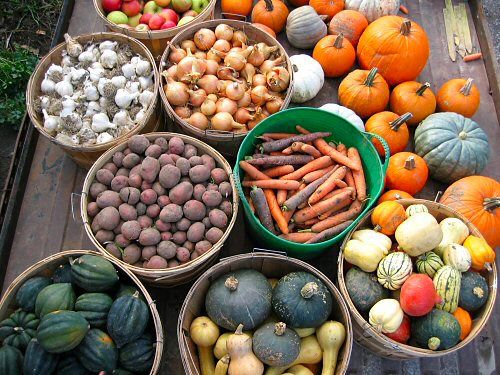
With the farmers’ market over, time to turn to fall-and-winter things. This year, I’m for the first time organizing a proper veggie selection for storage (it’s about time I started…training for that future CSA root cellar!). Instead of the usual bushel baskets of this and that, casually left around the barn to take their chances with temperature and location, now, there’s a bit of plan. For a root cellar, the basement of the farmhouse, the side with a dirt floor that used to be filled with potatoes when this was a fully working, big family farm. For the veggies, today’s haul has a mix of potatoes, assorted winter squash and pumpkins, various carrots, onions, garlic, plus apples picked up at the market. It’s a first step, there’s still lots more in the field: beets, spinach, collards and kale, herbs, and more carrots to go… Harvesting isn’t history just yet!
Seasonal eating
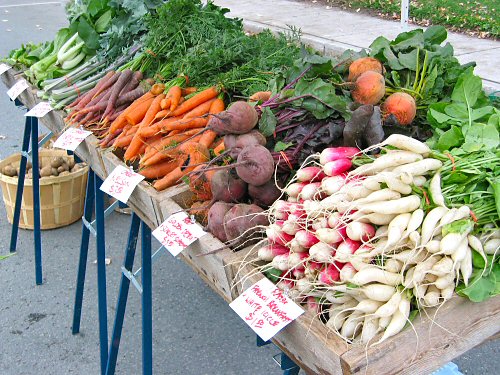
The veggie selection changes over the season, but it’s not necessarily reflected too dramatically on the stand at the farmers’ market this year. Compared to mid-August, the absence of snap beans and tomatoes is clear (with the mild weather, some vendors did have standard field tomatoes today). As for early June, well, more variety now is to be expected. Still, most of the cool-season crops for around here, like broccoli, cauliflower, and collards, also, winter squash, I have only enough of for CSA. On the stand, two types of radish (White Icicle, French Breakfast), three types of beet (Golden Detroit, Scarlet Supreme, Bull’s Blood, in smaller sizes here), two types of carrot (Nelson, Purple Haze), Red Russian kale, two types of bok choi (Mei Quing, Joi) and mesclun, plus Yukon Gold potatoes, Music garlic and Stuttgarter onions in baskets. The stand could be a lot bigger, offering more display space, and the harvest could be expanded (there are still herbs, summer squash, sweet and hot peppers, tomatillos, Brussels sprouts,…) but the marginal sales for many “secondary” veggies at this slowing down time of year don’t make it worthwhile. I’m still working on the balance between production planning, labor, harvest selection, post-harvest prep, and presentation… Sounds complicated, but it’s just…work! ;)
Potatoes from next door
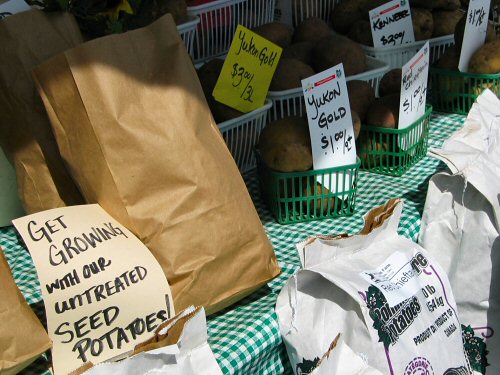
As the season picks up, I’ve been thinking a lot about…how short it is. Around here, we only have four months between last and first average frost dates, which means five months of fresh local veggies (six on the outside). This bothers me. Is eating locally-grown just a seasonal, novelty act…then it’s back to the supermarket for the rest of the year? I have all kinds of daydreams and plans for extending the season, most of them somewhat expensive and involved, like a large root cellar for a year-round supply. One of the things I have been doing, and decided today to make more…formal this year, is recommending customers to other local growers who offer things I don’t. For example, two spaces down at the market is a family farm, mother, father, daughter growing several acres of potatoes (in the pic, at last Saturday’s market they had stored spuds for eating and growing). It’s not a big operation, but they do offer 50lb bags in fall, a quantity I can’t provide at this point. I figure, anything that makes it easier for people to eat what they want, like truly local food, is…good! No tiny farm grows alone!!