
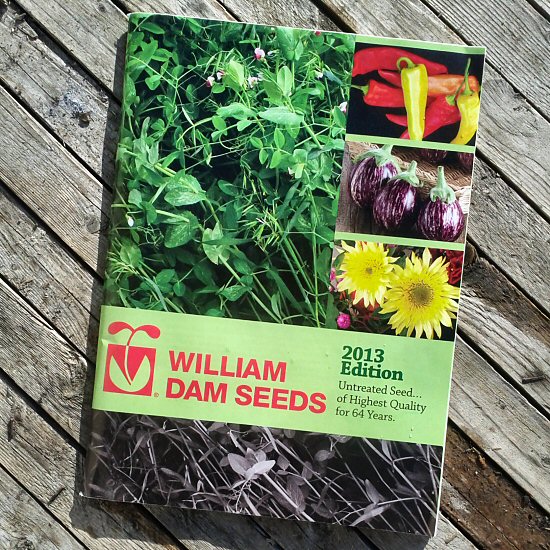
For the record, this year’s seed catalog! It arrived in late December, and I’ve been thumbing through, but it’s still not well-worn—I pretty much know what I’m ordering. It’s as exciting as always to get the new catalogs, but a bit more symbolic now, start of a new season and all that, than it used to be at the beginning, when I pored over it for hours. Like anything else, do it for a while and it becomes…easier. Also once again for recent years, almost all of my seed will come from just this one place, William Dam, a family owned company not too far from here, that carries only untreated seed. Selection does the trick, service is great, and I like talking to them on the phone. High Mowing and, of course, Johnny’s, both relatively close (Maine and Vermont, to my Ontario), have a lot more in general, and High Mowing is 100% organic seed, but at the moment, I’m fine with Dam! Everyone’s farming has its flow!
seed
Seed store
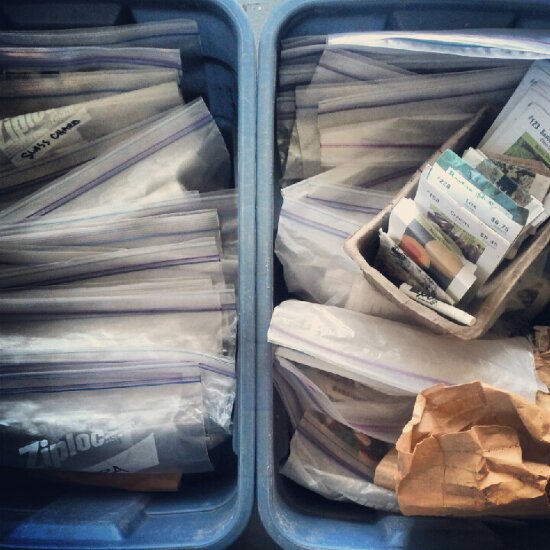
My current seed bank is around 60 Ziploc freezer bags. In alphabetical order. I haven’t been as careful lately with storage conditions as at times in the past, these plastic bins with lids (there is third one with bigger bags of larger seed, like beans and peas) are kept out of sunlight and away from heat. I could do a lot more, but I’m not going for long term storage, and most of the time there seems to be no critical difference in germination time and rate for seed 1-2 years old, which is the longest I keep anything in any sort of quantity. Fresh seed may pop up a little quicker, but with the many other variables based mainly on the weather, it all seems to even out by the time harvest day rolls around!
Bucket loading
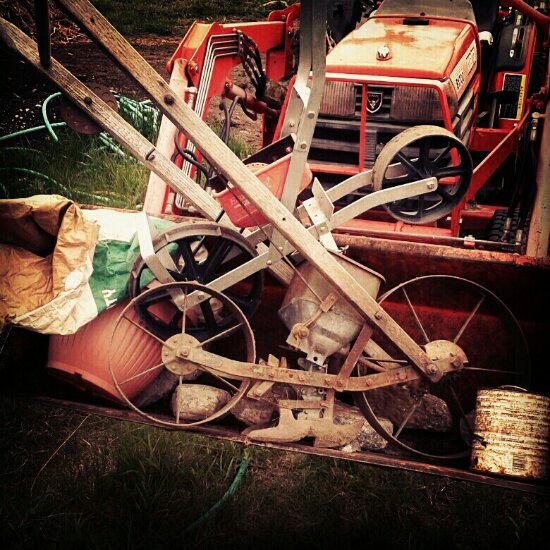
Especially in spring, with constant seeding and transplanting, moving gear around the field is a bigger deal than it may seem. Forget stuff, even little things like a hose fitting or a seed plate or some twine, and you’re heading back the equivalent of practically a city block to get it. A trailer of some sort is the ultimate for a 2-3 acre plot, but with decent packing skills, you can fit a lot into a tiny tractor bucket, too! This carefully balanced load includes everything needed for some direct seeding: the Planet Jr. and Earthway seeders (can’t forget the Earthway seed plates, they’re a perfect fit in that coffee can); seed, clipboard for notes, twine and stakes for row marking (all in that large flower pot); choice rocks for anchoring row cover (it’s never too early to protect brassicas from flea beetles!); and there’s the last of a 50lb bag of snap peas nestled in. It takes a practiced eye to fit everything you need so nothing falls out as you bump along—do it a few times and…easy peasy!
Mixing greens
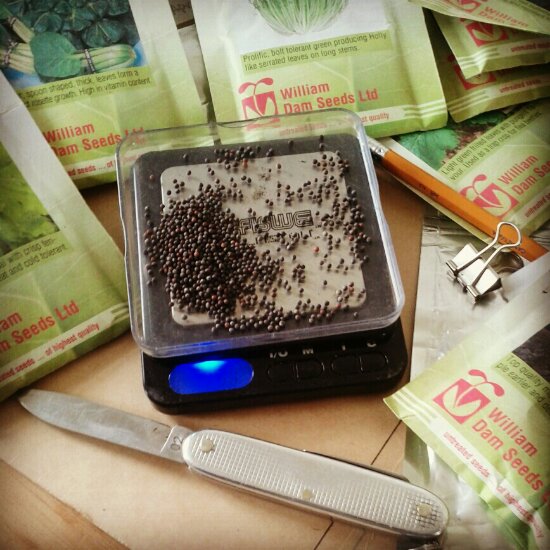
Measuring seed for lettuce and Asian greens mixes, using a digital gram scale from the local headshop. It works well, except I wish the auto-shutoff didn’t happen so quick. I was quite amazed by the selection of digital scales available, starting at, I think it was $20, and going up in $5 increments for a whole slew of models. Didn’t realize so many people were into making their own small-batch seasoning blends and custom salad mixes. Wow. Hahaha. The mixes are basically trial and error. For salad mix, it’s about color and texture at this point: frillier, greener, redder, crisper (baby Romaine is nice in there)—check the results, adjust the percentages for next round. For the Asian greens, it is more about taste, which so far has mostly come down to how much mustard to put in. Of course, how quickly they each grow is quite critically important, all varieties should grow at the same rate, in a fairly wide range of conditions. The lettuces are easier, and I started with some varieties recommended for baby leaf production for just that reason: fast-growing. The Asian greens, all brassicas at this point, are trickier. For example, tatsoi was included in our first runs, but it consistently grew lower than the rest, the leaves were a nice size, but when cutting, they tended to fall halfway below the blade. So, out goes the tatsoi, for now. It’s all about simple experimentation and adjusting things a bit as you go! (BTW, the knife is there just to slice open seed packs; for no real reason, that’s how I always do it…)
First seed catalog of the year!
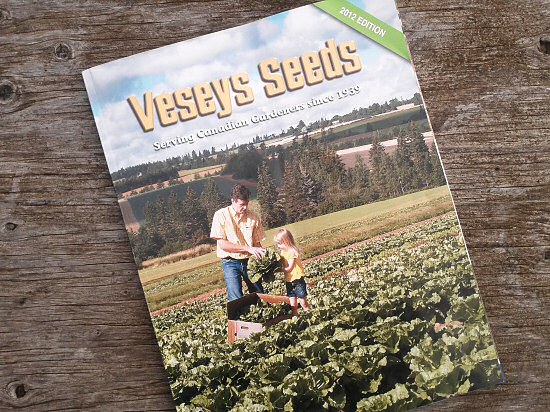
Well ahead of the pack, Veseys takes first new seed catalog of the year. They’re a pretty marketing-oriented company, they get their stuff out early—this actually arrived a while ago, but I only got my hands on it now! Which is fine by me. I haven’t been this, well, EXCITED with that new-catalog feeling in a couple of years. That’s good. There is a lot of proper, well-ahead-of-time planning to do, expectations for 2012 run high! Whatever the weather!!
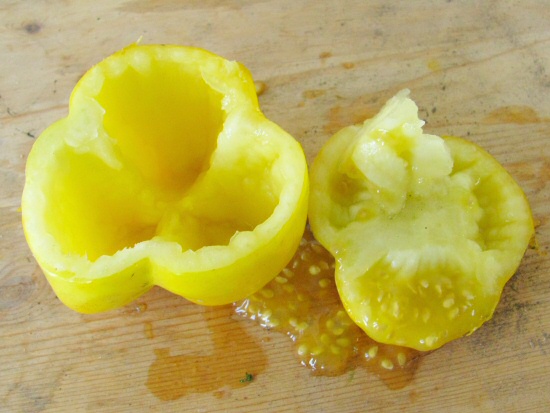
Yellow Stuffer, a tomato
Return of potato fruit
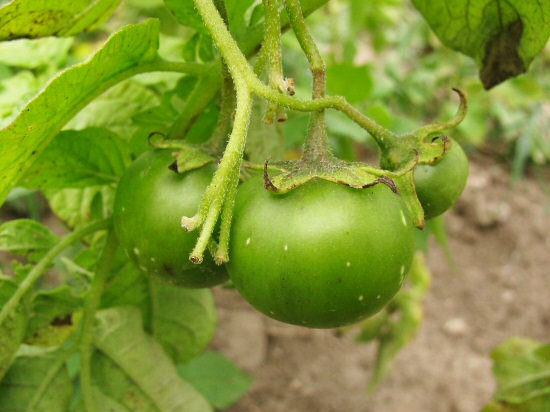
Almost missed this time around, last seen here four years back: a few of the Yukon Gold potatoes have fruit this year. These are poisonous little, green tomato-like fruit with seeds that you can grow into…potatoes. You can find out more about ’em in this POTATO FRUIT blog post from 2008, when I first ran into then (it’s the most commented post on Tiny Farm Blog!).