
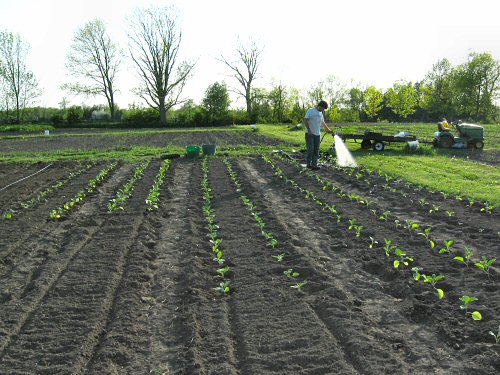
Towards the end of the day, Conall waters in newly transplanted eggplant and peppers. Over the last week, focus has moved almost entirely to the open field. The seedling room is empty, the last of the seedlings are now in the greenhouse, and the push is on to get things in the ground as quickly as we can. My juggling of HELP is on-going. Word-of-mouth recruiting has gone surprisingly well, there’s quite a list of willing workers, and it’s tempting to call in a whole crew to transplant all at once. On the practical side, having to explain and coordinate takes a lot of time, I don’t yet have a System that works for several people in the garden at once, so I’m going along more carefully, working with Conall and at most one or two others per day. And one can’t forget the budget. In any case, everything should be in over the next 10 days. Think fast, take it slow!
transplant
Tomatoes go in
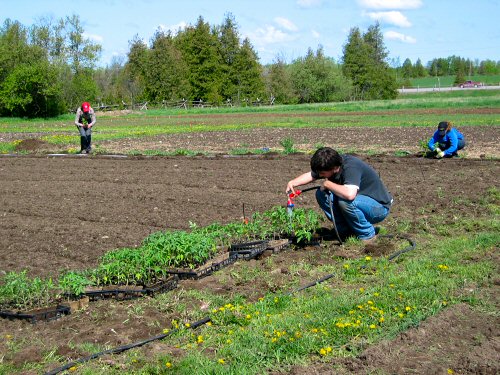
The first of the tender, warm season transplants—tomatoes—hit the field today! About 175 seedlings went in: Juliet, Striped German, Stupice, Emerald Evergreen, Mule Team, Yellow Stuffer. On the transplant team: Conall, Sherry and, new to the season’s crew, Jo. Compared to doing transplants alone or with one other person (my experience so far), this was quite the operation. Teamwork!
Juggling the weather and part-timer scheduling, I took a bit of a risk transplanting today, with patchy frost forecast for tonight. Still, the plants have been through highs and lows in the greenhouse, row cover will help, and tomatoes have…never let me down. I’ll be up at dawn to see how it went. Everything’s a gamble!
More hands on deck
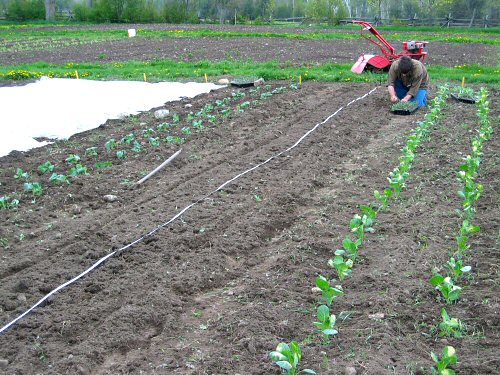
Conall, the all-new organic grower, is back after being unexpectedly called away two and a half weeks ago. That happened after we’d worked together for seven days straight. For me, making the transition from essentially solo tiny farming to having regular help was that quick. Having everything bouncing around in your head, with little need to explain it, is a luxury and efficiency of sorts. On the other hand, if you have people who you can sync with, sharing the gardening in an ongoing way seems like even more fun. And you can grow MORE STUFF with LESS WEEDS!! :) It’s a really welcome return. FREAK FROST: Three nights ago, according to the min/max thermometer, the temperature bottomed at a little below 0°C (and there was no reported cold snap or hard killing frost), but some of the brassicas (Brussels sprouts—see the whitish spots on the leaves on the right of the pic, bok choi, cauliflower) and two out of three varieties of peas got fairly toasted, burnt by the cold. Many of the pea leaves were totally killed off. I only noticed the extent of the brassica damage when we took off the row cover today. This is something I’ve never seen, and Bob, with 40 years of farming, hadn’t either, especially with peas, which can grow in the snow. The additionally odd thing is that some varieties (one of the peas, broccoli) weren’t affected at all. These are all plants that can normally take an overnight freezing and bounce back no problem—temperatures around zero should be nothing. Weird. My random theory: a very rapid temperature drop, many degrees in a few minutes, that didn’t give the plants enough time to adjust…? Anyhow, everything’s recovering just fine! The crazy weather effects continue…
More seedlings to the greenhouse
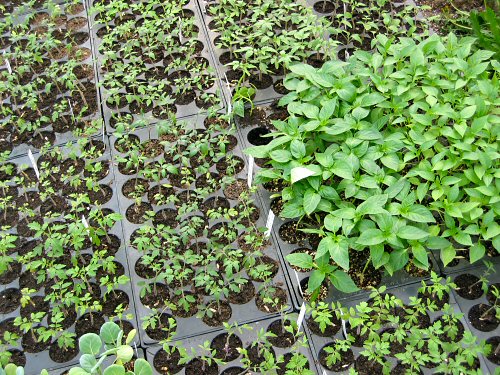
The spring seedling starting days are rapidly winding up. Moved about half of the remaining trays from the Milkhouse to the greenhouse, including most of the experimentally late-started tomatoes. Based on the marginally useful long-range weather forecast, I’m aiming to begin the main field transplants around the end of this week…
Gardens within gardens
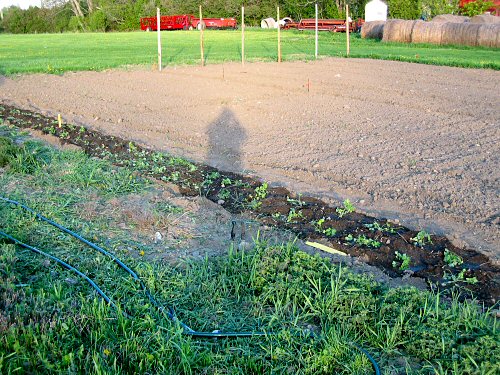
One part of this year’s plan is to expand the herb area from a few beds into a real little herb garden AND to create a home veggie garden. Here is the starting point (along with my shadow). At the bottom of the photo in the overgrowth are sections of sage, oregano and thyme, all doing fine after overwintering with no cover whatsoever, other than the snow. They need to be cleaned up and I’m going to move some. Next, I finally transplanted the parsley from plug sheets started in February, two varieties, Plain Italian flat leaf and Green River curly. The open area is waiting for warmer nights—over the next couple of weeks, I’ll transplant dill, basil, and see if cilantro can survive the jump from tray to field, and direct seed a bunch of others. I haven’t quite figured out where cutting flowers will go, maybe some here as well. And then, in the top corner, marked by 6′ stakes for trellis netting, I’m doing a home veggie garden, 20’x25′, with a little bit of everything, a tinier version of the big garden… It’s a little crazy as far as making work, but the idea is to have a demo for farm stand customers who want to start their own gardens. The more veggie gardens the merrier! :)
Greenhouse filling up
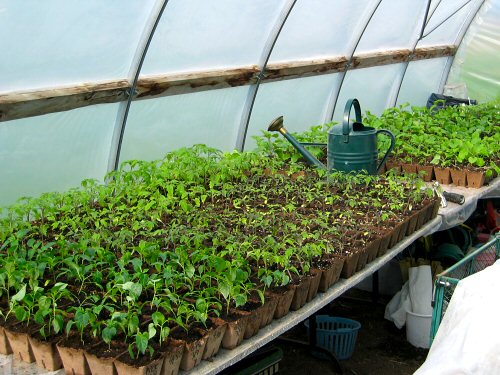
The seedling side of the greenhouse is already almost full. All of the tomatoes, eggplant and peppers in 3″pots (around 700) are out there, which is only almost a quarter of everything that’s going. I’m gonna have to make some space! There are many things to do. Last frost date is approaching and the long-range weather forecast, not worth a lot but still worth looking at, predicts temperatures steadily rising—planting out to the field will likely happen “on schedule” around the 20th. The farmers’ market is also starting, and I need to do some carpentry to finish up the new stand. Two-thirds of the potatoes still have to go in. There’s a whole list of seedlings that need to be started indoors. There are the flowers and herbs to tend to, separate areas on their own. The grass is jumping and the paths need a first mowing now! And so on. If you’re into a little higher pressure gardening, around here, this is the time of year for you!
Off to the hoophouse
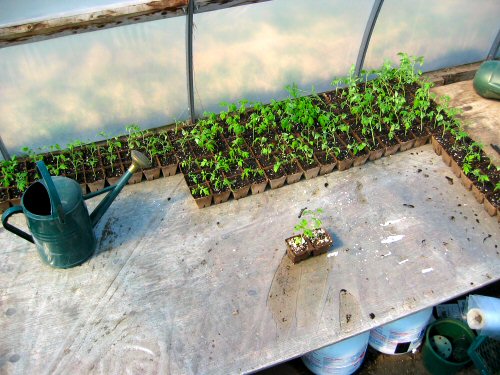
The first set of tomatoes is now in the unheated (but heatable!) hoophouse. They’re freshly installed in 3″ Jiffy pots (peat pots that can be planted), watered in, and awaiting the first night’s cold. It’s supposed to go down to 3°C (37°F), which isn’t bad, but it’s always chillier in the field than in the forecast. Peeking out from under the table, two fat little propane tanks: round about midnight, I’ll be on temperature patrol, ready to fire up the propane construction heater if it looks like a freeze. Working the night shift. Farming after dark!