
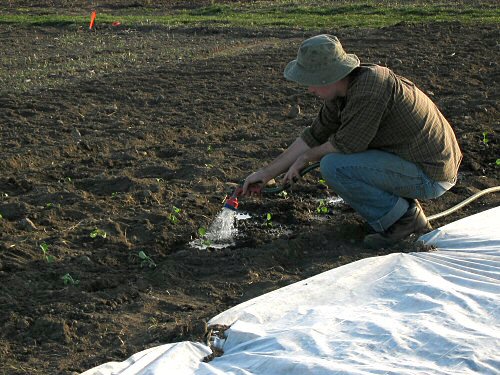
Conall, the all-new organic grower, starting from scratch as our first full-season, full-timer, waters in transplants. Today we set out three more beds of brassicas—so far, there’s cauliflower, broccoli, Brussels sprouts, bok choi—prepared beds for a dozen more crops, set up the irrigation pump for the season, cleaned out the winter storage area of the barn, turned the composting windrow….and more. Still, it’s the rush-to-get-it-in-get-it-done time of the year, and the days never seem long enough (although, they’re getting longer!!).
transplant
First field transplant of the year
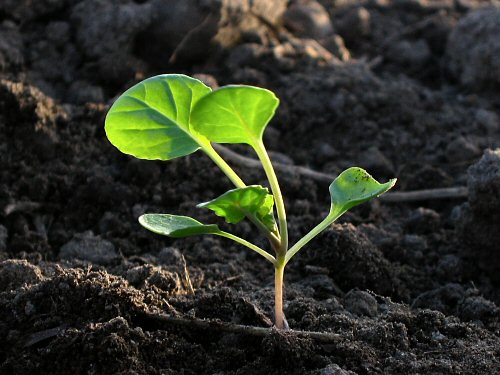
This little Jade Cross Brussels sprouts seedling, only four weeks old, is first into the open field. The weather remains pretty well perfect, warm and sunny, and we’re steadily chipping away at the list of crops waiting to be started right away. Today, besides the Brussels sprouts, the first three beds of mesclun, and a whole lot of bed preparation!
The rhubarb debacle
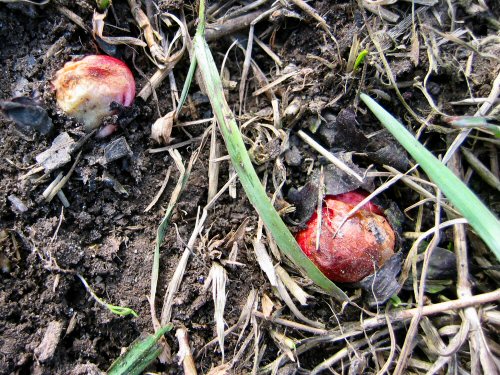
Debacle may be a little strong, the future of my newly established rhubarb patch is not absolutely dire, but it’s not looking perky just yet. I’ve so far managed to spot only half a dozen of the 50 odd transplants I set out last year in spring. I’d ambitiously dug up part of an ancient patch in the house garden (it needed thinning anyway), divided out a ton of roots, and planted at least 50 on 3′ centers (hopefully, I’ll be able to count ’em in a couple more weeks) in a permanent spot in the garden field. I can’t quite remember what I was thinking: eventually, rhubarb for an entire village?! Problem became the low priority of rhubarb in the busy year, upkeep of the patch got away from me, and it grew over quite heavily with grass and other weedy items. Also, fewer, denser plantings might’ve been a better idea. But rhubarb is tough, I dunno if it can be smothered by mere other plants… We’ll soon see!
Lettuce transplanted
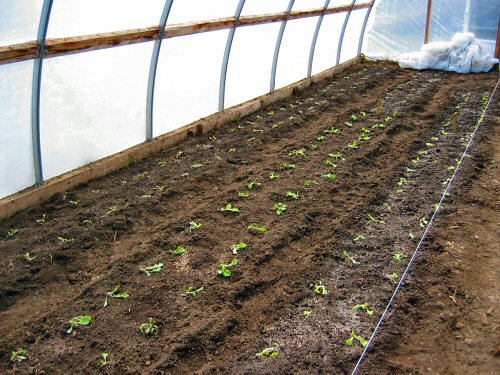
Five weeks after seeding in plugsheets under lights, around 180 little lettuces are in the ground. Especially without a hardening off stage, they’ll have a bit of struggle in the greenhouse-hot days and subzero nights ahead, but that’s the gamble for extra early harvest. Luckily, lettuce has been good to me. I have faith. And row cover.
Heading for the sun
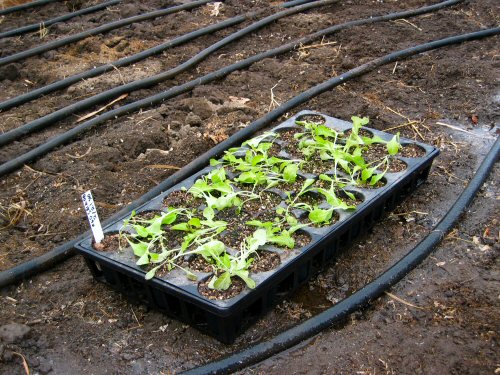
A first tray of early lettuce, set out in the unheated greenhouse yesterday afternoon, survived the around-zero night no problem. Lettuce is quite forgiving, and I’m forgoing the usual hardening off, going straight from the grow racks to the greenhouse ground. Although the sun feels great (it just came out now), hopefully it will only appear in breaks over the next couple of days, or the lettuce will be toast. The soaker hoses running up and down were on yesterday for a few hours to get ready for transplanting (without watering, inside the greenhouse, the ground obviously gets very dry).
Seed starting tools
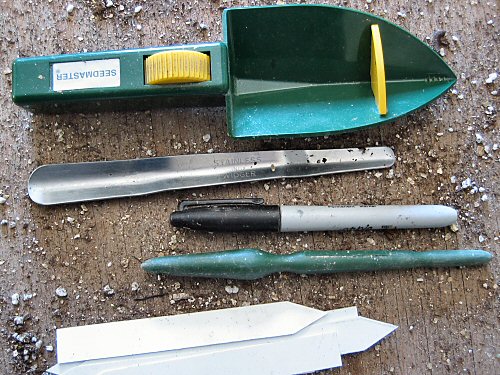
It doesn’t take much to get seed started indoors. Fingers, mainly. The Seedmaster is a bit of a gadget from last year, not liked much at first, but rising on the tiny tool chart. You roll the yellow wheel, which clicks and causes the tool to vibrate, shaking seed down and over those little ridges (speed bumps) near the tip. At first, the wheel was stiff and the whole process seemed slow, but this year, it’s loosened up and once you get used to holding it at the right tilt for each type of seed, it definitely works faster for me than finger-pinching tiny seed. It came with four yellow inserts, with different sizes of cutout at the base to further slow down different sizes of seed, but I keep it fitted with the largest. The stainless steel transplanter tool acts like a shoehorn, and works great for popping out plugs when potting up (it’s all in that little bit of a curve!). The permanent marker and plastic plant labels are of course indispensable (DON’T GET MIXED UP!). The green dibber (dibbler, pointy tool, whatever) is nice in principle: it comes in handy for poking little dents and holes, but fingers often work faster.
Grow racks at night
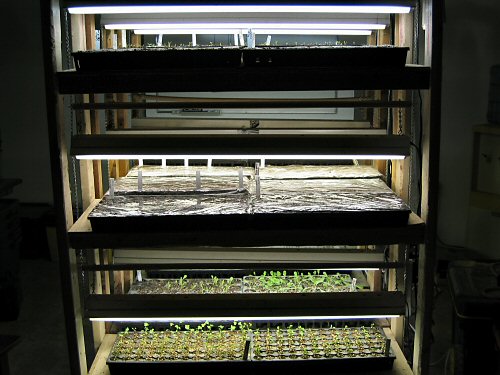
Plant racks, light stands…I usually call ’em grow racks. They’re filling up now.
Pushed to capacity, the three racks can hold a total of 36 trays, 12 each, or four trays per shelf. So, depending on the size of the plug sheet—I use 38s, 72s, 128s, 200s—I can start between 1,368 and 7,200 seedlings.
Sounds super-efficient. HOWEVER, it comes down to the light. With four trays per double fluorescent fixture, the light is pretty stretched, and a lot of rotating is in order.
Also, most of the fixtures are the old standard T-12 type, where the light is stronger towards the middle of the tube. You can clearly see the difference in growth if you leave trays in the same position for a few days. The newer T-8 type lights more evenly from end to end and uses less power, but I don’t feel like replacing all the fixtures (a couple in there are already T-8).
It’s an ongoing experiment to see which size plug sheet to best start in for each crop, given the light situation. That in turn determines if or how often I need to pot up to larger quarters before it’s time to transplant into the field.
All in all, I’ll get around 2,500 seedlings off the racks this year.