Thu, Jul 30, 2009 · Filed under Animals, Local food, Storage, Summer, Tools

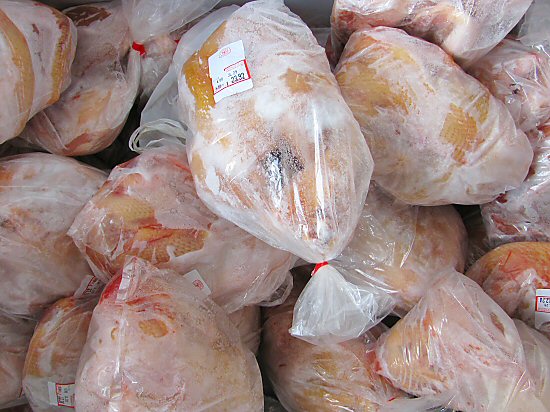
There they are: 38 newly processed chickens, freezing solid in the chest freezer (39 minus the one we took to roast fresh). It’s the last stop before the table on what was a pretty fine meat bird run.
Like everything else on the tiny farm (and in life in general!), when you get down to freezing chickens, there are the details. What I noticed this year is the amount time it takes to actually freeze chickens solid. This wasn’t quite as apparent last year, when we started with under 20 processed birds. Here, checking out the new freezer’s manual, I loosely followed the advice against freezing too much at once. I put in half, around 20 chickens, for a few hours, then added the rest. I’ve also been rotating them—they freeze faster when they’re exposed—but after a day, they’re not all rock hard.
I have it in mind that the faster you freeze stuff, the better it is when you thaw it out: firmer, not mushy. Something about smaller ice crystals doing less cellular damage. Sounds plausible to me!
Luckily, the chickens came heavily pre-chilled from the processing house. Processing your own in any sort of quantity, I imagine you need a fair bit of refrigerator space to cool them down, or a walk-in cooler, or lots of chest freezers. Another thing to look into for…the future!
Of course, the whole freezing thing is another puzzle. It’s quick and easy, and works really well for all kinds of food. Newer chest freezers seem quite energy efficient: this 15 cu ft one uses 400 kWh a year, which is like keeping a 60W lightbulb on for 9 months (at current electricity rates around here, that’s about $50). Doesn’t sound so bad, and there’s room for lots more in there. Still, we’re trusting a lot to yet another plug…
FINALLY, there’s the sticker, another fine feature of commercially-processed chicken. The meat is Ontario government-inspected (a provincial inspector is always on-site, that’s the law), which is indicated by a little logo on the label. Plus you get the date, weight down to two decimal places of precision, AND a price-per-pound of your choice. I picked $4. These birds are for our own use—not for sale—but it’s always fun pulling out an EXPENSIVE farm chicken for dinner, as long as it’s priced kinda within reason…
Permalink
Mon, Mar 30, 2009
Filed under Farm lab (research!), Spring

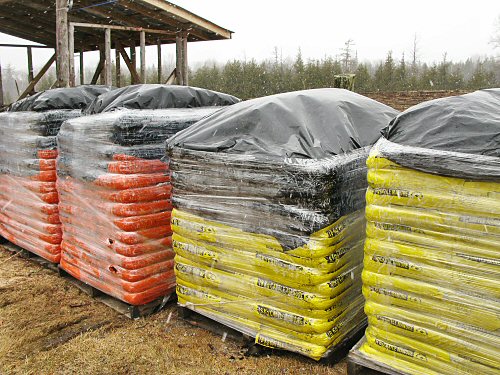
Back to cold and wet, with a bit of snow… Today was an interesting first in my brief tiny farming career: compost on skids! Fertility delivered! How convenient… This is about 5.5 tons (5,000kg) of fully composted, certified organic cow and sheep manure (half and half). According to the people who make it, at this point there’s no appreciable difference between manures, it’s all just high-grade compost now. Our organic certifier agrees: it’s “legal” to use any time, unlike any type of manure, which has to be spread a minimum of 90 days before veggie crops are planted. So here it is, from around 65 miles (96km) away, via flatbed truck and forklift up the drive…
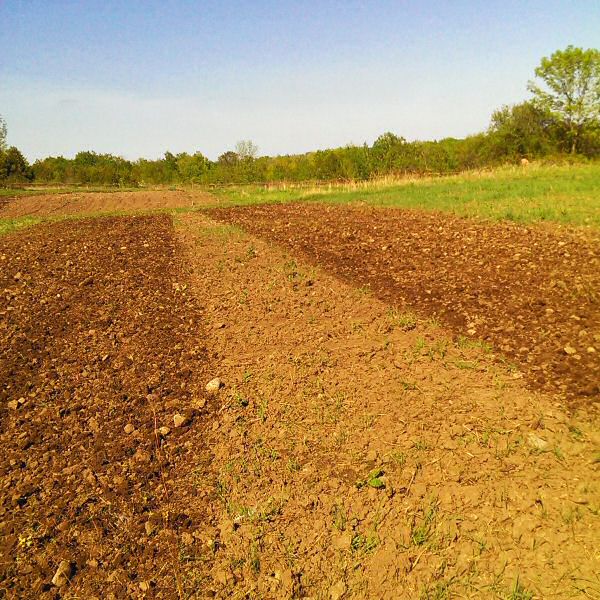
This is a one-time thing, part of what we’re doing to start the market garden from a hay field plowed late last November. Unlike at the old farm, where cow manure was well-aged and plentiful, available by the ton, there are so far no animals here.
While I like the idea of animal manure, and find DELIVERY kind of odd and offputting, the current reality does force one to really think about hidden costs. The cows at the old farm ate far more hay than the farm produced, which meant buying in, so all of that free, on-farm manure wasn’t exactly free, or on-farm. Factor in the total cost and complicated logistics of raising and selling local beef, and the relatively low return, and manure on a tiny farm can seem quite unsustainable.
In any case, maintaining fertility here is a whole new game. Green manure, compost, and a small amount of on-farm manure, from chickens first, are this tiny farm’s future. And today’s delivery is the kickstart. Here we go!
Permalink
Wed, Jan 07, 2009 · Filed under Animals, Winter

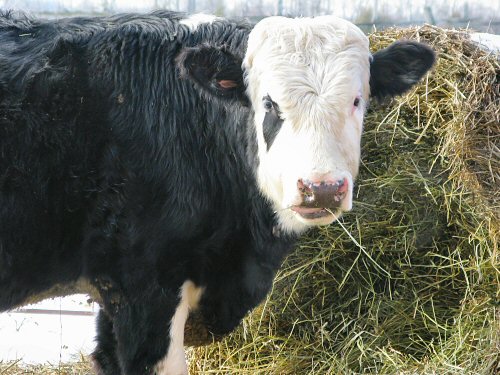
Sammy the Steer, born at 4am in the freezing cold barn last January, is healthy and hefty at around 800lbs (360kg), and approaching the end of his arc as a provider of tasty, mainly grass-fed beef. He and his three pals will likely go off to auction in March. They’re heavier than they’d normally be on a mostly grass diet (supplemented with some grain), because Bob didn’t wean them from their mothers for an extra couple of months. Mother’s milk is good. I’ll miss cows on the new farm. Although I’ve never been involved in their day-to-day, they’ve been close neighbors. My real connection with them is through MANURE, tons and tons of 6- to 12-month-old, air-dried, partially-composted, nutrient-rich goodness in a constant, convenient heap, there for the taking. I don’t see cattle in my near farming future. I hope to get to them eventually, meanwhile, putting some animals in the new tiny farm food chain sooner than later is on my mind. Perhaps goats?
Permalink
Tue, Sep 23, 2008 · Filed under Autumn, Fieldwork, Harvest, People, Pests & Disease, Tools, Veggies

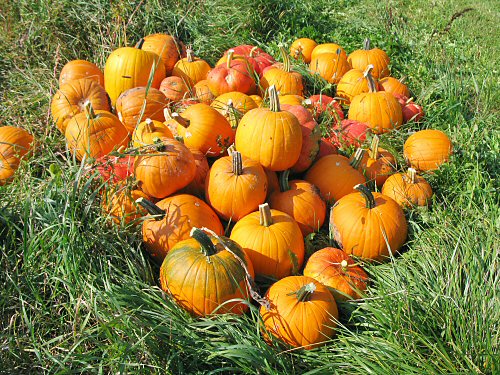
Today, the pumpkins came in, wrested from a jungle of pigweed gone wild. Every year, a few of the 40 50′x50′ sections that make up the 2.5 acre garden get a little overrun with one weed or another (usually, pigweed). This year’s pumpkin patch was a good example, with pigweed growing unchecked for a good six weeks—no time made to weed, not IMPORTANT enough a crop—until today, when Raechelle used the belly-mounted 52″ mower deck on the Kubota compact tractor to mow it down!

Of course, this is exactly what you DON’T EVER DO in a garden: allow weeds to flourish and go to seed, then mow them down, broadcasting seed everywhere… Oh, well. The alternative, pulling the pigweed by hand, then carting it off, we also do when necessary—see the Pigweed Mountain—but once in a while, I go for the instant gratification of seeing a section clean and clear in an hour or two. The millions of pigweed seeds, ensuring healthy future generations for years to come, will be dealt with…later. (As long as we weed on time next time around, how bad can it get?! :) Anyhow, it’s all part of the grand experiment! Guest pumpkin photo by Lynn.

Permalink
Tue, Jun 24, 2008 · Filed under People, Planning, Summer

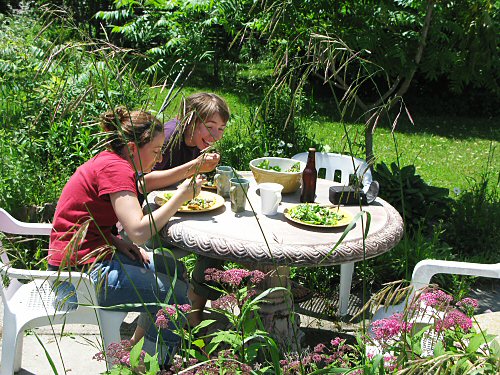
For the month of June, after Shannon, who’d been in the field just about every day in May, and while waiting for Lynn to start full-time for the rest of the season (July 1st!), I’ve been back working in solo mode, which has been, surprisingly to me, a little strange and…unfamiliar. Right now, there are several great people sharing the tiny farm experience (TFE ;) each week, but coming on single days. Here, with Lynn and Raechelle (Tuesdays!), we take an extended Endless Salad lunch break in the backyard. It’s as relaxed and fun as it looks. This, I think, is how it SHOULD BE, a laid back mix of fieldwork and practical leisure. It’s a lot different than the 10-12-hour, garden-obsessed days of the first 3-4 start-up years, when I worked largely alone. After working with Conall right through the season last year, I realized that my original solo mission, one-farmer-one-field mode had…changed. Evolved. To continue to grow on this tiny farm, it seems I’ve taken the path that needs not more production acreage or machinery or straight, head-down hours of labor, but simply more happily committed PEOPLE. Hmmm… Not a brand new discovery, but driven home over the last month. An interesting twist on tiny!
Permalink