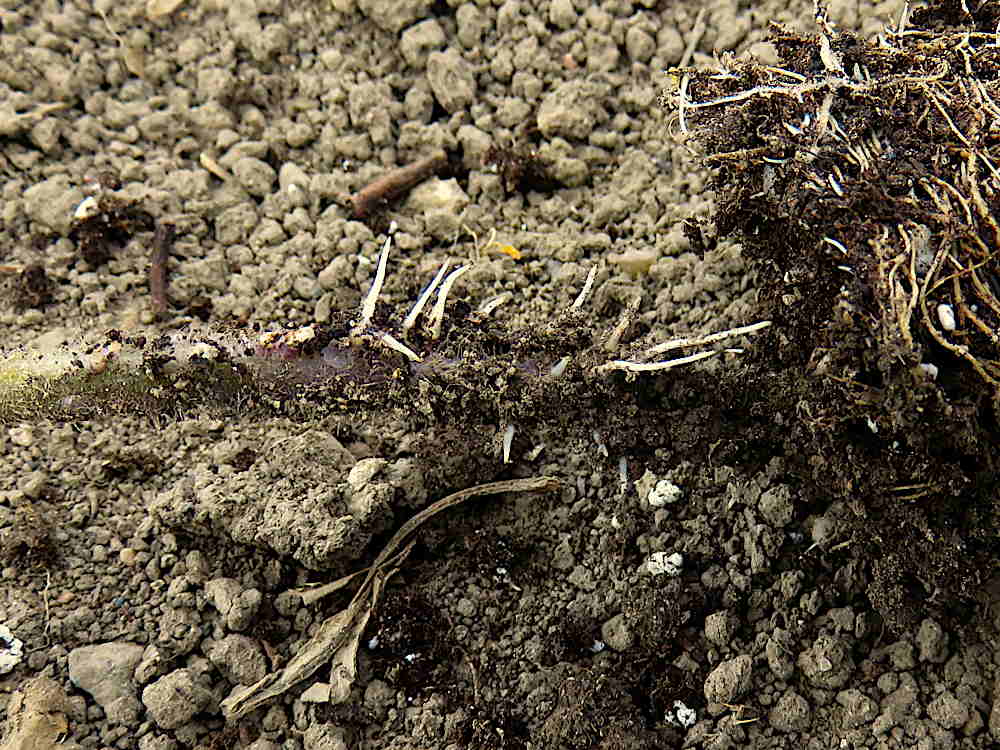
Most of us don’t spend much time at all looking at plant roots. Meanwhile, the things going on underground are quite wondrous. Take this humble tomato seedling, demonstrating a special power: adventitious rooting—a catchy way of saying they can grow new roots from their stems. Tomatoes, potatoes and peppers, all relatives from the nightshade family, have this ability. And? Well, if you have leggy tomato transplants, stretched from too much time indoors in tiny plug sheet cells, this ability allows for a neat trick. You can dig a little trench instead of a hole and lay the seedling on its side. Then, bury the root ball and most of the stem, gently curving up the last bit. Ta-da, a sturdy little transplant. I did this for a few leftover tomatoes two days ago. Today, I found one snapped off—wind? rabbit?—so I pulled it, revealing roots that had already started pushing out. It’s just another little bit of all that goes on in the hidden part of the garden!
roots
Bare root Brussels sprouts
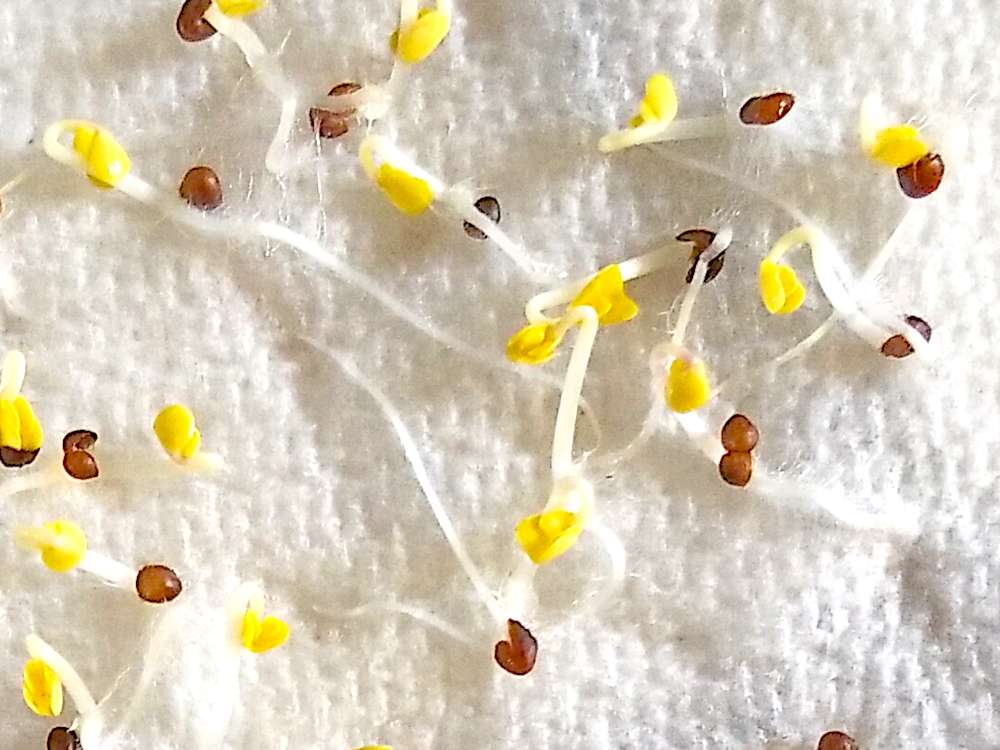
Yep, a wonder of Nature, up close. Three days or so after folding up the pinhead-sized seed in a damp paper towel, we have Brussels sprouts! Of course, this is only step one of many before we get to the deliciousness of actual Brussel sprouts. (Halved, tossed in corn meal and sautéed in butter is one way to go!)
Bare root germination like this is good for at least two things. It’s a useful germination test to see if old seed is still good. It’s also a way to start seedlings: transfer the sprouted seeds to a plug tray or pot, wait a few more days, and up they’ll pop. Let the greening begin.
The bare root approach adds an extra step compared to putting the seed directly in the plug or pot. It’s a little more work. It can be good with hard-to-germinate crops. Or if the seed is old, with a low germination rate, and you want to be sure that every plug has a plant. That it’s fun to see what’s going on is also a fine reason!
Parsnip root flashback
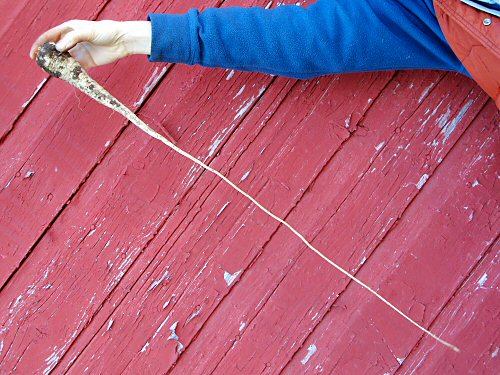
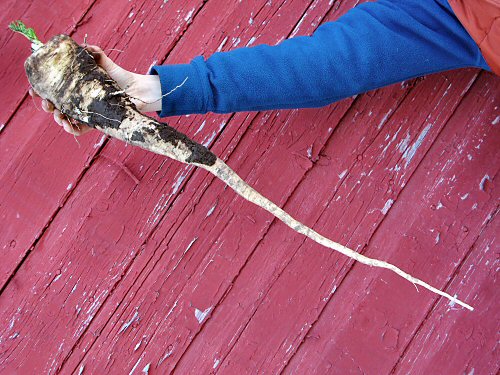
This harvested parsnip root only hints at the massive root systems that plants have down there. Mature parsnips can root down to 9 feet (2.7m), and spread up to 3′ (0.9m) in the top 10″ (25cm) of soil. Other garden veggies are generally as impressive in the root department. When we harvest, most of the delicate root network is torn off, and we only get to see the bigger, tougher parts, the taproot or the root ball. This pic is from an old post I ran into, a flashback to Oct. 2008: there’s more words and another long-rooted-parsnip pic at Root love! (The arm-and-hand model is Lynn.)
Harvesting Jerusalem artichoke
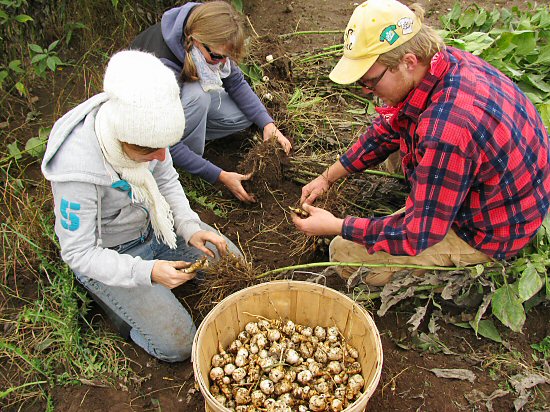
For tomorrow’s farmers’ market, Lynn, Andie and Jordan harvested more of this year’s Jerusalem artichoke. The tubers have gotten noticeably bigger since pulling some just a couple of weeks ago… Chokes are a really simple, satisfying harvest, at least, when you pull up the plants in their first year. These guys are spaced at 12″ (30cm), so we just grab the usually multiple stems at each spot and tug. The main root ball is shallow and contains most of the tubers: pull ’em off, and bang the root clump a bit to get at the ones in the middle. You also have to scrabble around for maybe a hand’s width or two past the little root crater to find a few extra outlying tubers—guess that’s where the “invasive” part of choke lore begins, they do try to spread. Overall, though, it’s quick and easy, especially when the fall weather is mild like today. Nice!
Kale in survival mode
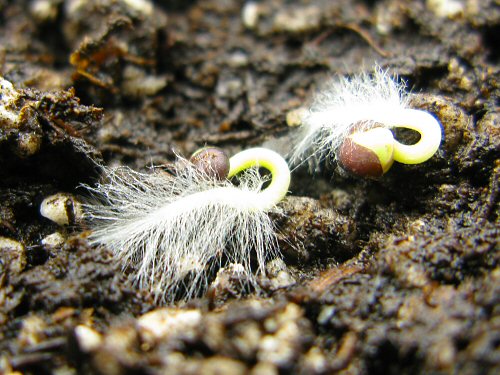
At first, it looks like some sort of horrible, fuzzy mold, about to devour your newly germinated seeds. But when you get really up close, it turns out to be superfine, hairlike extensions growing from the radicle. These kale sprouts pushed themselves right out of the seedling mix, probably because they weren’t pressed in and covered deeply enough.
Kale, broccoli, cauliflower and other brassicas do this in a very visible way during a surface emergency, sending out a mass of fine root hairs in search of water. Root hairs are normal below ground, but I’ve only really noticed them growing exposed on brassicas, other newly emerged seedlings with bared roots usually seem to just dry up. An unusual glimpse of what plants are up to with their vast root systems down below.
Given half a chance—a little surface moisture—these guys can actually manage to burrow down and root themselves. Pretty cool trick.
Frozen chokes harvest
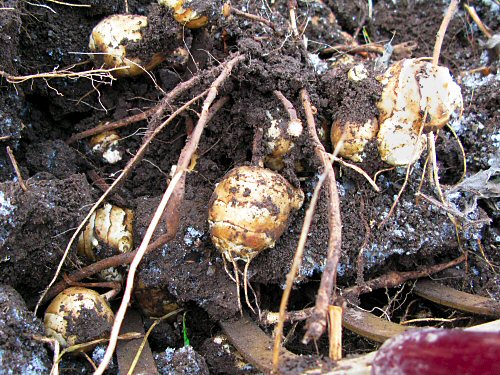
Despite the six inches (15cm) of snow on the big garden, fieldwork goes on. Today, I harvested about 30lbs (13.5kg) of Jerusalem artichoke out of the partially frozen ground, just to be sure planting stock is around over winter in case I need it. Since we don’t have a root cellar or walk-in cooler, storing crops in the ground as winter comes along is a risky but useful alternative. There’s still lots of carrot, parsnip, and some more chokes out there. Until the ground is frozen several inches or more down, it’s possible to harvest, although too much snow can make the whole thing a little crazy. Once thoroughly frozen, I’ve found carrots get killed off and thaw to mush, while parsnip and chokes withstand freezing just fine, staying alive and available again in spring. So far, though, everything’s still cool for digging. You can see the ice crystals in the frozen crust (above), but below that, it’s all cold, friable soil and plump, healthy choke tubers…
Root love
About the last thing anyone is likely ever to see first-hand is the amazing root structure of plants! I’ve been fascinated by the massive size and complexity of ROOTS since I first saw a sketch of a full root system, and way more so after browsing the wealth of technical drawings of garden veggie roots in the fantastic and fully-online Root Development of Vegetable Crops. Root systems can be VAST, but they’re incredibly difficult to actually see since the mostly fine filaments that tunnel everywhere simply break off when you dig up a plant. Today’s parsnip harvest yielded a couple of unusual, still very partial root specimens that only begin to illustrate what’s going on down there. Who knows how just a few managed to come up with so much intact… For parsnips, according to RDoVC, after a season’s growth, “at the 8-foot level roots were common and a maximum penetration of 9 feet was determined.” In the top 10″ (25cm) of the soil, lateral roots extended up to 3′ (90cm). Pretty cool, huh?! (Thanks to hand-and-arm model Lynn.)