
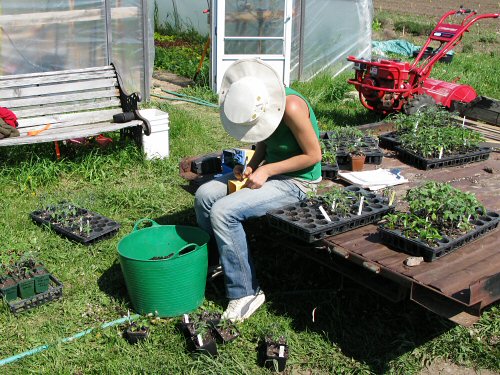
With the recently warming weather, field crops have started to grow more quickly, but nothing but radishes will be ready for this Saturday’s farmers’ market, and the early lettuce in the greenhouse has gotten pretty low after two weeks of harvesting. This is a first: by the end of May, mesclun and usually spinach have been ready in the field. Not this time. Sooo, we decided to fill out the week’s market stand offerings with seedlings. Selling my extra insurance seedlings at the market is something I’ve avoided until now: for the few dollars more, it didn’t seem worth the chance of complaints if anything goes wrong (I’ve heard people blame all kinds of things on the plants they buy)—usually, I’d sell or give only to people I know. There’s always a first time, so Shannon potted up and labeled a couple of dozen spares. We’ll take a walk on the wild side and see what happens… :)
tomato
Great day in the field
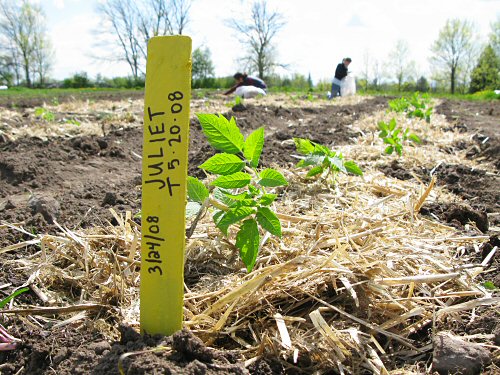
Especially compared to yesterday, today’s mainly sunny, quite warm weather added up to a glorious day in the field. Lynn, Raechelle and Shannon were all on hand, plus the inadvertent pet chicken, Colonel Saunders (I guess there’s no going back to the flock for him now, he’s been separated for a few days and probably wouldn’t be welcome, but, uh, he will be eaten…). It’s so absolutely fun to do even the most potentially tedious tasks (like hand-weeding between tiny green onion seedlings—done!) in a group with such a happy vibe. Besides a good amount of weeding, and putting ALL the chickens outdoors for the first time (those White Rocks don’t seem to want to do anything chicken-normal on their own, except eat), we transplanted the first 100 tomatoes. These were the deluxe early starts (Juliet, Striped German, Big Beef, Stupice), and they got the best transplant treatment ever: a deep, dug hole with a generous amount of compost, burying to the topmost leaves, a thorough watering in, mulching with the oat straw, and then, floating row cover over top for the coming few cold nights—it’s hard to imagine this is a…commercial operation, especially when you’re selling toms for only $1.50-2/lb. :) We mulched directly around the plants with straw, I’ll fill out the rows with grass mulch as soon as there’s enough. On the marker stake, there’s the variety, seedlng start date, and today’s transplanting date. At the other end of the row, Raechelle and Lynn mulch (Shannon seems to mysteriously avoid the occasional snapshots most of the time…). With all of the recent cold, we’re definitely at least a week behind the last couple of years in transplanting and in growth, but with a few hot, sunny days to complement the decent amount of rain we’ve been getting (not usual in recent years at this point), we might even catch up… Anyhow, a fine day!
Tender to the greenhouse
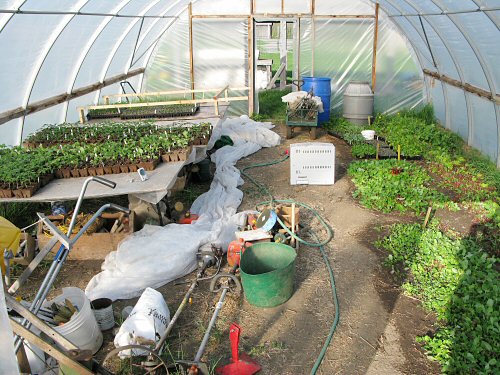
Moved the first wave of tender seedlings—100 tomatoes, plus eggplant and sweet peppers—to the greenhouse yesterday, with zero (32°F) predicted for the overnight. There’s just no more waiting, with all of the light space in the Milkhouse…taken. It’s a long way from the ambitious barely-heated greenhouse plan of February, but there’s row cover, and the new KeroWorld heater is ready for action (it’s the white box in the middle)… That’s how some plans go when you’re dealing with the WEATHER. Elsewhere in the hoophouse, I’ve let the early lettuce and mesclun blend with volunteer lettuce and arugula from last year’s early stuff going to seed. It’s unruly, tasty, and growing fast. I don’t know how much of it will make it to the farmers’ market: since there’s too much to do around here, I’m not aiming to go extra early this year (yesterday was the first market day), but one way or another, the greenhouse greens will get eaten!
Potting up
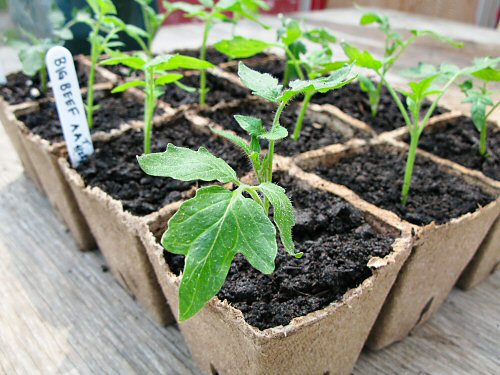
Many things are going on at once, and one of them is potting up seedlings and moving them out to the greenhouse. Already, onions, leek, parsley, lettuce, and the first trays of cauliflower and broccoli are out there, all of them hardy enough to take whatever cold comes along. What’s really going to use up space once they’re potted up are the tender tomatoes, peppers and eggplant. I’d like to’ve had them all done by now, BUT, there’s going to be a cold snap for 4-5 days starting early next week, a couple of nights may go down as low as -8°C (18°F), and I’m concerned that row cover and the kerosene heater may not be enough protection in the unheated greenhouse. So I’m waiting, potting up a few every day and finding room for them under the lights. I started with the Chosen 100, my earliest 100 tomato starts, 25 each of Big Beef (above), Juliet, Striped German and Stupice (in order, two hybrids and two open pollinated heirlooms). They’ve gone into 3″ peat pots, with a mix of peat, compost and soil, and I’m also hardening them off outside. The rest of the toms were started a couple of weeks later. They’ll move from 72- to 38-cell trays, all part of the spend-less-time-on-transplants experiments… Waiting on weather forecasts is a bit of a risky way to work, it’s really not a good idea to delay anything at this point in the year, I’ve found it’s generally better to get on with things and deal with problems as they come up, not try to second guess the future. But I have so much else to do, I’ll take the chance and wait a couple more days to finish them all…
Seedlings everywhere!
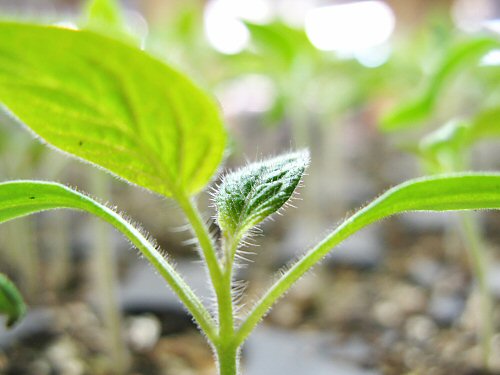
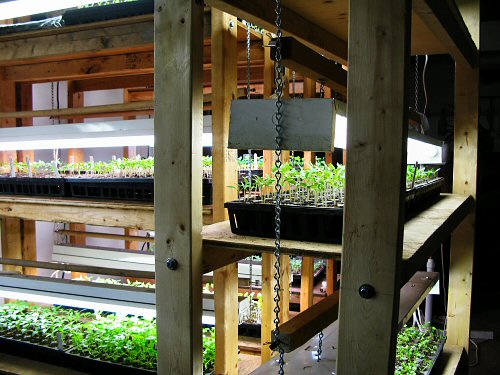
Seedlings are everywhere. The first set of tomatoes is putting on its hairy true leaves: that’s a Striped German in the pic. With Lynn honing her new putting-seeds-in- plug-sheets skills today, the early seedling starts are just about done. From the top (the end of January), that includes lettuce, rosemary, leek, parsley, peppers, eggplant, onion, celery, celeriac, tomato, cauliflower, broccoli, cabbage, collards, tomatillo and Brussels sprouts. Between the Milkhouse and the greenhouse, there are about 40 trays of plug sheets going. Most have 72 cells, and there are a few 128’s and 200’s. The seedling grand total so far is somewhere around 3,000. Actually, that’s the cell total, and many have two or more seedlings per, some to be thinned or divided, or else transplanted together. So, maybe 3,500 seedlings. I’ll start a few more veggies tomorrow, another 500 seedlings on the way, and that’ll be it for now. The most ever, although the number is kinda meaningless, except as a measure of the space they take up, since one tomato will produce for the season, while a cauliflower is off with its head and it’s done… Timing wasn’t great on a bunch of the starts, I waited in some cases 2-3 weeks later than I could’ve, which means transplanting out smaller or…later. This wasn’t meticulously planned, I was just playing off the weather (cold April forecast…that doesn’t seem to be happening anymore) and not wanting to be stuck with lots of overgrown seedlings. And, I’m always trying to reduce overall seedling time by seeing how late I can go… Anyhow, it’s about five weeks to average last frost. In another week, I’ll start the last wave, the CUCURBITS: summer and winter squash, pumpkin, cucumber, melons. They go directly into 3″ pots, usually take 3-4 weeks to get to transplant stage, and absolutely want HEAT, especially, toasty soil, when they hit the field. OUTSIDE, it’s getting warm!!!!
Early spring rounds
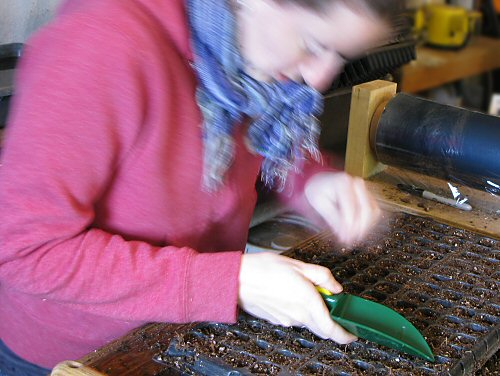
A gray and gloomy, windy day…but WARM. Well, fairly above freezing for the most part, and with a little rain, yesterday’s speeded-up melting continued. But we’re still a ways off from actually doing any work in the field. So, another pretty laid-back day. Lynn came by for her weekly installment of tiny farming. Out in the greenhouse, moving tables around and some hand-watering (those barrels of snow water are coming in handy!). In the Milkhouse, more seed starting: 400 more tomatoes, and a tray of leeks (a little late for this batch, but still better than direct-seeding). For her very first time starting seedlings, Lynn seeded 19 varieties into a 200-cell plug tray (10 each, 20 of one). Clearly, I trust her…accuracy. Working in the tiny cells, changing seed every row, and keeping track of names requires a bit of concentration. A little wandering attention, and who knows what tomatoes would be growing where… Living on the edge! :)
First tomato: 2008
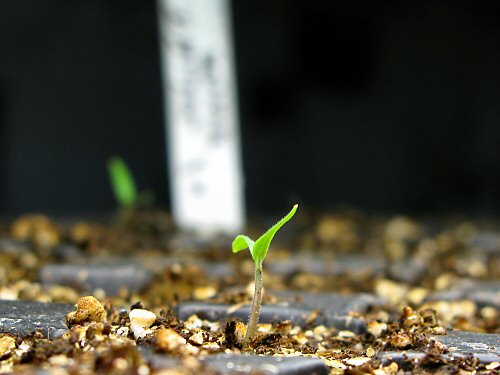
Here’s the very first tomato seedling to emerge and spread its seed leaves: a Striped German (a big, bi-color heirloom, one of my top 3-4 favorites over the last couple of years). This is six days after seeding. I don’t usually keep track THIS closely of the seedling action, but with the unusually slow, uneven emergence of most of the peppers and eggplant—new ones are still just breaking out, two weeks after seeding?I’m watching every little move right now with the toms as well. And there’s that fine MACRO feature on the new camera, always happy to take notes…