
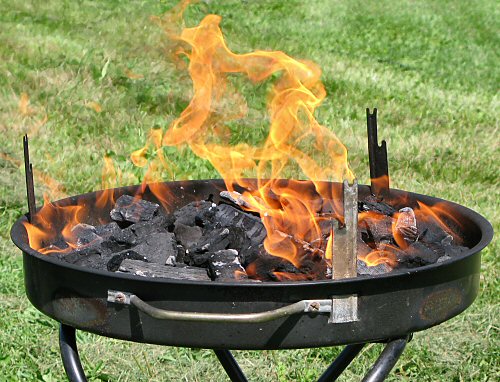
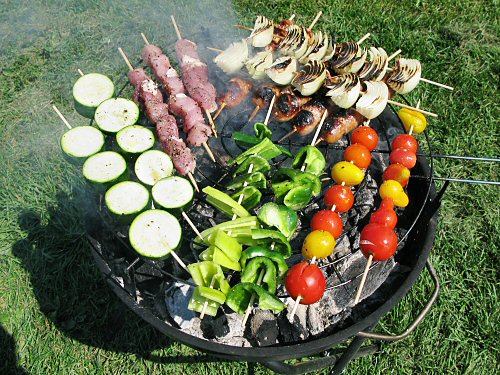
It took a while, but I finally dragged out the classic no-frills barbecue and continued the simpler BBQ approach started last season. This time around, I stumbled onto lump charcoal, which is pure wood carbon, and a step back from additive-rich preformed briquettes (I’m not all that serious about this, I just grabbed a bag and…discovered lump!). And so, on to the basic, quick-lunch-in-the-field experience, with garden veggies plus meat that the local independent butcher declares to be “local” (at least, from around us here in the province of Ontario). Chicken, pork, and several types of pork sausage, plus zucchini, onion, sweet and hot peppers, and cherry tomatoes from the garden. Also tossed rosemary branches right onto the coals for some aromatic smoke—between the breeze and the open grill, it didn’t do much flavoring, but it smelled nice! Cooking time is made easy by putting only one type of meat or veg per skewer—just slide off what you want and combine in your mouth! Simple and…tasty!!
tomato
Poor tomatoes
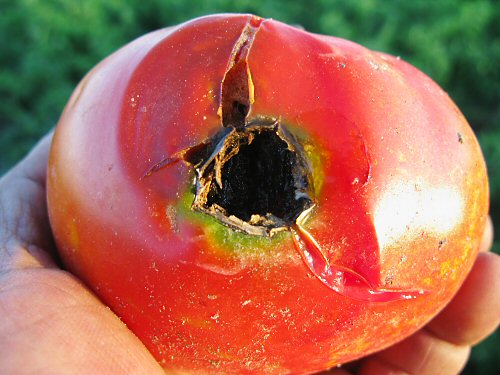
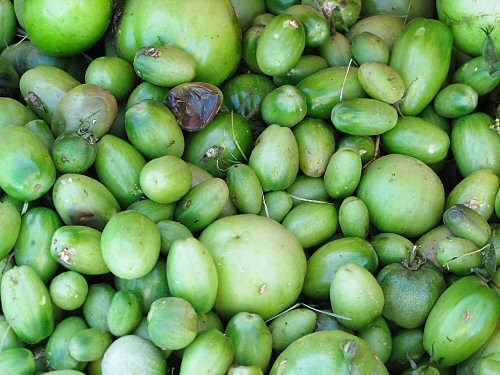
Checking out the tomatoes’ progress is definitely the least happy task of this season. After removing most of the hail-damaged fruit, there’s not that much left, new growth is slow, and what’s there is taking its time to ripen. Also, with the summer’s abundance of water, taste and texture can run to the mushy, and toms are more likely to split. Here, double damage: a hail-nicked spot has grown and rotted, and the tom has split as well. Gruesome! On the upside, the weather has finally changed, with warm, sunny days forecast for weeks to come. It’s about time!
What’s new at the farmers’ market…
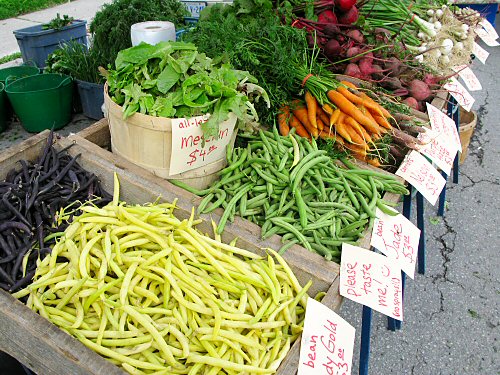
Ahhh, something new on the farmers’ market stand: BEANS in three colors (we had the first green beans last week)! There’s yellow (Indy Gold), purple (Royal Burgundy), and of course, green (Jade). One way I watch the season unfold is through the debut market days for the headliner crops, the big people pleasers. Lettuce is always the first up, a hit partly because it’s the first fresh veg of the season. Then, roughly in order, there’s spinach, peas, carrots, beans, garlic, and tomatoes. Strawberries and corn are also standard hits around here, but we don’t grow berries, and when we do have corn, it’s only for CSA shares. I find it odd that these particular veggies are so generally popular. What about delicate and delicious summer squash, lightly grilled? Versatile and tasty beets, diced and broiled, or grated raw with carrots in salad? Beet greens and Swiss chard, sauteed in butter and olive oil? The list goes on and on… Just about ALL of the 20+ basic garden veggies we grow are equally great to me, but that’s not the case for most people. Curious…
Hail damage reassessed
Three days after the nasty hail storm, and the full extent of the crop damage is more evident. It’s quite a bit worse than it first appeared. The plants will bounce back, but we’ve lost a lot of the fruit that were furthest along. Little nicks in maybe 70% of the toms and eggplant and peppers means that the first harvest of these veggies will be…small. Curiously, but not really suprisingly, I’m quite unfazed by this turn. I can really fret about setbacks that I could have avoided, like deciding not to overnight frost protect with row cover, then getting hit with frost, or not seeding a crop when it’s dry, then getting a week of rain and mucky, unworkable ground. But where it’s purely a Mother Nature play, I’m instantly in half-full mode, seeing the good side of things automatically: well, we’ll have SOME first-round tomatoes…and there are lots of other, undamaged crops… So I’m good. But even from my relatively small (and small-scale) experiences with losses due to weather, I can imagine how nerve-racking large-scale monoculture must be, especially in these crazy weather times, when you have dozens or hundreds or thousands of acres tied up in just one thing. That sounds like really bad stress…and mixed crop tiny farming seems by that measure alone, much…better.
Three minutes of mayhem

What at first seemed like a mild three-minute hail storm this afternoon did an impressive amount of crop damage right across the market garden. One of those sudden, short storms that’ve been popping up more or less several times a day built up, rain started to come down quite heavily, this time with a sharp wind, and after a couple of minutes, HAIL joined the action. I went out to check on the trays of seedlings sitting outside the Milkhouse: you could hardly feel the ice pellets on bare arms and the seedlings didn’t seem bothered by the brief pounding. The pellets were pea-sized, in two configurations: smooth, and jagged (the sample in the pic is from a few minutes after the storm ended, with the sharper edges on the rougher pieces already melted off). The hail soon stopped, a few minutes later the rain ended and…sunshine. Great! Not particularly concerned, I went out to inspect (we’ve had small hail a couple of times with absolutely no plant effect that I could notice). Well, SURPRISE!
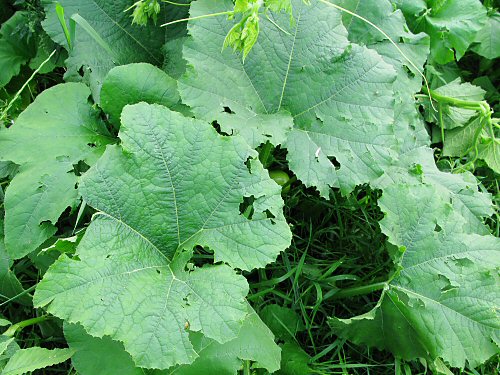
Crops with fairly large leaves, the squash here and more mature beets, had leaf edges sliced and holes punched right through.
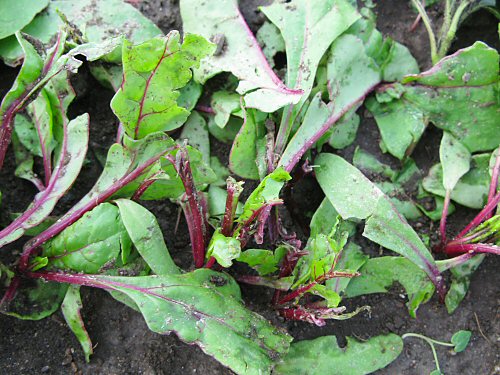
Snapped stems was the most surprising effect. Here, beets were pummeled…
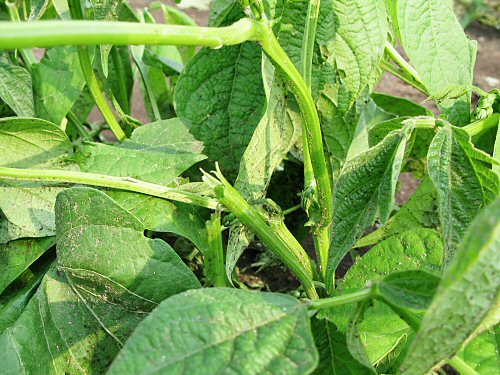
…beans were also quite heavily hit, with severed tops of plants lying in the paths…
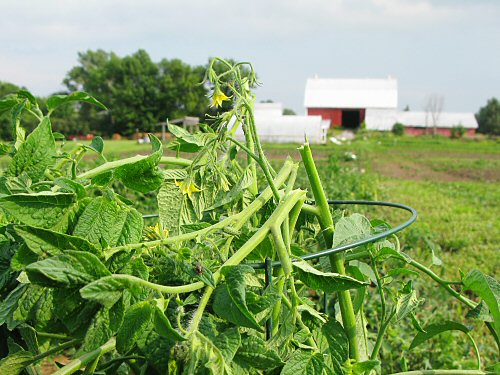
…and tomatoes took a good hit as well. I didn’t closely examine the developing fruit, like tomatoes, peppers and eggplant. It looks like there’s some bruising, but I’ll wait a couple of days when any damage will be easier to spot. Overall, not the end of the world, but a definite setback…not welcome.
View from the stand
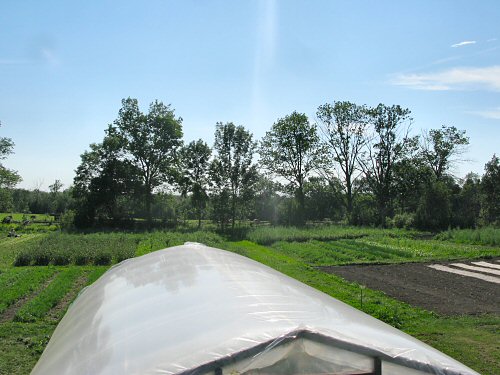
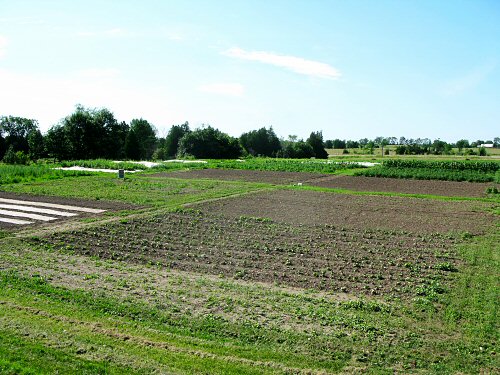
It’s mid-July, and on a (recently rare) sunshiney afternoon, things are looking OK. Better from a distance than up close, because a few sections, like the summer and winter squash, are quite severely in the weeds and in need of intensive hand pulling. And the ground remains almost constantly wet. Our moisture-retaining clay-loam soil, such an advantage in the usual near drought conditions we’ve had over the last three years, is now a bit of a hindrance. Sprawled tomatoes are particularly at risk if they don’t dry out against damp ground, and instead contract early blight (more about that another time!). Still, carpe diem, huh—seize the day! From atop the farm stand, the view is fine! We have the north end (above), with carrots under burlap (third planting), brassicas (newer transplants still under row cover), the cover in the far middle over squash, in front and more to the right, tomatoes, with a windbreak of giant sunflowers at the very right, and sweet potato bottom center. Open sections will include brassica transplants in a couple of weeks, and a fall cover crop. Out of sight to the north are onions…
In the middle, clockwise from the left, there’s a second planting of carrots, fifth mesclun right in the corner (with Maria weeding on the Greens Machine), garlic and parsnips, and potatoes in the distance (with more big WEEDS), the first planting of beets, carrots and green onions, and the edge of the third carrots under burlap from the first photo.
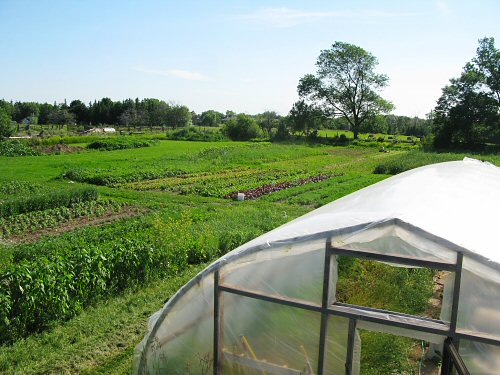
And then, the south end of the field, going left from the peak of the greenhouse, the garlic and Maia in the mesclun, the second planting of carrots and beets (that slash of of red is Bull’s Blood beets), the fourth mesclun , a weedy area with nasturtiums and tomatillos, and to the bottom left, herbs and flowers (fairly towering Jerusalem artichoke at the bottom left). (Guest photos by Lynn)
Scaling up the grass mulch
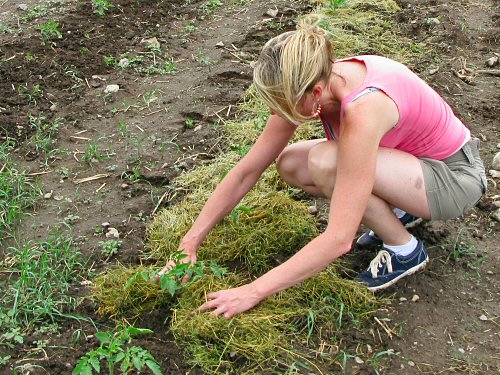
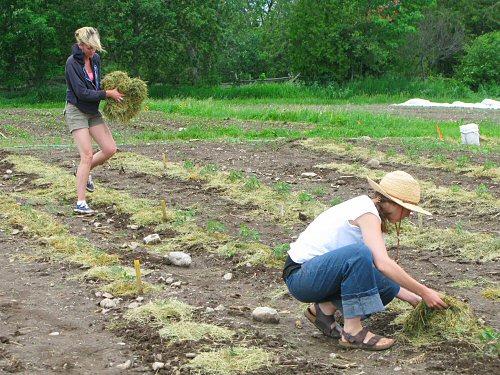
Not the nicest weather today, but good for gardening: not too hot (finally) and not too wet. The grass mulch experiment continues. With all of the recent rain, there’s been good growth, and I’ve cut and gathered quite a bit. Still, the volume of grass mulch available earlier in the season is still unknown, and it takes a lot to cover just one section. Here, Raechelle and Melissa (first time in the field) mulch tomatoes…
