
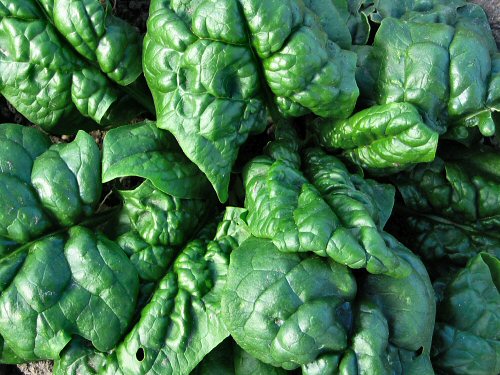
Fall spinach is finally ready to pick! The first five beds are pretty sparse—really poor germination in the dry heat of August—but what’s there is looking…succulent. The scattered new plantings of spinach, radish, mesclun and spicy brassica greens make parts of the field look like a whole new season…
Year: 2007
Trying fall rye
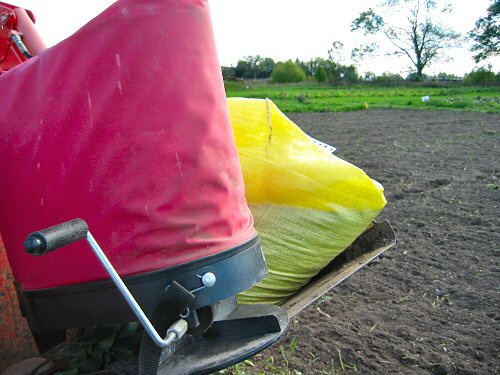
With the oats experiment going good all around the field, it’s time for experimental green manure-cover crop #2, fall rye (starts and grows well in cool weather). Reading about cover crops online, I found one apparently popular method for seeding ’em is…”airplane”. I use the more down-to-earth Earthway broadcast seeder, which works like one of those hand-held lawn seeders, except there’s a big zippered bag and shoulder strap instead of the handgrip and little funnel. You fill up the bag, sling it over your shoulder, and then, in one smooth movement—limbs, synchronize!—turn the crank with your right hand, slide open the seed hole (with a little spring-loaded lever) with your left, and start walking (I go forward). The seed streams out of the aperture at the bottom of the bag, onto a rotating plate with dividers that flings the seed a little over 180° in front of you. The combination of seed hole size (determined by how far back you pull the lever), and the cranking and walking speeds determine the coverage. Seed is spread maybe 5′-7′ (1.5-2.1m) on either side. Open the seed hole aperture too much and you’ll drain the bag in no time at all—heavy coverage. It’s not at all difficult, you can be broadcasting seed in minutes, but still, a little bit of a trick!
Screen table
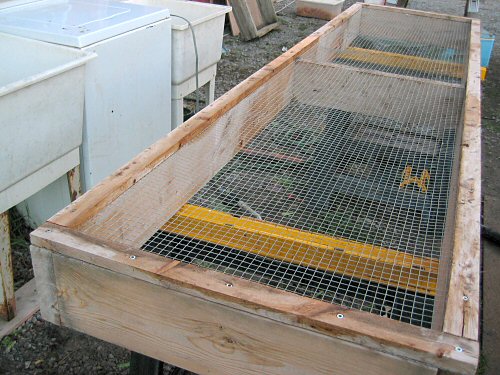
The new screen table was this year’s big addition to the washing up section of our little post-harvest processing area. Building it earlier this year was quick work: some 2×6 and 1×2 lumber, screwed together, with 1/2″ hardware cloth sandwiched in as tight as I could get it. Hardware cloth is the mesh of choice because it’s welded where the wires cross, so leaves and the like don’t get snagged the way they would in plain woven screen, like chicken wire. Positioned on sawhorses close to the washing machine and tubs makes it easy to pluck crops out of the water and onto the rack to drain. Simple, inexpensive, and one of my favorite bits of harvest gear… The last couple of harvest Fridays have been more work for fewer people, as part of the summer crew left at the beginning of September. With the days getting shorter as well, it’s the first time this year we’ve been finishing up the sorting and packing after dark! This week: mesclun, beet, carrot, spinach, radish, kale, tomato, potato, a few cauliflower and broccoli, squash, hot and sweet peppers, and onions and garlic from storage…
Row cover decision
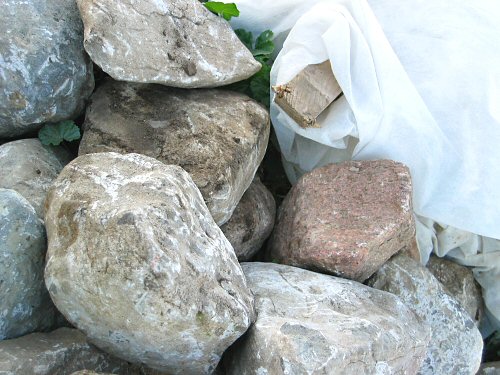
After a chilly and only reasonably busy day at the farmers’ market, it was a bit of afternoon nap time, and then on to making the first frost decision—to cover or not to cover—of the fall season. I “consult” four different online weather services, in general trust none to be very accurate, but when it comes to more dire predictions, like super high and low temperatures and mighty gusting winds, a certain one out the four usually stands apart and is…quite accurate. True to the norm, today three services forecast overnight lows of around 5-7°C (40-44°F), while the dire one calls for plus 1°C with “risk of frost”. So, a couple of hours before sunset, we started assembling floating row cover kits near tender crop sections. The cover, 14′ wide and cut to 50′, is kept loosely rolled on 4′ lengths of 2×2. Heavy rocks, 10lbs and up, are gathered and kept track of over the season. And that’s all you need: row cover and rocks! Unlike for insect protection, where edges of the cover should be buried, or at least, anchored firmly every few feet, frost protection only needs draping over top, and tacking down at the corners and a couple of additional spots. Anyhow, in the end, I considered the breeze, the slight cloud cover, and my…um, instinct (?!), and decided not to cover…
Weed gone to seed
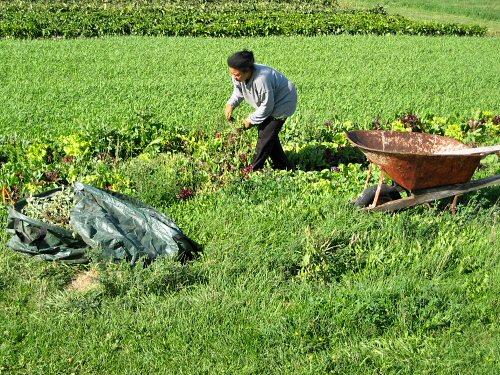
With more people in the field this year, end-of-season clean-up is already well underway. Here, Midori, visiting after moving to France a couple of years back, removes weeds that’ve gone to seed from three older beds of mesclun that’re waiting to be tilled in.
Ideally, finished beds would be promptly mowed down, spread with compost, tilled, and then seeded with a new veggie or cover crop a week or two later. Things aren’t usually that efficient, finished beds sometimes sit for weeks, weeds pop up in the interim, and if they go to seed, have to be removed before tilling so as not to add more seed to what’s already there…
Lying around: the green plastic garden totes are quite useful once the handles have been properly reinforced with rivets; the old builder’s wheelbarrow comes in handy for rocks, fallen tomatoes and the like.
The grass in front, in need of mowing, is part of a wide path on one side of the greenhouse, the grass beyond is the magnificent oats green manure cover crop.
Oh, no frost last night, as you can see from the happy peppers at the top of the pic!
Goats…
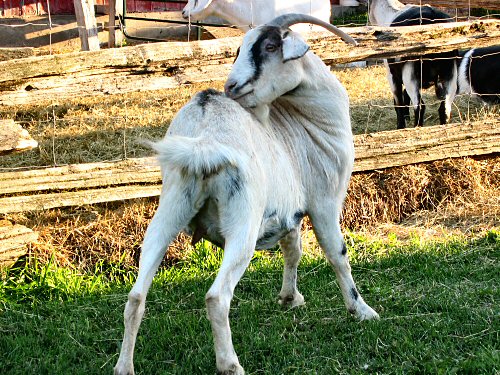
One side of the barnyard leads to the market garden field. At the other end is a somewhat rundown goat barn full of…goats. These gals have nothing to do with the organics and the market garden, they’re just kinda pets, around 30 of them now, kept by Bob and Karen. In earlier years, I spent a fair bit of time checking them out. More recently, it’s too busy on this side to pay ’em much attention. But they’re there, a mixed breed lot, endlessly eating, wandering around, basking in the sun, sometimes pounding on one or another unlucky member of the herd for a day or two until the hierarchy is back in balance. Mostly, theirs seems like the laid-back good life…until a few get sold off for MEAT. For me, they’re an everyday reminder of how cool it’ll be when we finally get around to incorporating some livestock into the big garden plan. First, chickens?
Garlic for sale…?
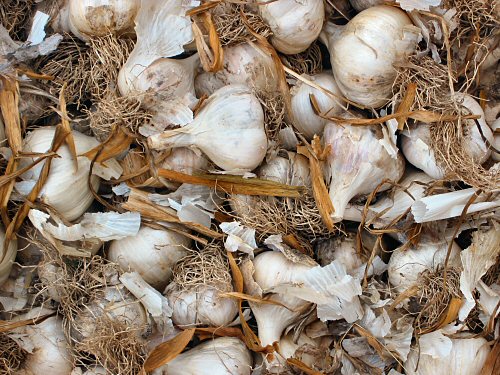
It’s never too early to make sure you have enough garlic to seed next year’s crop. Local garlic is kind of a cult item, people who want it get quite intense about stocking up, whether for winter or to finally take a shot at growing their own. And it’s somehow hard to resist selling your every last bulb… It’s not a money thing, because it costs me just about exactly what I make to buy back the same quantity, it’s that people seem so happy to have gotten some.
I’ve chatted with independent garlic growers small and large, and overselling your stock seems to be quite common. As a bonus to saving rather than buying every season, selecting the best bulbs as seed garlic from your own harvest may eventually result in an improved strain for your particular plot (the way garlic reproduces via vegetative cloning, I’m not sure what genetic science says about this as an improvement strategy, but it certainly can’t hurt!).
Every year, I go through this same bit of reasoning…and can’t resist loading up another bushel for market… This year, I had the urge to check my garlic suppliers earlier than ever before (at some point every year, they run out), and a couple of quick calls today gave me added incentive. Apparently, seed garlic is selling out fast, possibly because of an apparently growing public aversion to garlic from China (that’s where much of the cheap supermarket garlic comes from). Last year, I was able to get garlic in November. Now, my big wholesaler of certified organic Music thinks he might be sold out by next week! Time to start selecting…