Cutting spinach

Spinach cutting close-up

Spinach has kinda been the star of the harvest for the last couple of weeks. After a “normal” summer—hot and dry for the last three years—it’s usually not around at this time of year due to poor germination. This season, with cloudy, cooler days and all the rain, spinach is in abundance: glossy, deep green, succulent, full of flavor. Libby and Lynn chop away, cutting an inch or two up the stems. This technique takes out the small new growth leaves, but it’s fast and efficient, and the plants still grow back for a second harvest. The alternate picking-single-leaves approach is more laid back, great for leisurely field chats—this harvest, we opted for quick…

Nothing like teamwork: head down, knife in hand, side by side…

My, what a nice, wide path!

After the row cover: weeding!

Weeding after row cover

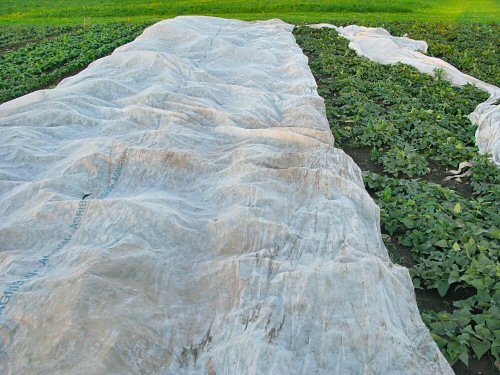
It’s been about six weeks, time to permanently remove the row cover from the last transplanting of fall brassicas! There are two sections, about 20 x 50′ beds in all, with broccoli, caulflower, cabbage, collards, kale. The cover protected against flea beetles, and at this point in the season, the FBs aren’t around much. Which leaves the post-cover weeding! I generally plan to remove the cover earlier, weed, and then replace it quickly, but this seldom seems to happen. Instead, it’s one big weed-a-thon at the end… Here, the mainly pigweed looks fairly big and dense, but it’s actually not much of a problem. The row cover has protected the ground from many days soil-packing rain, so the beds are nice and loose (it’s amazing how much rain can compact clayey soil).  Weeds come out easy! With two people, it’s a relatively quick job, 2-3 hours for a pretty thorough clean-up. We worked with a combination of hoe and wheel hoe, me doing the paths and between-row clearing, and Lynn hand hoeing in-row, between the plants spaced at 18″ (45cm)…

Each time I use the wheel hoe, I grow to love it that much more. So easy, so TIME-SAVING! It’s such a sophisticated yet simple tool, a perfect marriage of wheel, leverage and steel (you could say! :)… Today’s job is heavier work than it’s usually used for, the weeds aren’t just emerging, they’re pretty big. Rather than rolling the wheel hoe continuously down the rows, I’m cutting the weeds with a series of forward and backward strokes that either slice the plants below the surface, or pull them out, roots and all…

Clearing a path (before and after, above) in the loose soil takes maybe 3 minutes for 50′, many times faster than hoeing or hand pulling…

For this heavier weeding work, I use a fairly forceful forward stroke that travels about 1-1.5′ (30-45cm), then raise the blade to clear the felled weeds as I step forward to start the next bit…

The wheel hoe is equally good at cutting on a backstroke, which comes in handy for dense areas and tough specimens… It’s not particularly strenuous work: the blade is sharp, the wheel and angle of the handles give lots of leverage and momentum, and some part of the hoe is always in contact with the ground, so you’re never completely lifting the whole tool. Like most things I do here in the field, I’ve figured out how to use the wheel hoe on my own, by reading instructions, looking at pictures and applying my version of common sense. Techniques no doubt vary. It’ll be interesting to eventually see how others do things! Meanwhile, everything seems to work out…especially, the wheel hoe! (Wheel hoe action photos by Lynn)

More post-harvest action

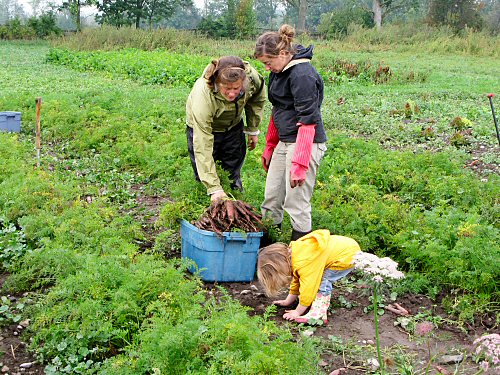
If it’s Friday, it must be time to harvest! After a beautiful weather week with barely a cloud in sight, an otherwise welcome gentle rain today meant a bit of a muddy harvest. Here, the picking and pulling has all been done, and we’re about halfway through the sorting and rinsing. Ramrod green onions are all bundled and ready for a quick rinse. Nelson carrots are underway. And, a couple of several bins of tomatoes, with Juliet saladette in one, and a mix of smaller heirlooms in the other. With toms, we only fill the bins 2-3 layers deep to avoid squashing and splitting, especially with big heirlooms. (I suppose getting cardboard tomato flats, one tomato deep, would be more space-efficient, ’cause the pick-up truck that we use does get full around this time of year, but so far, we’ve managed without.) Everything’s looking and tasting good!

Good beans…

Just a few sunny days and the new planting of snap beans have sized up perfectly for the Friday harvest. They’re the crop of the week, a shade on the young side, maybe 2-3 days from being fully filled out, super-long and slender, with firm, thin pods (compared to the sturdier skins of the slower-growing first set), and only a hint of the actual bean inside. Cool! Because everything is fresh-picked on Fridays, regardless of when the “perfect” picking day may’ve been, it’s interesting to see what the luck of the draw brings to certain crops. These beans are an example. By being a little early, I lose a bit of yield, maybe 10-15%, but the beans are at that elusive, slightly young stage. Mesclun may reach that perfect first cut, when the leaves are still mild-tasting and almost melt-in-your-mouth, on, say, a Monday or Tuesday, and, especially if there’s sunny weather, grow past it by the Friday—still excellent, but a little firmer and stronger-tasting. Same for some of the fastest growing summer squash, like the zucchinis, which can practically double in size in 4-5 days. I’ve found the picking window for tasty veggies is usually quite forgiving for even the fastest growers, at least a week in summer and longer in the fall. As always, it’s mainly about the weather: how much heat, sun, and moisture they get. Since I’m not harvesting or sorting for uniformity—I don’t NEED carrots of a certain length and diameter and so forth—there are no worries on this front, and it’s fun to see and eat the variations of each crop and planting at each harvest all through the season….

Last of the lettuce

Can’t quite seem to stop planting! Lynn and Libby put in a last 200 or so lettuce seedlings to see how far they’ll go in fall growth. The soil is still moist an inch (2.5cm) or so down, but the surface is way DRY from a few days of sun and breeze, so we watered in these guys—the weather’s been great, sunny and warm this week…and it’s back to the hoses!

Poor tomatoes

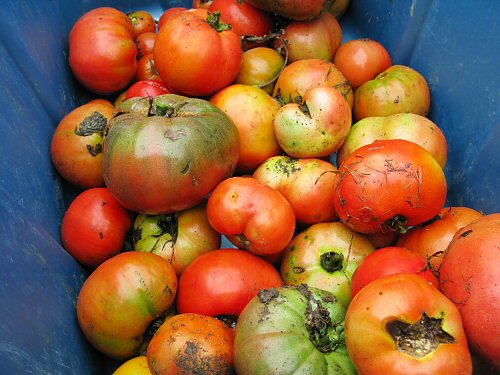
Checking out the tomatoes’ progress is definitely the least happy task of this season. After removing most of the hail-damaged fruit, there’s not that much left, new growth is slow, and what’s there is taking its time to ripen. Also, with the summer’s abundance of water, taste and texture can run to the mushy, and toms are more likely to split. Here, double damage: a hail-nicked spot has grown and rotted, and the tom has split as well. Gruesome! On the upside, the weather has finally changed, with warm, sunny days forecast for weeks to come. It’s about time!

Post-harvest aftermath

Sorting and packing after harvest—post-harvest processing!—is in good part a wet job, made a lot messier in rainy weather when root crops come in with a load of mud attached. Once again this season, the main work surface for sorting is a 4’x8′ sheet of plywood set on sawhorses. Actually, we added a second table, so now there are…two. Here, we’ve just finished sorting and bundling carrots, which then went for a rinse on the screen table. Sometimes, rinsing is done first, depending mostly on who’s doing what and what else is going on. In the closed blue bins, which hold a little over a bushel each, are carrots already bundled, rinsed and ready to go. This week, there are four bins of carrots, around 160 lbs (73kg). The residue is sorted out: here, damaged carrots will probably be topped and kept for house use, and the greens (there are some beet greens as well at the end of the table) are fed to the goats, some to the chickens, and the rest onto the compost pile. Then the table is hosed off. Couldn’t be simpler or wetter!