
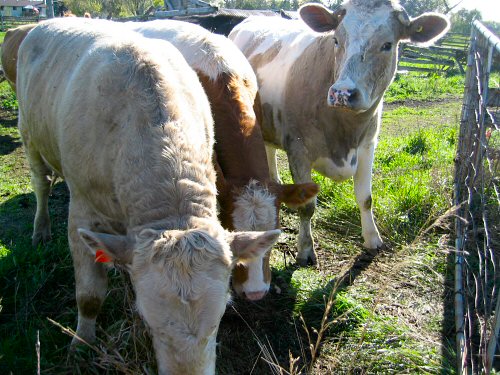
Rampaging cattle! Well, more like, a few cows wandering into the field. This happened once before, three years back, and that time, the potential for disaster was a little greater. Unthinkably, TWO critical gates had been left open overnight, and around a dozen cows headed in at dawn. It was also around June, with a whole market garden full of new crops, there to be ravaged. Just by chance, the intruders were spotted early, and it took three sleepy people, lots of running, and a pick-up truck, to head ’em out (it’s a 9 acre field). Luckily, the cows were most interested in the hay, on the way there trailing giant hoof prints down just about every bed in the garden, leaving the veggies otherwise untouched. So it turned out fine. This time, with most of the cattle gone from the farm, the remaining little posse of five cows and a bull, all friendly and laid back, made their way up an 11 acre pasture and slipped through the garden field gate in the four or five minutes when my eye wasn’t out there. I’d been using the Kubota compact tractor to move manure from the barnyard, about a dozen trips, with a few minutes of blind time each trip as I spread on the new garlic bed. Crafty, stealthy guys… There was a moment of sharp…concern as I eyed the wide open double gate across the field, leading to the side road and on to unfenced houses on the subdivision, and the wide open two-lane highway not far down. But the cows were absolutely fixated on the first lush patch of oats they encountered. With the other gates closed, herding them out went surprisingly smoothly. The whole adventure: 20 minutes! An interesting break…
Fieldwork
Making mulch, part 3
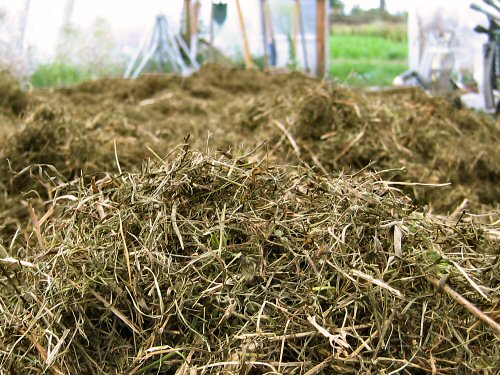
The grass and alfalfa mix spread in the greenhouse a few days ago is drying nicely—it’s almost done! It was a tad touch and go at first, the rows in the field were starting to turn black and decompose, and no sun in sight. So I turned it a couple of times a day for the first couple of days, doors wide open on both ends let through lots of air…and things worked out! Seems like a nice mix, with good bulk, not too fine. Then again, my mulch experience is in its early days, so we’ll see. Rough calculation: there should be enough to spread a fluffy 3″ (7.5 cm) over the new garlic plot. This experiment so far: not too labor-intensive, room for easy improvement to the process, seems like it would scale well (for covering larger areas), and RELAXING (some fieldwork is particularly enjoyable)… Grass-and-alfalfa mulch may have a big tiny farm future!
Frost protection
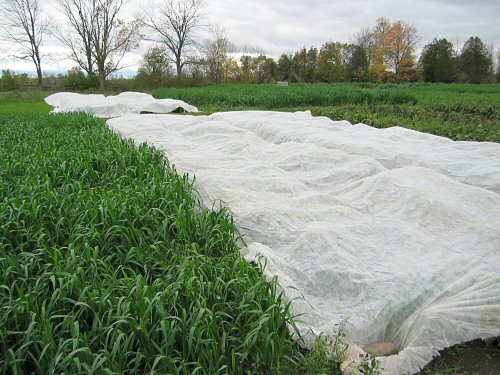
With last night’s forecast calling for -3°C, I finally figured a little floating row cover frost protection might be a good idea. In fact, though, with the cloudy, windy, wet conditions right through to Saturday evening, a solid freeze didn’t seem all that likely. And that turned out to be the case. The min/max thermometer outside the greenhouse registered a low of -5°C, but only a few crops suffered minor damage. Even the basil, which is really tender, did well: the top layer of leaves took one for the team, but the rest were fine. Here, some sweet pepper plants sit under cover, but the forecast for the next week is…quite warm. When exactly does the season end?
Making mulch, part 2
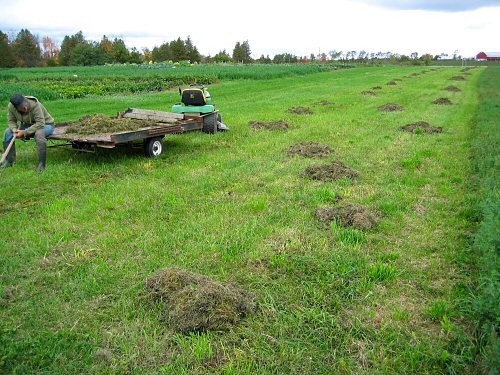
Working just ahead of more rain, Conall (fighting a cold that’s knocking people out around here—farmers can’t get sick!) and I raked the mini-windrows of grass and alfalfa into little mounds, piled it on the trailer, and dumped it in the greenhouse to finish drying. In the week since it was mowed, there was enough rain here and there to keep it damp, which wasn’t in the plan. Oh, well. A grass catcher for the riding mower would be the time-saving mechanical approach. This was a lot more fun, quite relaxing, a couple of hours well spent. Now, let’s hope it’ll dry, not rot!
Making mulch
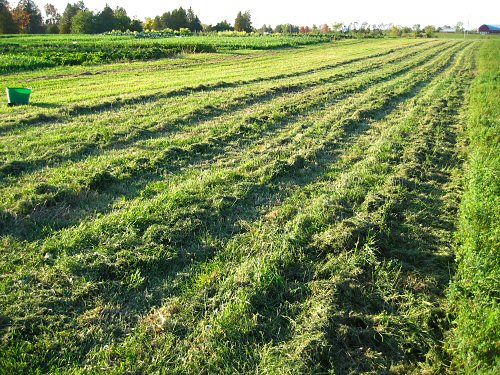
Yet another experiment: making mulch from some of the hay that grows alongside the garden. The hay, originally alfalfa and red clover, is dying out, and what’s left is mainly grass and alfalfa, currently around 10″ (25cm) high. I cut it with the riding mower, which instead of scattering the clippings, leaves a convenient tiny windrow. A couple of days drying in this year’s hot October sun, and it should be good to go. I tried thoroughly dried grass clippings as mulch a couple of years ago on a few tomato plants, and it worked out well, so on to a larger scale. This crop will be used on the garlic, to be planted in a month or so. The mower is sadly in need of new blades, so the cut is rough, but it should work out fine.
Rainy day harvest fashion
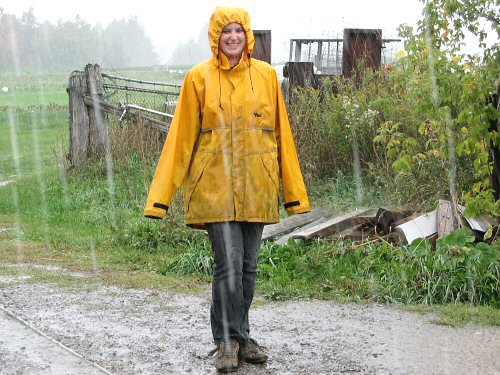
Jo sports a borrowed rain jacket with snap-on drawstring hood, in striking work yellow—perfect protection for a rainy harvest day. Today was probably the wettest harvest Friday of the year, and it wasn’t bad. A couple of heavy downpours kept us indoors for quite a while (snapping farm fashion shots out of the Milkhouse door…), otherwise, a light drizzle for part of the afternoon hardly slowed us down. For the occasional wet work, Conall favors a full rainsuit, jacket and pants, while I so far make do with a hooded rain jacket—I’ll pop inside and wait out the heavier stuff. Lynn arrived after the major downpours. Today’s four-person crew made good time despite the weather. For the record: mesclun, spicy salad greens (arugula, mizuna, tatsoi, red mustard), collards, kale, spinach, radish, carrots, beets, green onion, summer squash, bok choi, tomato and potato (harvested yesterday), and garlic and onions from storage!!
Pumpkins come in
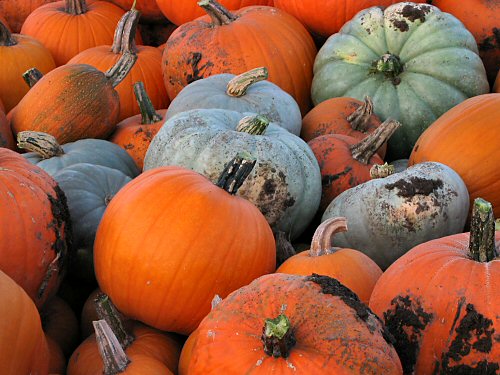
A leisurely late afternoon harvest yielded one trailer and one tiny tractor bucket piled with pumpkins. I didn’t count—there’s more to come—but I’d guess around 70. Pumpkins don’t have a big market value here just yet, but they’re fun to have around and they generally come through with little care. These guys received absolutely no irrigation and suffered somewhat for it, but they managed! The varieties: Connecticut Field and Neon for the bigger orange ones, Snackjack and Small Sugar for compact (3-5 lb), CSA share-ready selections, and Jamboree for that bit of difference (they’re the greenish-grayish ones). We’ll clean ’em up and lay them out on the nicely roofed farm stand to give the stand a bit of a purpose for fall!