
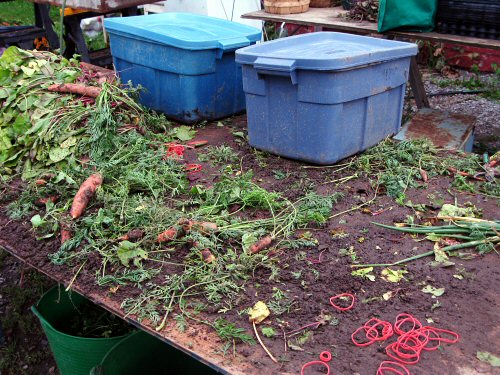
Sorting and packing after harvest—post-harvest processing!—is in good part a wet job, made a lot messier in rainy weather when root crops come in with a load of mud attached. Once again this season, the main work surface for sorting is a 4’x8′ sheet of plywood set on sawhorses. Actually, we added a second table, so now there are…two. Here, we’ve just finished sorting and bundling carrots, which then went for a rinse on the screen table. Sometimes, rinsing is done first, depending mostly on who’s doing what and what else is going on. In the closed blue bins, which hold a little over a bushel each, are carrots already bundled, rinsed and ready to go. This week, there are four bins of carrots, around 160 lbs (73kg). The residue is sorted out: here, damaged carrots will probably be topped and kept for house use, and the greens (there are some beet greens as well at the end of the table) are fed to the goats, some to the chickens, and the rest onto the compost pile. Then the table is hosed off. Couldn’t be simpler or wetter!
Veggies
Burlap expires
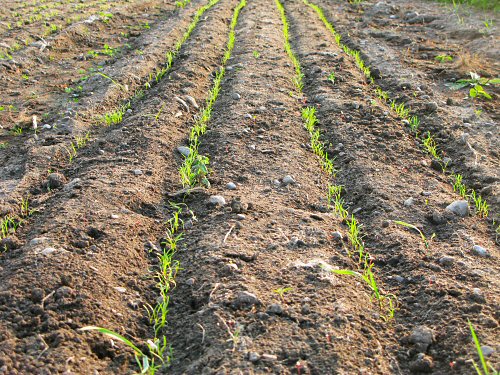
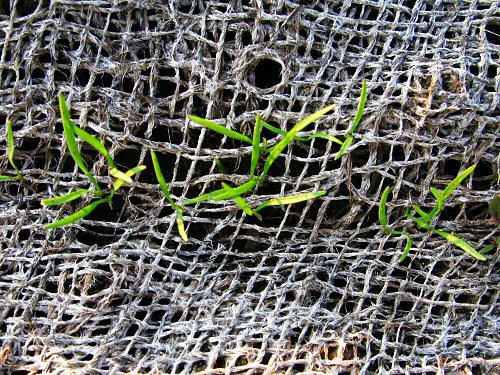
After a nice long ride, the burlap (of the burlap carrot germination method) is finally breaking down, shredding as we fold it up off the final carrot beds of the season.
Even in this wet weather, the burlap makes a big difference, probably because it holds the soil heat—the difference is clear at the ends of the beds, where the seed drills extend past the burlap, and germination has barely started.
I haven’t been keeping accurate count, but this batch has done at least eight seedings over the last two years. At about $30 a bed for a double layer of burlap (100’/30m) over a 50′ (15 m) x 4 row bed, that makes it less than $4 per 200′ (60m) of carrots, more than worthwhile. If we’d taken better care of it during this wet weather, mainly by making sure it dried out quickly, it may’ve even lasted for a seeding or two more.
Like floating row cover, burlap is an outside input that I don’t like to rely on, but for now…it works!
Harvesting around the rain
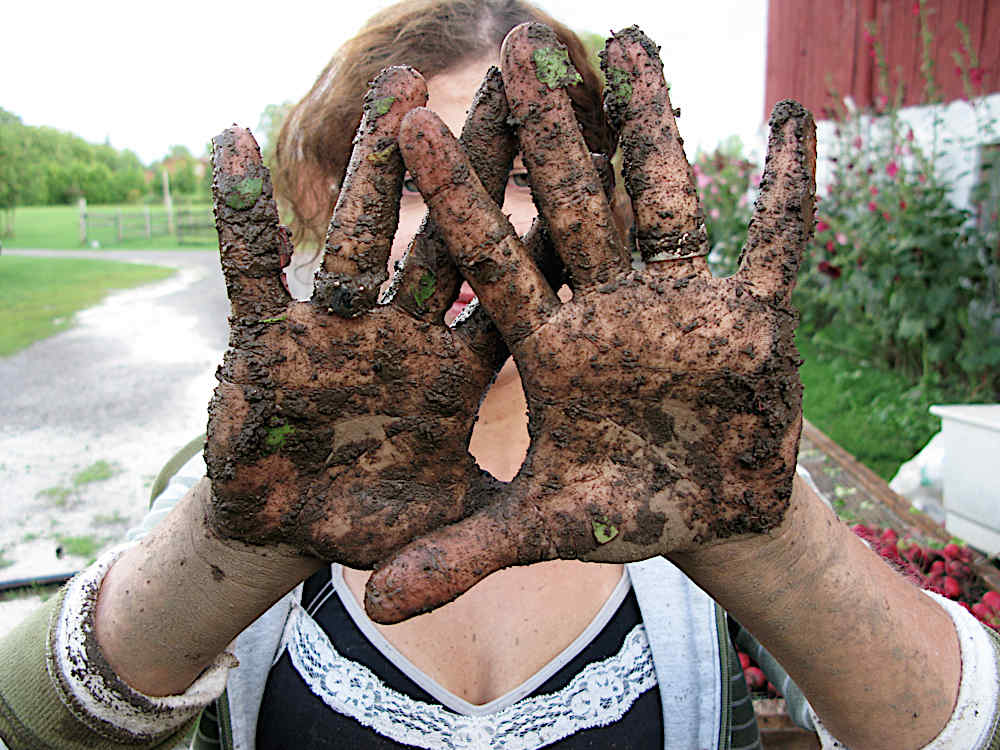
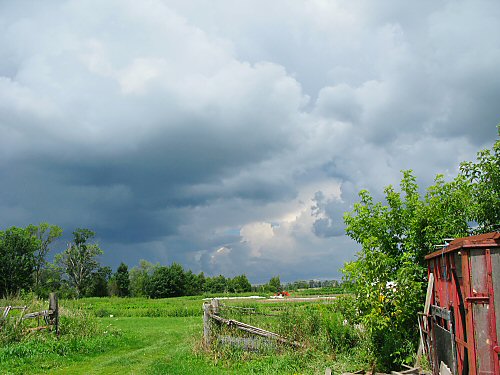
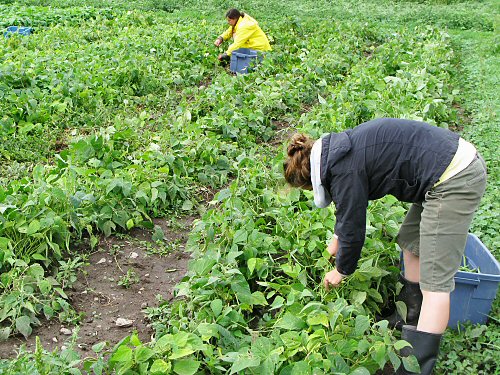
Have I mentioned that it’s been RAINING a lot all summer, like, a few times a day? We’ve taken to planning the Friday harvest to fit the slots between downpours, using…weather radar on the web! It works pretty well, checking the national and local maps, you can see precipitation quite accurately up to 3-4 hours out (it’s a little…high tech, but so is this crazy weather!). To avoid a late morning downpour, we started picking beans—finally, our first snap bean harvest of the year!—first thing in the morning (Maria, Lynn and that’s my bin at the top left of the pic below), so that we wouldn’t be messing with wet bean plants (they really don’t like being touched when wet, they get…diseased). That was pretty satisfying, picking about five bushels before the first shower, which arrived as foreseen. And so it went for the day. You can work between the daily rains, but mud avoidance is not an option—Michelle illustrates!
The View in early August
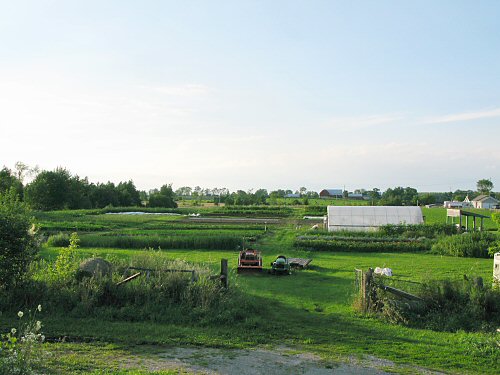
Here’s the long view for early August, notably GREENER than it was around the same time last year. I like the scene from up here, at the top of the gangway going into the upper level of the barn: distant, peaceful strips of green, row upon row… ;)
Buckets of rainbows
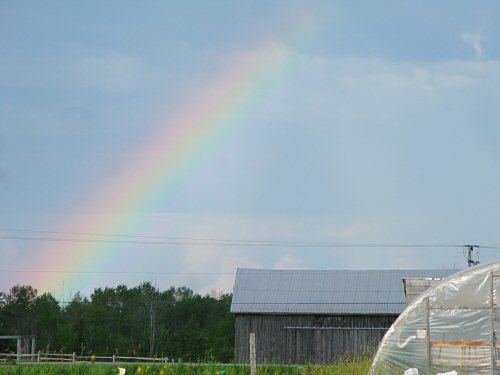
First title that came to mind for this post was: “Yet another rainbow…” That sounded a little…downbeat. After all, rainbows are one of Nature’s delightful wonders, a free, magical expression of light and simple beauty. If memory serves, we usually get one or two spectacular rainbows every year, maybe a couple more that get noticed. With this year’s rain upon rain, they’re kinda everywhere! Still…pretty! :)
Farmers’ market cruises along…
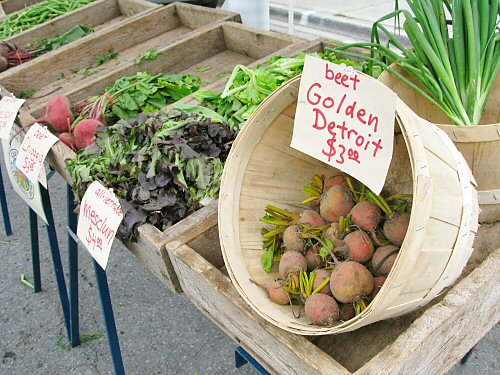
It’s 11 am and most of our harvest is sold. This is good, because the quantities of what we’ve been bringing have been fine. Still, with no early tomatoes, late green beans, not much summer squash, a wiped out first planting of cucumbers, and hail-killed first round of much of the peppers and eggplant, the pickings feel a little slim. It’s funny how variety seems to work at the market (and probably in the CSA shares as well): the greater the selection, the happier people seem to be, even though they don’t really buy more, or still buy mostly the same things. Maybe it’s because, as consumers (here in North America, at least), we’re so accustomed to being wooed by apparent choice, a regular parade of the “new” and the “improved” and cleverly repackaged, that having the same staple crops for a couple of weeks in a row makes the stand seem a bit stale. It’ll be…amusing to see outlooks change if (when) fresh food starts to get scarce. Well, all in all, a good day at the farmers’ market!