
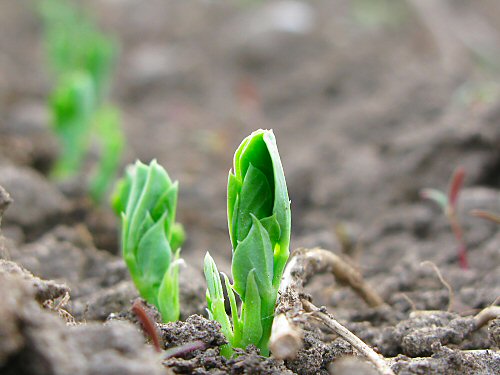
The first peas suddenly popped. A bit of welcome action in the field, amidst all the dryness and slow germination. These are Sugar Ann snap peas, edible pod. There’s 1000′, double rows, 3-4″ row spacing. They’re coming up well in stretches, but a lot haven’t yet appeared. Well, there should be some real rain tonight! On the right of the pic, a fine example of PIGWEED doing its stuff as well, keeping pace with the gardening effort all on its own. (Yes, lying on your stomach in the dirt is the easiest way to get the macro centered on these little guys!)
Veggies
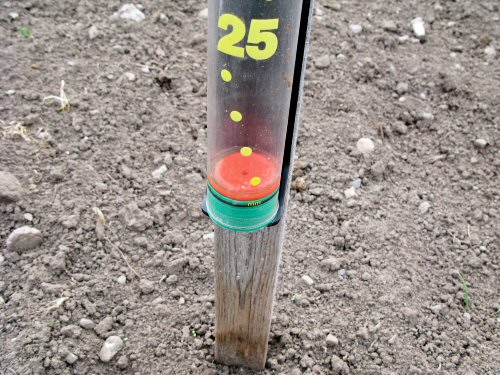
Potting up
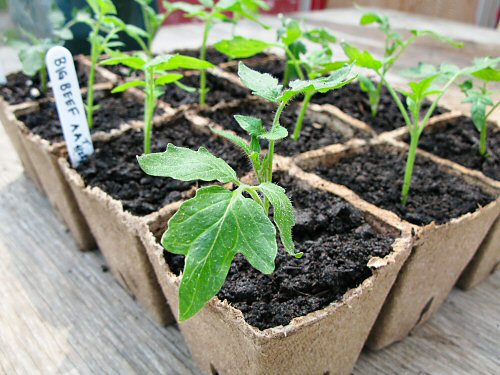
Many things are going on at once, and one of them is potting up seedlings and moving them out to the greenhouse. Already, onions, leek, parsley, lettuce, and the first trays of cauliflower and broccoli are out there, all of them hardy enough to take whatever cold comes along. What’s really going to use up space once they’re potted up are the tender tomatoes, peppers and eggplant. I’d like to’ve had them all done by now, BUT, there’s going to be a cold snap for 4-5 days starting early next week, a couple of nights may go down as low as -8°C (18°F), and I’m concerned that row cover and the kerosene heater may not be enough protection in the unheated greenhouse. So I’m waiting, potting up a few every day and finding room for them under the lights. I started with the Chosen 100, my earliest 100 tomato starts, 25 each of Big Beef (above), Juliet, Striped German and Stupice (in order, two hybrids and two open pollinated heirlooms). They’ve gone into 3″ peat pots, with a mix of peat, compost and soil, and I’m also hardening them off outside. The rest of the toms were started a couple of weeks later. They’ll move from 72- to 38-cell trays, all part of the spend-less-time-on-transplants experiments… Waiting on weather forecasts is a bit of a risky way to work, it’s really not a good idea to delay anything at this point in the year, I’ve found it’s generally better to get on with things and deal with problems as they come up, not try to second guess the future. But I have so much else to do, I’ll take the chance and wait a couple more days to finish them all…
Garlic the Reliable
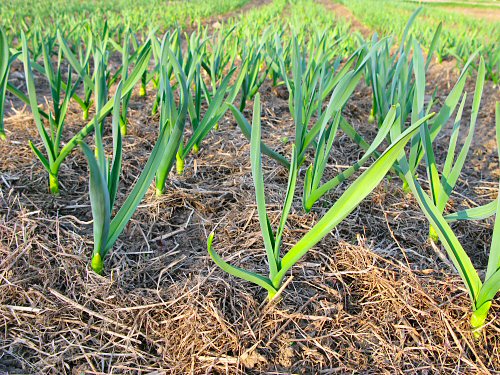
The garlic is looking great, here in unusual shades of green thanks to a bright yellow sunset. They’re doing pretty much the same as this time last year, and the year before. I read somewhere that garlic reproduction from cloves is cloning, so the garlic we’re eating now is genetically identical to the original varieties from thousands of years ago. Dunno, sounds cool and kinda reassuring, even our weird weather doesn’t seem to affect these guys. Gazing over the garlic patch on a warm evening after a satisfying day in the field, it’s almost enough to make me believe that all’s right with the world, and Blue Fox Farm‘s motto, “Farming like there’s a tomorrow” (it’s been running through my head all spring), is just amusingly paranoid wordplay. Maybe… And then I think about filling up the tiny tractor (diesel just hit $1.25 a liter, that’s $4.70 a US gallon, good thing I don’t use much…), and the bizarre weather (from mid-summer conditions in mid-spring, we’re plunging back to way subzero nights in a couple of days), and, well…it’s good to be working in the garden, and the garlic looks great! :)
Grass fire across the road
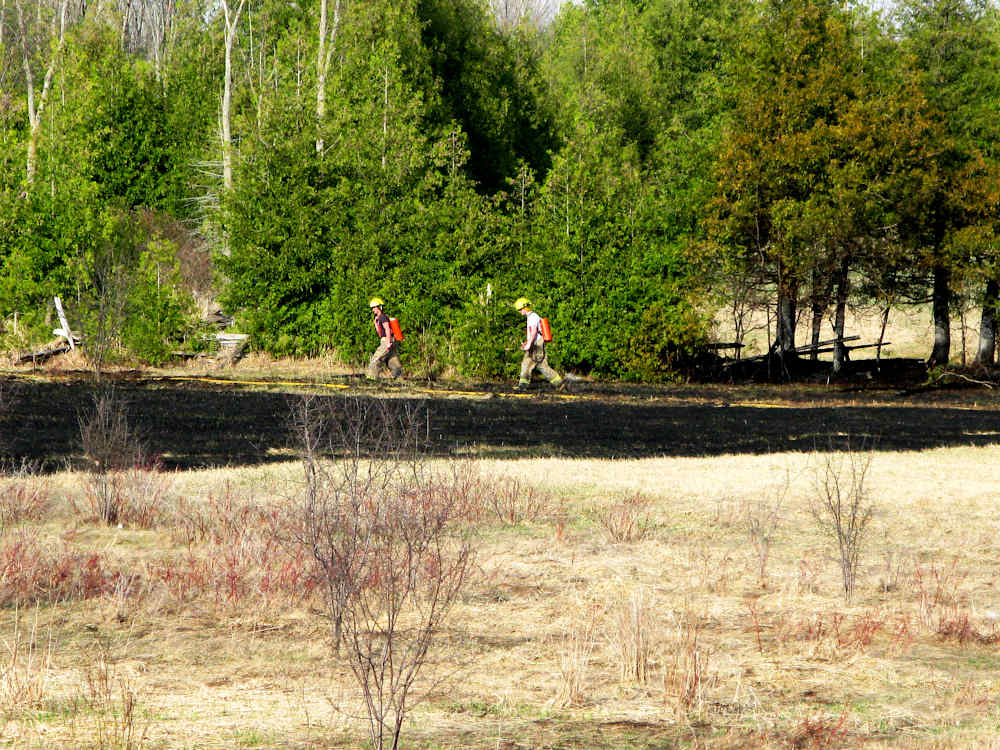
Someone in the village burning junk in their backyard set off a grass fire that spread across a field and threatened to burn down the barn and house across the road. I missed the flames, and took a look as the firefighters were mopping up. I’m somewhat aware that, lately, a good part of the planet is on fire at any given moment, but this was the first time I’ve seen any sort of fire damage first-hand, outside of buildings and stuff in cities. What struck me was the unexpected, forbidding BLACKNESS of the charred ground, like a black hole sucking in all the light, looking like it could spread and swallow up…everything (I’m sure spreading flames are a lot scarier)… Interesting. With the dry weather, there’s a burn ban on in the region (I haven’t yet heard the full story on the unfortunate firestarter…he or she must be fined into oblivion…). On this side of the road, the predecessor to the big barn I’m in right now was accidentally burned down in 1949, and these days, we do have a burn barrel, but I don’t think much about fire day to day: only burn on wet, non-windy days, always put the grate on the barrel, don’t take any sort of fire or drive gas vehicles (like the riding mower) into the barn (apparently, gas engines can spark, hay and straw dust is extremely flammable, diesel’s OK)… That’s about it. Still, another thing to keep an eye on. On the farm, it’ll probably take more than a handy fire extinguisher if things get burning…
Seedlings don’t wait around!
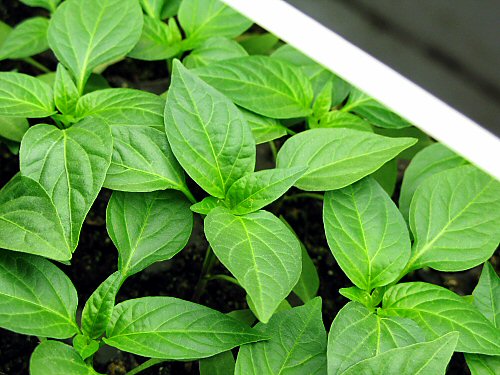
The weather’s been warm, sunny, essentially FANTASTIC for the last couple of days, and the forecast for the next few looks just as good. Indoors, many of the earliest seedling starts are putting on growth spurts, quite suddenly crowding each other and grabbing for the light, like these Gypsy sweet peppers. That means hundreds of seedlings have to be potted up, hardened off a bit, and headed out to the greenhouse, NOW—it’s not good to constrain their growth in small cells, and once they’re in bigger quarters, there isn’t room for them all under the lights. It’s no coincidence that, just as you’re driven to seed a dozen crops into the field RIGHT AWAY, the transplants are ALSO blowing up and demanding immediate attention—it’s the miracle of the garden plan working. They’ve been timed to be at this stage right about now. This is the way it goes. I’m so completely swamped with things to do, not just planting, but building and repairing things, working on the new farmers’ market stand, setting up the irrigation, and on and on. It can be quite overwhelming. Often, it doesn’t seem possible to get it all done in reasonable time. But you plug away—if you’ve done it before, you can do it again!—and eventually things ease up, and you get to survey your first crops setting up in the field—not to mention, EAT STUFF, like a perfectly crunchy spring radish…just brush off the dirt—and at that point, the deep feeling of satisfaction and simple happiness at having done it all is really, truly, have-to-experience-it excellent. MEANWHILE, that’s a good six weeks away, and until then, it’s the full-on SPRING RUSH! :)
Field day!
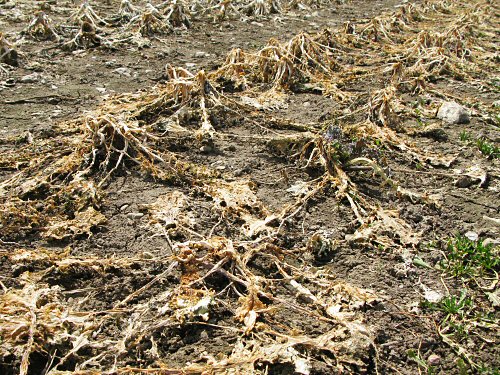
Left to the last possible harvest in the fall, brassicas like kale, Brussels sprouts, cabbage, broccoli and cauliflower (above), were eventually winter-killed and now have to be cleaned up—one of the first field-readying jobs of spring! Today, I started. (EVERY day is a field day from here on in, through November at least, or the first heavy snow that sticks.) A day of tiny farming fieldwork is really just a whole lotta gardening… Now that the ground has dried out enough to be tillable (that could’ve been yesterday, but…errands and CHICKENS), and warmed up enough to direct seed the crops that germinate in cooler soil, it’s a whole new world of things to do…and think about doing. There are two basic ways to ponder the progress of the season’s garden: by timing and by area, each useful in its own way. Timing is mainly about the plants: when to seed, when to water, when to harvest. Area is about where to locate particular plantings, which in my case doesn’t mean absolutely running out of space, since there’s lots more field to expand the garden into if I wanted to (which I don’t), but more like where to position stuff efficiently, so you’re maintaining crop rotation, but not having to, say, drag hoses all the way down the garden to a couple of newly seeded beds that need daily watering in (although there’s a field production plan made up, there are lots of adjustments on the way—where to put stuff will come up again and again!). So, the start of the season is mainly about area, because you have to prep beds and get veggies in in a rough order—cool soil seed, then cool weather transplant, then warm soil seed and transplants—and the timing is a constant: it’s all right away! One way I keep overall track of this garden is by counting sections: it’s about 2.5 acres, divided into 40 50’x50′ squares (each fits 10-16 beds, depending on width). At some point in the next six weeks or so, almost all SHOULD be planted out, nearly 40/40. Today, I started seeding in one…
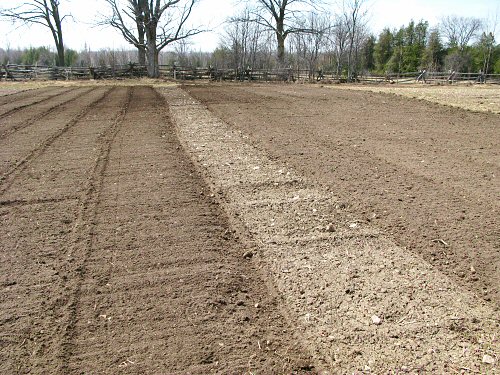
Tilled and untilled: Partially composted cow manure was spread and incorporated in the fall. Now, a light rototilling to prepare for seeding is all that’s needed. Today, I used the tiller on the Kubota compact tractor.
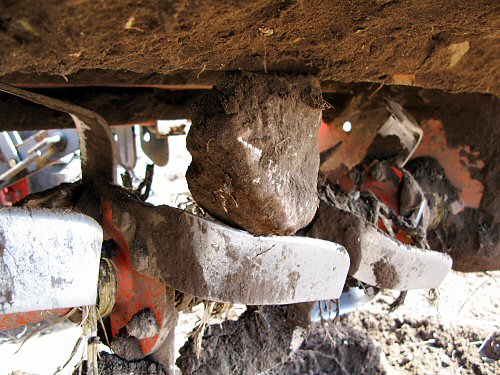
Rock beats tiller: There are lots of stones in this field, they work their way up continually, and even a fist-sized rock, caught in the right way, can stall out the 48″ rototiller on the Kubota (it’s a tiny tractor!). No problem: remove and restart.
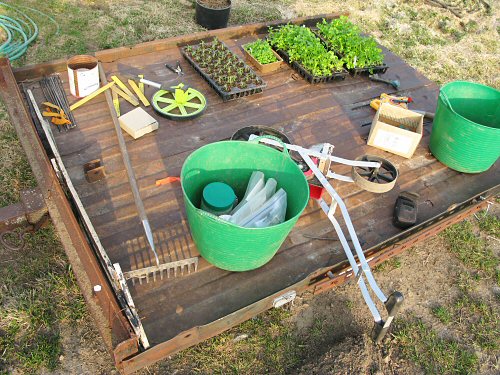
Getting set to seed: I work mostly one or two sections at a time, prepping an area with the tiller, marking the beds, then seeding (or transplanting). This way, I can get the crops that need to be started in as quickly as possible. Here’s the cart towed by the riding mower, loaded with assorted seeding gear (and some transplants being ferried to the greenhouse).
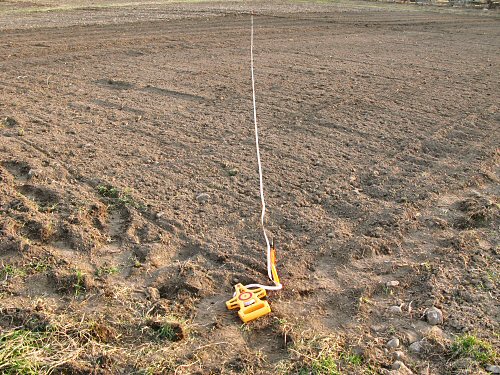
Making beds: Oh, there’s A LOT of tiny farm history behind my bed marking methods. :) I’m still working on the most efficient way to set up beds. Right now, it’s fairly streamlined, involving a 100′ tape measure, stakes, and pacing off distances. This year, I’m planting in 3′, 4′, and 5′ beds (that’s path included), depending on the crop.
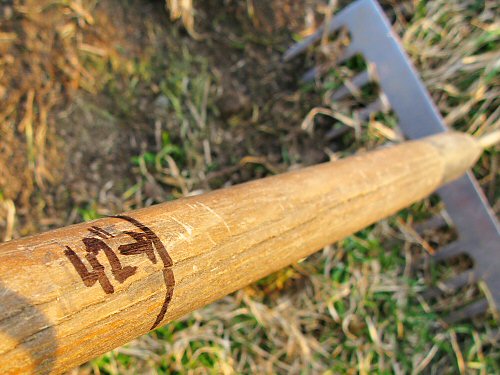
Customizing the Rake: Every season, I re-ink faded measurement markings on a couple of hand tools I use the most. Here’s a convenient mark for 42″ from the top of the handle (that’s the planting area width for a 5′ bed. There are other marks further up the handle, and the whole rake is exactly 5′. It’s convenient for quick checks, especially on the favorite rake that I use for touching up beds right before seeding. And so, off we go…!