

Every year so far, there’ve been two or three major projects that I’m sure just HAVE to be done. They’re usually EXPENSIVE (at least, expensive in the world of tiny farm finances!), which means, they take some thought. We’ve had the seedling greenhouse, excavating the pond, the Milkhouse Extension, the tiny tractor, the first full-time field hand (Conall!), and a few other steps… So far, so good. For the coming year, I have in mind a few more…important upgrades. I was reminded of one of them in the drive shed today, where the stakes used for my semi-effective semi-sprawl method of tomato support are stored, along with some of the couple hundred (largely useless) home-style tomato cages. For a while, I was dreaming of moving up to the basket-weave method—lots of twine and…weaving—although I have a hard time picturing all of that suckering getting done. What I REALLY want is BIG CAGES made from concrete reinforcing mesh…but it seems so expensive. Rough pricing: about $7 a cage times 500 cages, plus a fair bit of labor setting them up and taking them down. I know the method works well, but will it work well HERE, this year? Is it worth the money? For the same cash, I could almost build a second, production-size greenhouse. Or put more into drip irrigation. Or build a cooler for better short-term storage. Come to think of it, does growing dozens of varieties of tomato really make sense, couldn’t I just sprawl two or three big, round red varieties that would be easiest to sell…? In fact, I could grow a lot more of a lot less, cut out many varieties and entire crops, concentrate on the trendy best sellers, and get on the waiting list for an upscale farmers’ market in the big city. Top dollar! Maybe try for a bank loan for a bigger tractor (hey, there’s more acres in the garden field!) and a refrigerated truck?! If this is a (tiny) farm business, that seems to make sense: GROW! Yet somehow I’m heading in the OTHER DIRECTION. Stopping the city CSA to go local. Trying more crops and varieties every year and figuring out ways to buy stuff for them, like big tomato cages… It seems so…contrary. Which, in tiny farming, is something I guess you gotta like!!
Veggies
The joy of decay…

During the growing season, decay is the last thing you want to see, let alone observe over time. In the off-season, what with culling veggies from cool storage, I’m a little more thoughtful about…decomposition.
This miniature butternut caught my eye as it slowly returns to its essence in the Milkhouse. I’ve watched it instead of tossing it out. I like it! It’s soft, but seems to be drying faster than it’s rotting… Those little amber crystals, the product of ooze, are interesting: hard, translucent, sort of brittle, almost tasteless… I wonder what they are? I’m sure chemistry and biology would give me great, detailed explanations of the entire process of winter squash decay. But is that…good? Is that what I want?
I used to think that understanding how EVERYTHING worked was kinda the goal, you’d learn and learn and learn stuff and become…better. But tiny farming doesn’t seem to lead that way. You watch and you do learn lots of things when they’re useful, but simply tearing everything apart into little chunks of measurement and description, just for the sake of it, isn’t as appealing as it once seemed to be. I think I want to know LESS. Demand simplicity! Let the squash rot in peace… (Of course, things don’t really work that way, do they…)
Broccoli flowers (flashback!)
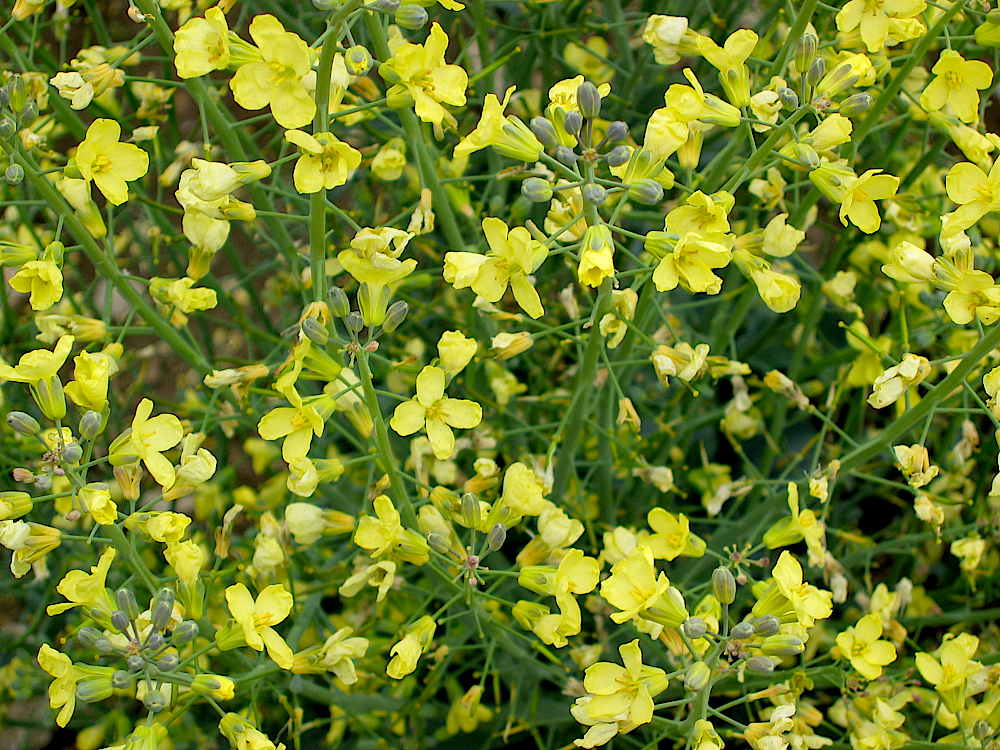
No real farming action today, but here’s an alternate entry from 2-Oct-2007—never let a perfectly serviceable post go to waste!: On my way to seed saving, I tend to let things go to seed! Here, the secondary shoots in a bed of Early Dividend broccoli have exploded, the tiny green beads turning into a gently rolling sea of miniature flowers on long thin stems. Unfortunately, the eventual seed from this hybrid variety wouldn’t be reliable…but it’s a step in the right direction! Also going to seed around the field: lettuce, radish, cauliflower… There’s some cleaning up to do. :)
Update: As mentioned in the comments below, these little guys are delicious as edible flowers, slightly sweet, tasting mildly of broccoli. We take them to market to offer as a free garnish for salad mix.
Catalog season
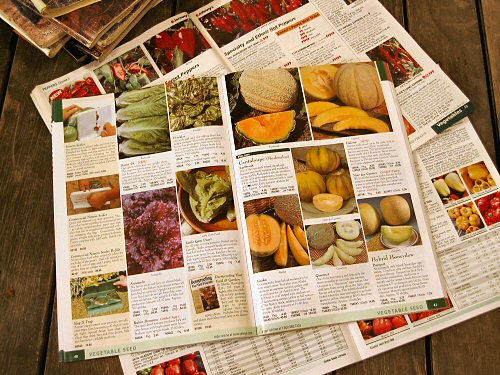
As pure, abstract small farming pleasure, for me so far, catalog season can’t be beat. This year’s catalogs started arriving two or three weeks ago. The first from one of my main seed suppliers has been here only a couple of days, and I’ve started flipping pages and poring over tiny type. What’s all the fun about? Simple. It’s the clean slate, the chance to START OVER, with the little edge of knowing what you know now, after another way less than PERFECT but oh so educational growing season. EVERYTHING is more than possible…next year! I’m picturing—visualizing!—a two-month continuous harvest of succulent MELONS, plump, super-early hybrids followed by exotic long-season heirlooms. Never mind that, between water issues, cucumber beetles and roller coaster temperatures, the melon crop here has never been too fine. That’ll change. Melons, and all manner of crisp, mild salad greens right through the summer heat, parsnip without endless hours of tedious, fingertip weeding while waiting for germination, plentiful red and orange and yellow and chocolaty brown peppers well before first frost (several varieties of eggplant, too!),… Wow, it’s almost unbelievable!! Especially with the pristine new CUT FLOWER GARDEN. And it all starts with the catalogs! I realize this is an odd sort of consumer world pleasure, and most of this is about hybrid seed that HAS to be bought every year. Still, I can imagine it as SIMPLE, and it’s great fun, until I get around to seed saving… ;)
Heat!
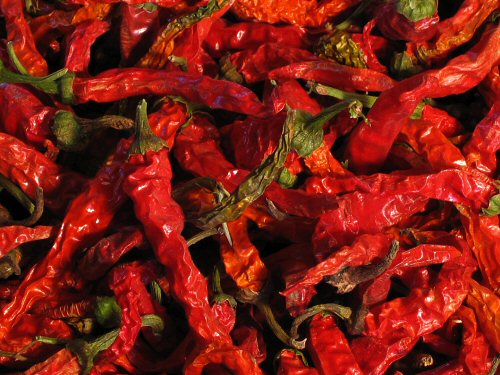
Finally finished a bit of hot pepper harvest, now there’s a convenient pile of dried heat! A few weeks ago, wondering whether to cover for frost, I decided to also pull up some hot pepper plants, roots and all, instead. An experiment! We loaded about 20 of the Cayenne Long Slim on the cart and dumped them in the Milkhouse, heaped on the grow racks that we’d been using, with the lights removed, as summer storage shelves. And there they sat, blending into the decor, drying, the peppers that were still green maturing to red. Until today… (This is the kind of thing you can do in a Milkhouse, not so acceptably in a real house…) They’re satisfyingly high on the heat scale, delivering a little pain if you don’t sample carefully. Great!
Kale under…snow
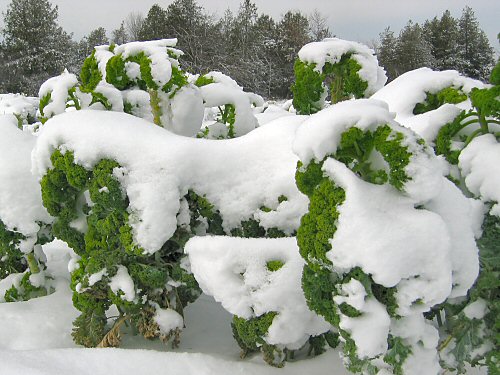
Another installment in the snow-covered series: Winterbor kale! I’m so used to rollercoaster weather and the new winters that never really get started, it’s kind of a shock to have this much snow for three days in a row in November. And there’s no melt-off in sight, with the 15-day forecast predicting little sun and day temperatures hovering under 0°C (32°F). Picked a few pounds of the kale today, it’s still holding up, particularly the young new growth. It won’t last long if it stays frozen day and night. All this watching of cold-weather crops is bound to come in handy…sometime!
Rosemary under snow
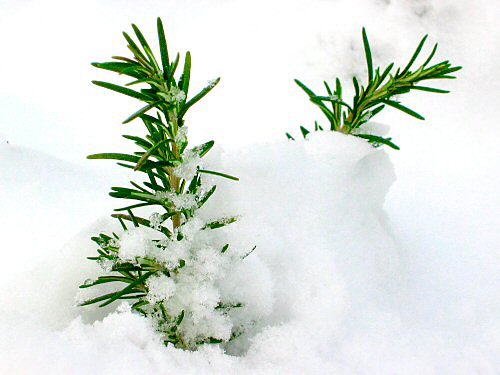
The rosemary’s looking quite fresh and perky, buried tip deep in snow. There are many cultivars, some apparently able to overwinter in quite brutal cold. I have three types here, two without names (one a survivor of last winter’s rosemary greenhouse debacle), plus a new Barbecue cultivar. How hardy are they? Are they as happy as they look in the snow? Will I eventually take them in (as planned)? Or mulch them where they stand?