
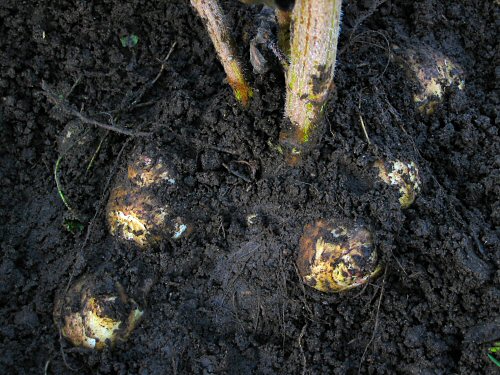
The Jerusalem artichoke leaves died off in the cold a few weeks ago, not too long after flowering, and I’d kind of not thought about ’em in a while (they’re right by the 26 rosemary plants that have to be potted and brought in at some point, maybe that had something to do with it—I’m trying to figure out how to keep the rosemary without putting them under lights…another little puzzle). Anyhow, I wandered over today and cleared away an inch or so of dark, cold soil to find…beautiful, big, bulbous TUBERS. I’ve been looking forward to this from the beginning. It’s always excellent to see a first-time crop come through! I didn’t dig deeper, but from this peek, it looks like my original stock of 45 pieces has multiplied at least six or seven times, well on the way to real choke production next season. I’ll harvest some soon and…eat them!
Veggies
Spreading grass mulch
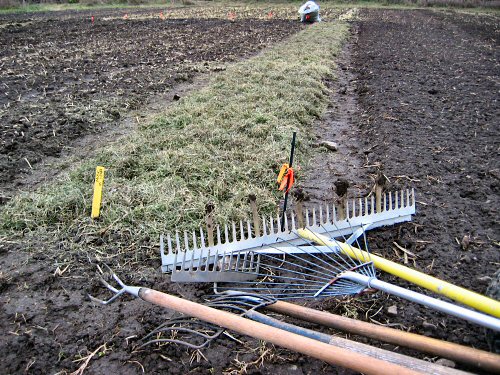
Today, I took advantage of a one-day reprieve from the cold—it was a pleasant 9°C (48°F)—to test the new grass-alfalfa mulch on a bed of garlic. I suspected spreading the light, loosely clumped mix would be more of a chore than tossing around straw, and it was. I first tried dumping it out, but the big clumps took forever to break up and spread, so I switched to pulling it apart by hand. The large bags of mulch weigh next to nothing, so that wasn’t hard, but you wouldn’t want to do it in the wind. Next, spreading it evenly. This proved to be a bit of a puzzle. I started with a hay rake, with three widely spaced tines, but this just slid through the grass, not catching enough to move it around. Out came an unlikely array of other hand tools to try: the compost fork (dark tines, right at the bottom of the pic), the 3-tine cultivator, a regular rake, and a leaf rake with round tines (the wide landscape rake was for marking rows in another bed). None of these worked well. Closely-spaced tines caught too much and cleared areas rather than covering them. I eventually used a combo of the 3-tine cultivator to break up the clumps, then skimming with the small rake to even it out. The results were pretty good, with a fluffy 2-3″ layer down the 50′. But it was delicate, picky work as the grass is very light. There are five more beds to go to refine my method (basically, figure out a better way)! I also planted a final 50’x5-row bed, using up the last of my seed reserve, bringing the garlic total to about 3,000…
Crispy cold carrots
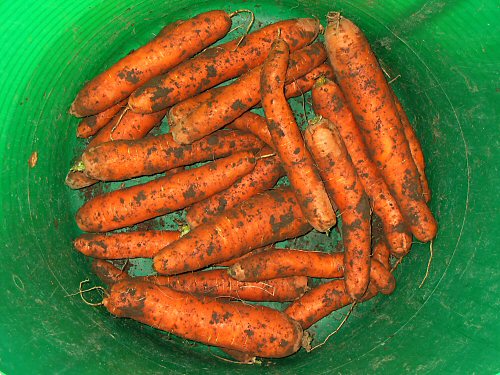
Dug up about five pounds of carrots for a phoned in order for “whatever there is”. The ground isn’t frozen, but the many sub-zero nights have really chilled it out. These heirloom Touchon carrots benefited from their cool storage conditions. They’re crisp and super-tasty, not as sweet as my other standby, the Nelson hybrid, instead delivering a rich carrot flavor. Also still being picked in the cold, there’s spinach, kale, collards and flat-leaf parsley…
Bye-bye, sweet peppers…
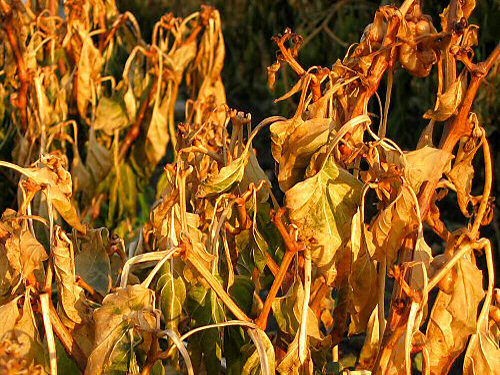
A mildly golden late afternoon sun turned the beds of dead peppers into a stunningly rich sea of color amongst the greens and browns. Peppers seem to have their own way of dying off in the cold (at least, under row cover, where they usually are in autumn). Instead of turning a sickly, muddy green, then quickly to grayish-brown as they dry out, like eggplant and tomatoes, the peppers tend to fade from green to greenish-yellow and dry in pale golds and tawny browns. Interesting… I’m not sure if this is standard behavior, but it’s how they seem to go around here! After rolling up the last of the row cover and snapping a couple of pics, it was on to the Kubota compact tractor for a quick tilling, and this year’s sweet peppers are…gone!
Spearmint and the other herbs
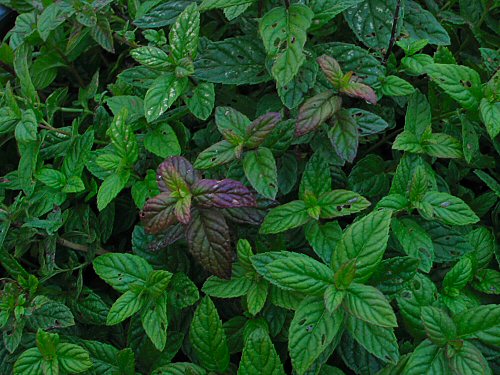
The fall season that wouldn’t quit has more or less come to an end. For the last few days, overnight temperatures plunged well below zero, we’ve had hard frosts and some snow, but the ground is far from frozen, and there are apparently warm days ahead (for more tilling, planting additional garlic, harvesting the last of the carrots and beets)! In the herb garden, there’s not much to do, except bring in the rosemary. Flat leaf parsley is in fine shape, doing better than the curly stuff. Sage seems indestructible, thyme and oregano are largely toast above ground, while the tarragon starters seem to be fine—I’ll put them all under a couple of layers of row cover, although the sage, oregano and thyme have come back no problem for the last two years after overwintering right out in the open. Some of the peppermint was killed off, although the roots may be okay. Apart from a few cold-burned leaves, the spearmint, in the picture, is right as rain…
First snow comes and goes
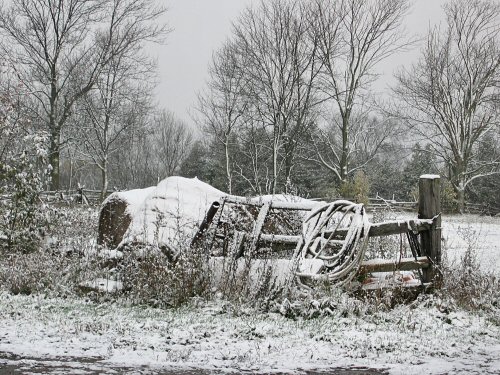
Even a section of fence sorely in need of clean-up and repair looks kinda interesting under a little snow. We’ve had the lightest of powder trickling down for a few minutes here and there over the last couple of days, but overnight, it finally snowed enough to stick around for a bit. This was about 9 a.m. Within a couple of hours, the sun was out and the first snow was gone without a trace…
Root cellar lite
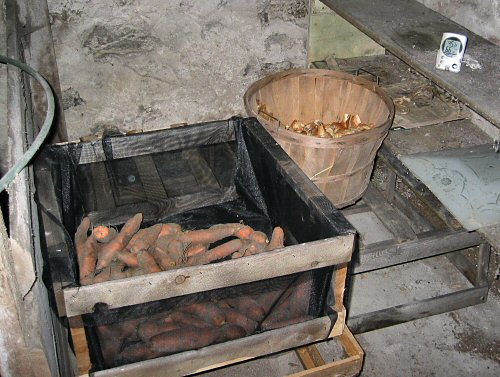
Finally got around to starting to sort out the spot for the root cellaring experiment. It’s in the basement of the house, against the north wall. I thought the floor was dirt, but it turns out to be cracked and rubbly concrete. Oh, well. It’s still fairly warm, around 60°F (15°C), but should cool down soon. I’m not doing much, other than clearing enough room for 8 or 10 bushel baskets. Monitoring temperature and humidity through the winter—a handy little digital min/max thermometer/hygrometer is already on duty—and seeing how the veggies hold up week by week is the main thing for this round. Some squash and beets are just out of sight to the left. The bulk of the veggies go in soon…