
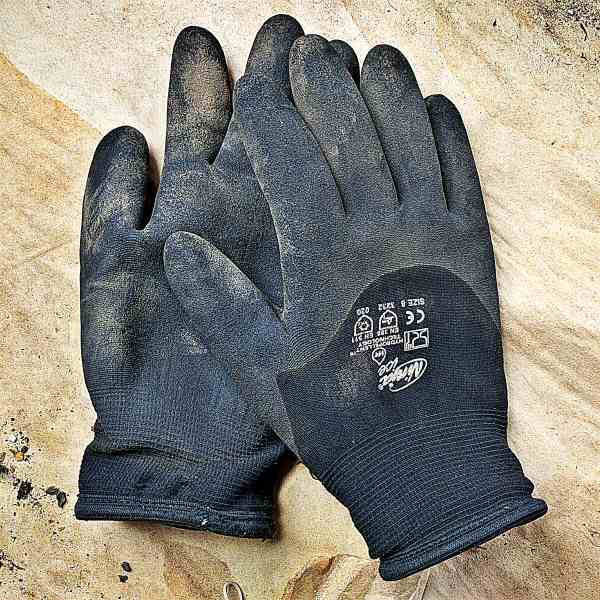
How excited can you get about a pair of gloves that you use to work in the field? Quite! Although enthusiastic may be the better word. This style of glove I’ve used for a while, for fall and winter, in cold weather. I wrote about their many fine features a while back—this particular version is the best yet, with the grippy, waterproof coating extending just far enough down the back so that they don’t get wet during normal handling of soggy stuff, while allowing enough open, breathable area so your hands don’t sweat. What more can I say?!
Tools
Equipment for large-scale agriculture is too big or too expensive, and many home gardening tools don’t work efficiently on larger jobs or break easily. Tiny farming on plots up to two or three acres requires its own special gear…
Wire work
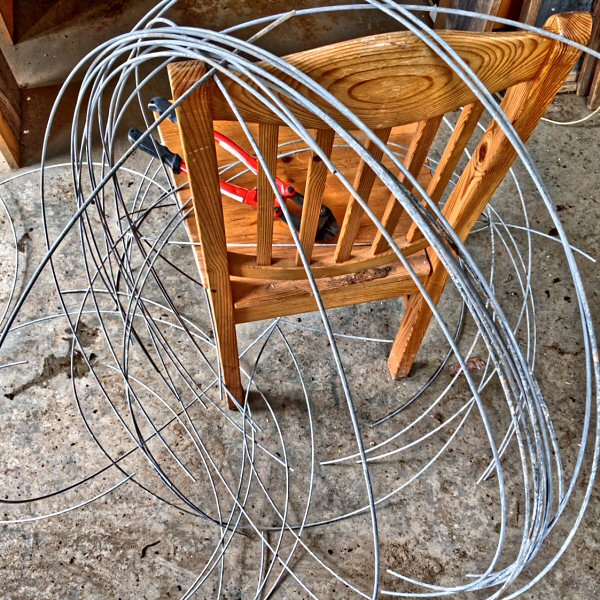
Electric fence wire work, snipping 6-foot pieces of 9-gauge wire for hoops to hold up floating row cover in the greenhouse. Hopefully this wire is stiff enough to do the job, supporting up to three layers of row cover, heavy with moisture from humidity and being dripped on by water condensed on the inside of the hoophouse plastic, or weighed down by ice, when the soaked cover freezes at night. This test batch of about 180′ came coiled, in a circle about 2½’ in diameter, and the built in curve is perfect for stretching slightly to span about 4′ of bed. So, no bending required, it’s all about the snipping!
Spring tilling
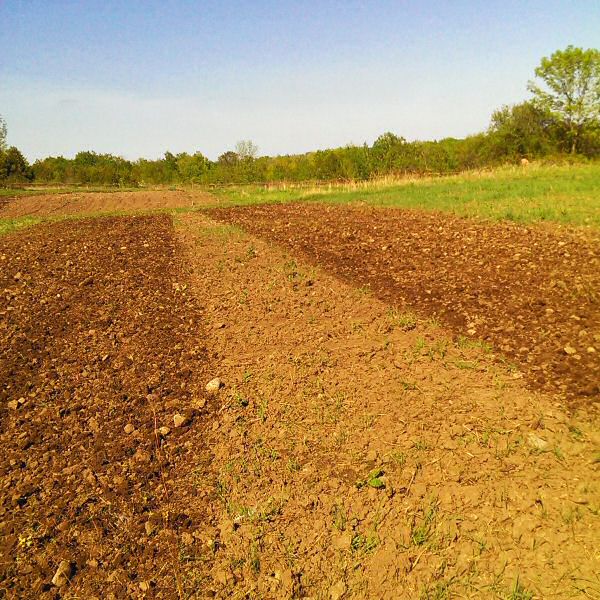
“You see a section being tilled, I see PUMPKINS. Actually, mainly spaghetti squash. And some zucchini.” There’s nothing that says, “Things will be just perfect this time around: well-weeded, vigorously green, prolifically fruitful,” better than a freshly tilled patch!
Working around steel
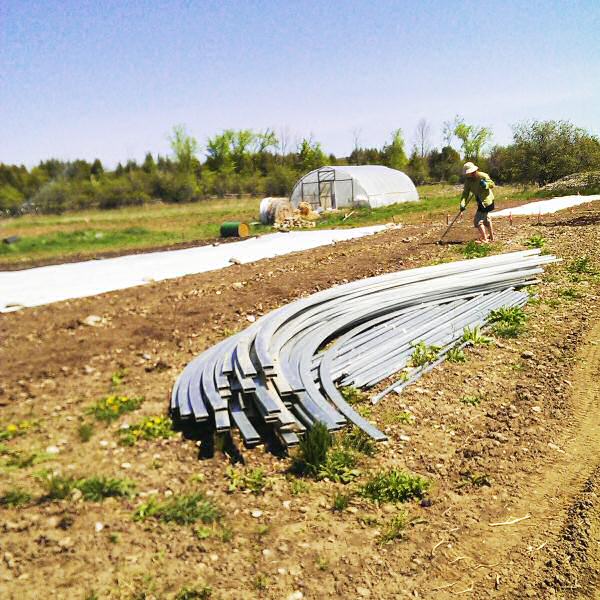
Exactly where it was delivered last fall, the steel for the new hoophouse is kinda in the way, so we’re working around it (it doesn’t look like much in the pic, but it will expand into 30’x108’x16’H of plastic-covered year-round field protection). Beds of brassica greens are already in and protected by row cover from flea beetle attack. Lisa preps beds for more. Spring direct seeding proceeds…
Picking rocks
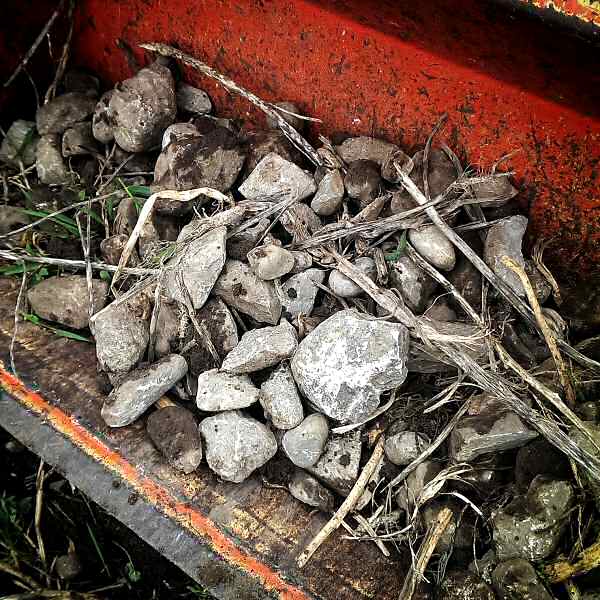
We have rocks, it’s not a big deal when you get used to them, although I suppose I’d really notice the difference if suddenly all the rocks vanished. As it is, little ones like these are usually ignored, but in one small area they were dense as cobblestones, so we picked them… The method: pick ’em up, toss ’em into the Kubota compact tractor bucket, when the bucket’s full, dump it on one of the rather large rock piles. With two or more people, you can spread out and toss rocks into piles from a convenient tossing radius, and travel around with the Kubota, loading the piles into the bucket. It’s really quite straightforward. And quite quick. Of course, there’s a mechanical alternative, with various tractor-run contraptions for removing rocks in large volume. It’s all about scale, and how many hands and rocks you have!
Water from the barrel
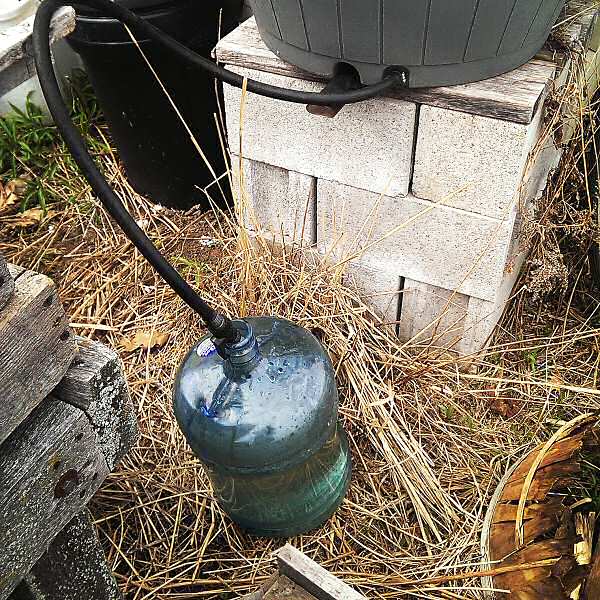
Rainwater upgrade: We only turned over this rain barrel yesterday, set bottom up for winter to keep empty in order to avoid frozen water expansion cracking the plastic, and it rained overnight. A little rain, a fair-sized collection area (roof with eavestrough), the law of gravity, and presto, the first seedling water of the season from just outside the door, a lot handier than having to haul it over in 50 lb jugs from the well pump in the barn, a bit of a hike away. Modern conveniences!
Catalogs!
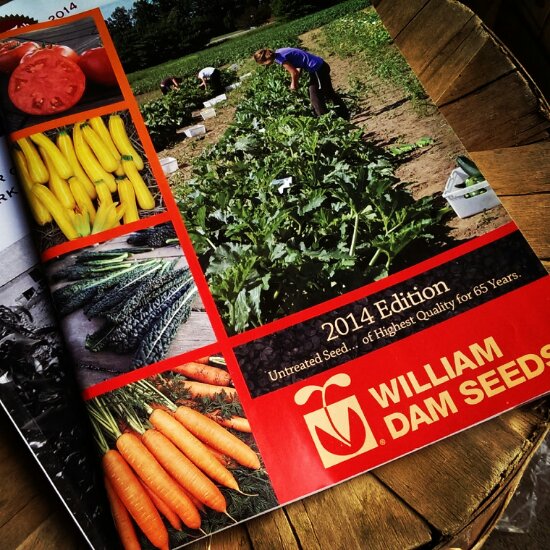
This year’s seed catalogs! Haven’t kept on the mailing lists for the dozen or more I used to get. I do always look around online, but for the hard copy, and the main seed ordering, it’s reduced to two, one main seed supplier and a backup. The more you know, the less you need? I like the sound of that! :)