
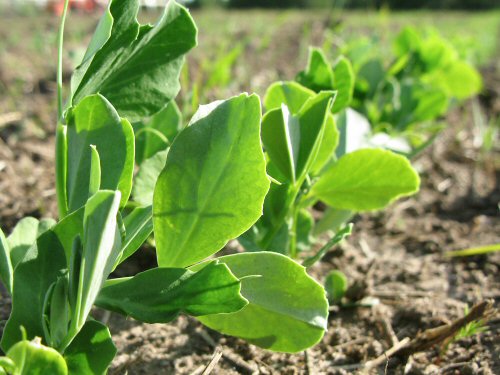
Snap peas (above) are still the crop to watch for pleasing signs of veggie life in the fields. Mild concern over the chopped sod content continues, so each new bit of healthy growth, while expected, is still a happy event! The soil itself is nice, I’m comfortable with the fair degree of clay content (water-holding is good!), I’m pretty sure we’re developing a good working relationship. And there is a lot of other stuff to see. Three successive seedings of Sugar Ann snap peas are doing well—the first two are below, and in the distance, two seedings of spinach, broccoli and cauliflower under cover, radish, beets,… And there’s lots more. With tiny farming and Mother Nature, trust is good, but seeing is believing!
Compost spreading: another way…
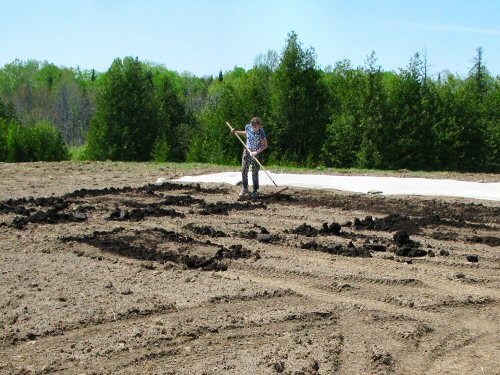
When there’s a whole small section to cover, spreading compost with the Kubota compact tractor bucket is a lot faster and more efficient than the painstaking bed-by-bed method. This has been my usual approach for spot spreading, usually for 50’x50′ squares. Covered in reverse: the roughly distributed compost is quickly raked out (looks like a lot of work, but only takes 5-10 minutes!), before being rototilled in.
The real trick is backing up while dumping, rotating the bucket up and down. As long as the compost is flowing and not too clumped, this works great, gets a lot of the job done.
After a little experimentation, we came up with a simple debagging method, Lynn demonstrates: slit the bag in the bucket, then quickly flip it, pull up, and give it a couple of shakes. This compost is quite heavy (35% moisture, the label says?! expensive certified organic water…), so it quite easily tumbles out… And there we go, tiny methods for the tiny farm!
Hardening off continues
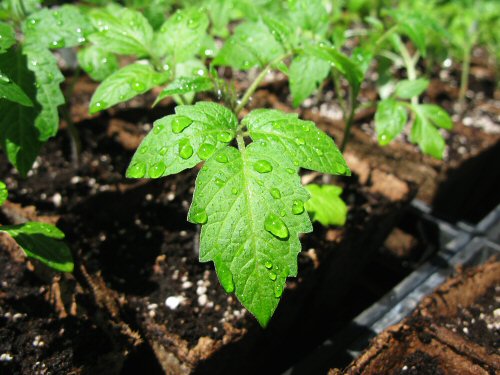
Ferrying 60 trays of seedlings in and out of the seedling room continues. When you focus up close on a lush green tomato leaf, decked out in droplets after a gentle hand watering, everything seems peaceful and orderly on the tiny farm. This is not untrue, but it’s also pretty crazy around here with the MANY THINGS TO DO. One more rainy stretch in the next few days, then heat and sun are in the longer range forecast—looks like our big gift for spring, free irrigation via regular rain, will soon run out, so WATER in the field is next on the gotta-get-it-running list. As May rapidly unfolds, it’s all about the To-Do-Now!
Allie’s photo gallery II
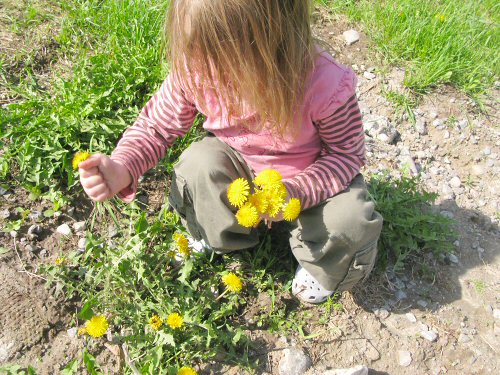
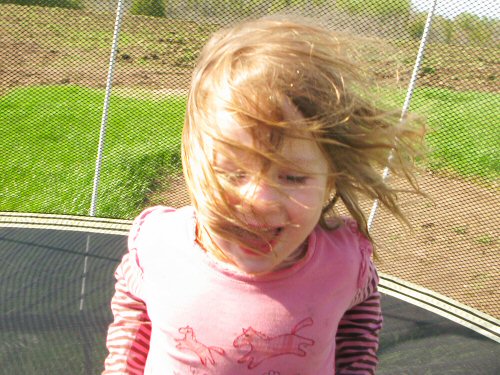
Michelle, back for her first farm day this year, sorted out seedlings while daughters Allie (7) and Violet (3) checked out the new farm. Clearly, kids take well to…activities, so, to follow up her first successful camera mission last summer, I gave Allie my camera, and off she went off on a photo shoot. Little sis Violet, camera-ready and joyful, turned out to be the subject du jour… (Photos by Allie)
Sprouts!
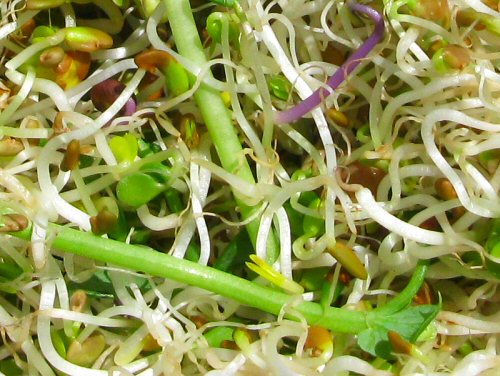
Sprouts—the tinier tiny farming! After two Saturdays of buying them by the bag at the farmers’ market, I’m totally hooked! I want to grow sprouts, the nutritional claims are quite amazing, most of all, I really love the taste and crunch of EATING them (mostly, by the handful).
Until our first harvest, we’re dropping by our market to stroll around, chat, and buy food. It’s only been a couple of weeks, but I already have a routine with favorite stops, including one to get salad greens (first time in a few years that in-season salads aren’t homegrown), and one for SPROUTS!
I get the megamix, with a little of everything. Can’t even remember the whole list, but there’s something spicy, tastes like mustard, pea, kale, broccoli, I think, lots more.
Sprouts aren’t new to me. As a kid, I remember my mother growing a jar of bean sprouts for a regular Asian-style stir fry-type dish she made, and I’ve bought usually alfalfa sprouts for sandwiches, but I never really NOTICED sprouts till now. They’re great. So, it’s figuring out the simplest way to grow a wide variety for a steady personal supply…
Transplanting team…
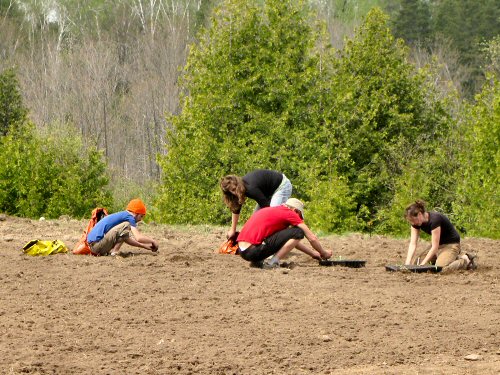
Another big Friday showing of people in the field: Chris, Libby, Jordan and Lynn transplant broccoli and cauliflower, while Andie is on a solo rototilling mission in the other field. Later, everyone got together to plant a few hundred onion seedlings and sets. And some other stuff got done.
Although we’re in the thick of it as far as timing and weather and urgency to get things out, our spring schedule is slower than it could be, and the field days are so far fairly laid back. Slowing things down is the start-up stuff: a ton of tillage to do (working in the grassy remnants of last year’s hay field), water for irrigation to put in place, electricity to run, chickenhouse to build, and a long list of other basic things that we have to put in place along with starting the season’s crops. Getting it all rolling together on this new farm, now that’s fairly intense!
Spot the tiny farm!
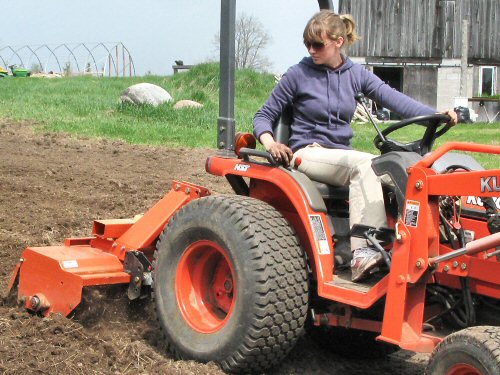
What’s in a photo? Depends what you’re looking for! Take this pic of Andie, rototilling today with the Kubota. Pretty straightforward: woman, machine, field. BUT, can you spot practically EVERY main part of a really tiny farm (at least, of this one), represented right here?
It’s mostly hand work, but there’s some gear: Of course, we have the Kubota compact tractor, flagship of an motley assortment of gear specifically suited to tiny farming. It’s rugged, very much a diesel TRACTOR, but small, and designed more for the big estate crowd than agriculture. Around here, though, it’s the workhorse machine, a people multiplier with its bucket and essential 48″ rototiller. As far as I know, rototillers aren’t core gear on tractor farms, but it’s our ONLY field implement so far, a huge labor-saver over walking up and down with the walking rototiller, or digging by hand. And the turf tires seem to work just fine.
New people diving in: And then there’s Andie, doing (tiny) tractor work within the first few hours of her entire market garden experience. (It’s cool that she’s already looking over her right shoulder, it’s a classic tractor farming pose—except maybe not with GPS?) She also has DIRTY HANDS on the wheel, from checking out the tilling results, and they’ll stay dirty as she moves off the tractor in a few minutes, on to hands and knees to plant onions.
A big shed (aka barn): A barn of some sort is the main, sooner-or-later essential, working structure that separates clear land from a working tiny farm. Really, a basic barn is just a big, all-purpose shed (this one, 20’x32′, is pretty tiny, just four walls), for getting things out of the weather. You use it to store harvests and gear, and to work out of the wind and rain (and of course, we have winter). With rough carpentry, you remodel and reconfigure it to fit: an extra hook here, new door there, closed off room in a corner, whatever you need!
Lots of work, all day long: Elsewhere in the pic, less obvious but clear signs of tiny, labor-intensive veggie growing. In front of the barn, tables of seedlings are hardening off. They’re brought out in the morning, taken in at night, back and forth, back and forth. That’s because the greenhouse (hoophouse frame on the left) isn’t finished yet. And THAT’s because there is just SO MUCH TO DO ALL AT ONCE. Like, mow the grass for mulch, before it gets outta control. And get a new battery for the John Deere riding mower (on the top left), so it can haul around the trailer loaded with whatever we need to get LOTS MORE STUFF done. It all weaves into one big picture of tiny, simple, interdependent tasks that go on and on and on, all day long…
It can get a little intense, but it’s also really fun, if you don’t get all grim and serious about it and try to tie in the state of the entire planet (try to stop following the news!). You get to pretty much see where you’re going. Meet people in a really interesting way. Eat well. Sleep well. Kinda…simple! I think that’s a pretty good start…