
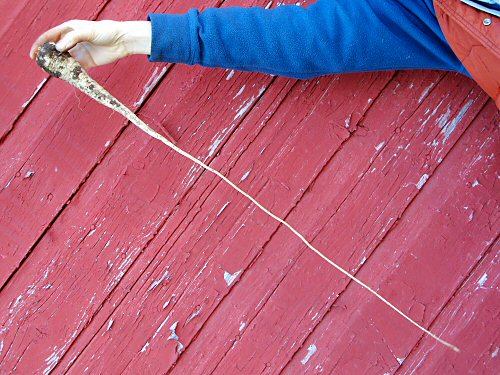
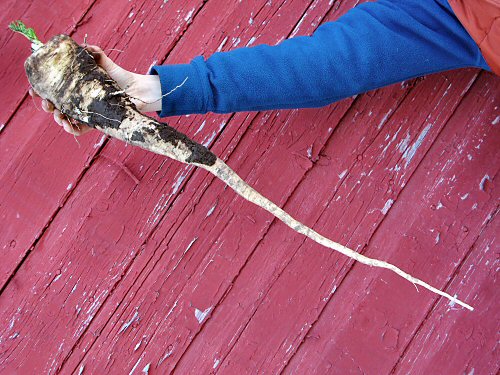
About the last thing anyone is likely ever to see first-hand is the amazing root structure of plants! I’ve been fascinated by the massive size and complexity of ROOTS since I first saw a sketch of a full root system, and way more so after browsing the wealth of technical drawings of garden veggie roots in the fantastic and fully-online Root Development of Vegetable Crops. Root systems can be VAST, but they’re incredibly difficult to actually see since the mostly fine filaments that tunnel everywhere simply break off when you dig up a plant. Today’s parsnip harvest yielded a couple of unusual, still very partial root specimens that only begin to illustrate what’s going on down there. Who knows how just a few managed to come up with so much intact… For parsnips, according to RDoVC, after a season’s growth, “at the 8-foot level roots were common and a maximum penetration of 9 feet was determined.” In the top 10″ (25cm) of the soil, lateral roots extended up to 3′ (90cm). Pretty cool, huh?! (Thanks to hand-and-arm model Lynn.)
Series: Small wonders, little mysteries
A collection of at least mildly unusual-to-me things found in and around the veggie plot.
Potato fruit
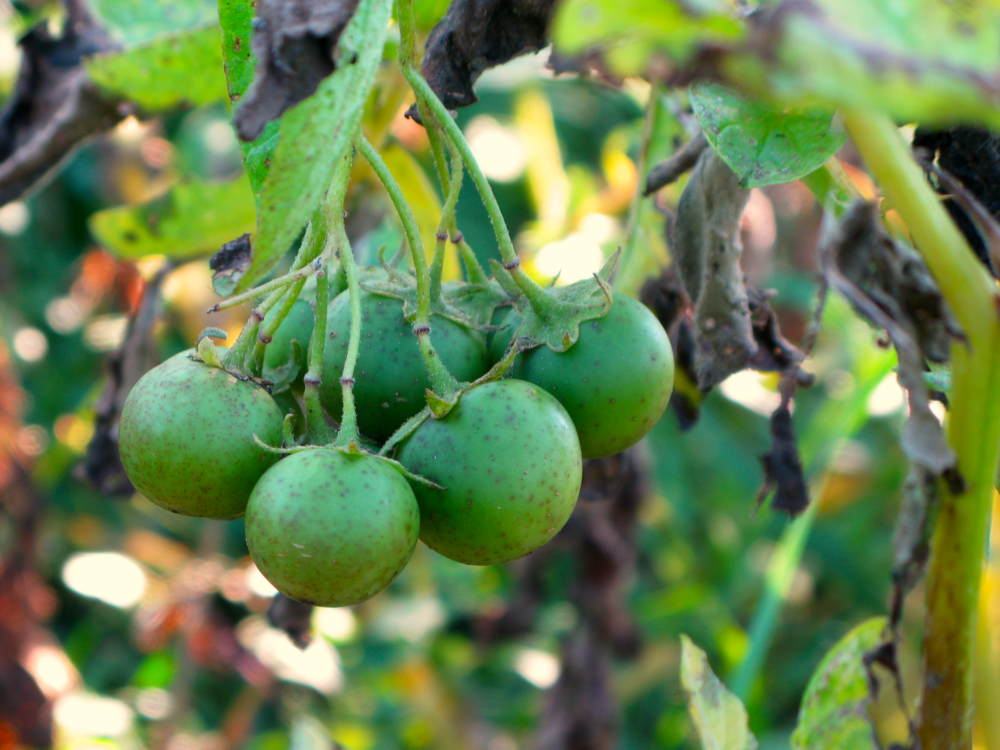
Here’s something I haven’t seen before in my, uh, six years of growing potatoes: green, tomato-like, walnut-sized potato fruit. Bob hadn’t seen ’em either, in 40 plus years of farming. I hit the web for education.
These are genuine fruit (also called berries), but not that common. Usually, potato flowers just drop off. Pollination can be an issue, but even when pollinated, little details of the season’s growing conditions can make the the difference. When fruit do form, they’re more likely found on certain varieties, like Yukon Gold. This year, there were fruit on just about every Chieftain plant, here and there on the Kennebec, and none that I noticed on the Yukon Gold. Since they suddenly appeared this year on two varieties I regularly grow, I’d guess it was about the weather!
Each fruit contains 300-500 seeds that don’t come true: planting them doesn’t result in the same potatoes as the parent plant or each other, there’s lots of genetic variation, each seed will produce a genetically different plant! Potato breeders plant out thousands of seeds, check out the results, then keep replanting the most desirable potatoes for many years or generations to get new commercial varieties—this is the traditional way new potatoes are bred.
Meanwhile, it takes only two seasons and one generation to breed a new potato, so for the small farm or home garden, as opposed to the big potato breeder, this seems worth a try. At least as an experiment. Harvest seed one season—you can hand-pollinate to cross two varieties—plant out the next and select the best-looking plants. The tubers (potatoes) from each individual plant are ready to go: planting out the tubers will produce genetically identical plants.
But there’s a kinda big BUT: even though a potato grown from a tuber is genetically the same, you can’t be sure how its genetic makeup will react to different growing conditions. For example, it may be the perfect potato after a wet summer, and quite different after a dry one. (That’s why professional breeders check over several generations, and now there’s also high tech genetic analysis, to make sure it will be the same potato in the full range of growing conditions.) Still, at the very least, fun to see what happens!
And, the fruit are poisonous, rich in solanine, not for eating. Potatoes, tomatoes, peppers, eggplant and tobacco are all members of the “deadly nightshade” family, all prone to having toxic parts (potato fruit are somewhat similar to little, hard green tomatoes). Interesting!
Since this is such a popular post, being dug up over and over via Google, I’ve started to update the article as I discover more. The post sounds the same as it always did, just surgically filled out a bit with more info. This is unusual. In general, I don’t edit old blog posts, and clearly mark the updates when I do!
Row cover mystery
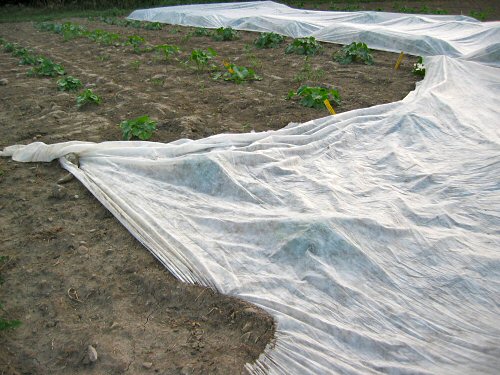
Odd bits of strange, unexplained phenomena turn up in the field from time to time, nothing to get overly excited about, but definitely weird stuff, like this case of mysteriously removed row cover. Earlier in the day, I noticed the cover on one section of risk crop squash was off, thought Conall had removed it, but found when I walked over that about two-thirds of the 50′ (15m) sheet had been ripped off, and lay, bunched up, about 10′ away. In the pic, you can see the remaining piece, perfectly in place, and above it, an adjoining covered row that hasn’t been disturbed in the least. The cover is 14′ wide, and while not hard to tear, isn’t easily sheared right across like that. There’s been no heavy wind in the last few days. There are no footprints or animal tracks in the bed. How did this 35’x14′ section of row cover, anchored by burying the edges every few feet, and with heavy rocks at the corners, manage to detach so cleanly?! It’s a mystery!
Big, ugly, quite tasty
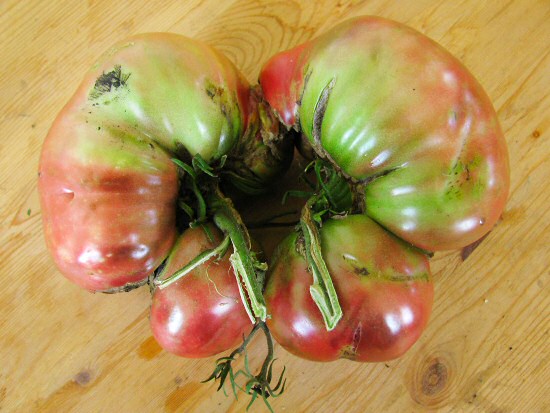
There are thousands of the tomatoes in the field now, and this Black Seaman is just one of ’em, but a big, gnarly one that caught my eye. Didn’t weigh it, but was probably close to 2 lbs (900 g), and grew in a complete circle. Interesting! Most of the fruit are regular beefsteak shape. Anyhow, I gave this one away, and tasted another one at the same time: not bad, the usual complex “black” tomato taste, a little tart, not the best ever, but still…reasonably fantastic! By the book, Black Seaman is a mid-size (12-16 oz/340-454 g), mid-season, determinate, purple-black, potato-leaf, Russian heirloom—that’s what they say. It’s my first season growing them, waiting for more to ripen before PASSING JUDGEMENT. There you have it.
Exploring down below…
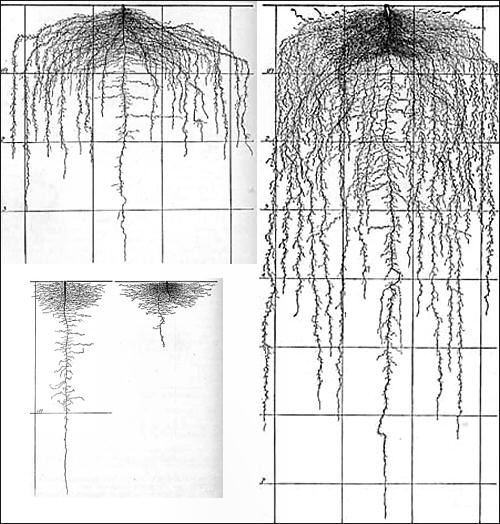
These technical drawings of a lettuce root system are from Root Development of Vegetable Crops*, first published in 1927 and now in the public domain. This is an incredible book that I just discovered. The text is like a complete gardening course delivered from underground. Over 30 North American common garden veggies are covered, a chapter each. The drawings record direct observation, the result of years of root excavation.
I can hardly describe how satisfying and…enlightening it is to simply look at page after page of painstakingly drawn root systems! Here, the top two pictures are lettuce at two months and then at three months and flowering. Each square in the grid is one foot. The little side-by-side illustratation shows 3-week-old seedlings, grown on the left in loose soil (nearly 2′ down!!), on the right in compacted soil (and to think, I have 3-week seedlings in tiny plug sheet cells, 2-1/2″ deep!). One look at this and your mind expands!
*I downloaded it from the fantastic Soil & Health Holistic Agriculture Library, an online repository for numerous excellent books, mostly from 1910-1960, and all entirely free—there are many organic farming classics, tons of great, practical stuff!
The joy of decay…
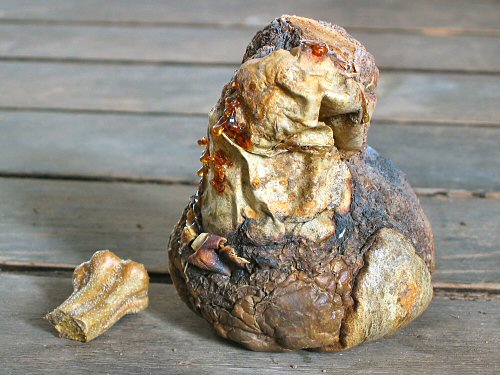
During the growing season, decay is the last thing you want to see, let alone observe over time. In the off-season, what with culling veggies from cool storage, I’m a little more thoughtful about…decomposition.
This miniature butternut caught my eye as it slowly returns to its essence in the Milkhouse. I’ve watched it instead of tossing it out. I like it! It’s soft, but seems to be drying faster than it’s rotting… Those little amber crystals, the product of ooze, are interesting: hard, translucent, sort of brittle, almost tasteless… I wonder what they are? I’m sure chemistry and biology would give me great, detailed explanations of the entire process of winter squash decay. But is that…good? Is that what I want?
I used to think that understanding how EVERYTHING worked was kinda the goal, you’d learn and learn and learn stuff and become…better. But tiny farming doesn’t seem to lead that way. You watch and you do learn lots of things when they’re useful, but simply tearing everything apart into little chunks of measurement and description, just for the sake of it, isn’t as appealing as it once seemed to be. I think I want to know LESS. Demand simplicity! Let the squash rot in peace… (Of course, things don’t really work that way, do they…)