
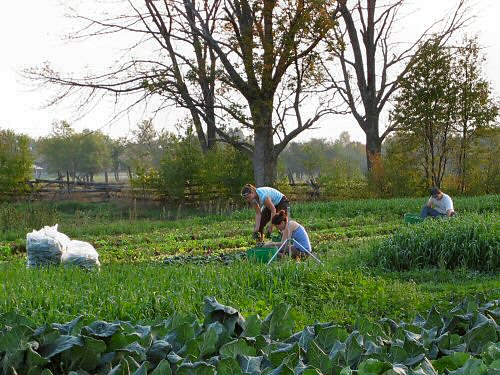
A steady harvest through a warm, hazy afternoon wound up quite early, with just about everything sorted, rinsed and bunched or bagged by around 8:30 pm. Smooth! The end-of-season crew has settled down to Jo, Lynn, Conall and me. Here, Jo and Lynn are harvesting a sparsely germinated but bountiful spinach patch (the second growth leaves are HUGE, fleshy, tasty and tender), while Conall cuts all-lettuce mesclun on the Greens Machine. When not snapping pics, I’m bunching kale in the last stand of brassicas. Filling in between the veggies, lush expanses of oats. In front of Lynn, a sprinkler from the last days of irrigation. The large clear leaf bags are used once for greens harvest, then saved for collecting mulch, or at least, trash. All is in order… It flashed through my mind how over the course of a few short weeks, everyone who came regularly to work in the field started with, in most cases, no experience, and casually transformed into a cheerful, efficient crew. Tiny farming must come naturally!
brassicas
Spicy greens
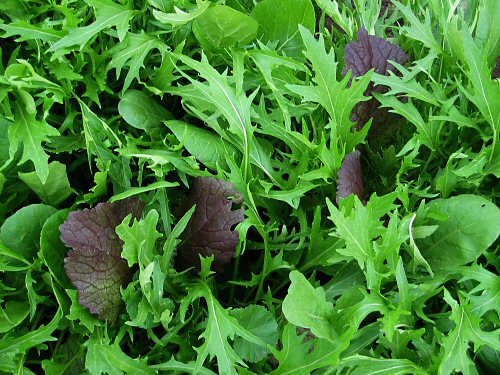
Although we haven’t had frost and the weather’s been overall incredibly mild, it’s still the fall cool season crops that’re doing best. Here, a mix of spicy brassicas, grown entirely in the post-flea beetle season—no row cover and no holes! There’s arugula, mizuna, tatsoi (a kind of bok choi), and red mustard. It’s a zesty, peppy salad on its own, or mix with lettuce. The leaves are a little past the baby greens stage—they’re growing so fast—so just tear ’em up! (That’s what I say at the farmers’ market… :) Oh, and while the weeds have slowed down dramatically, they’re still around: can you spot the mallow?
Cabbage and cauliflower
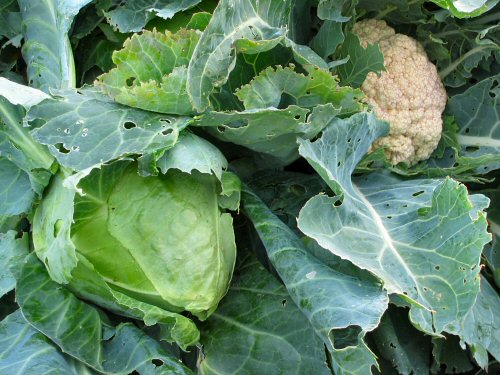
A pointy English cabbage (Early Jersey Wakefield) and a hybrid 55-day cauliflower (Early Dawn), side by side on the harvest wagon—not too common a sight! The main crop brassicas (broccoli, cauliflower, cabbage, kale,…) are easy to grow but harder to maintain when conditions get rough. Vicious flea beetle attacks on seedlings (and occasionally, when they really swarm, on mature plants) last from spring well into August. Floating row cover is a must. This in turn makes weeding difficult: either the weeds build up under the cover, or there’s a whole lot of uncovering and recovering to do. Then, the effects of regular drought can be brutal on big brassicas, and our spot irrigation doesn’t always keep up with their thirst. When more permanent drip irrigation is in place, the brasscia situation will get a lot better (next year!). Right now, every successful haul is a particular pleasure!
Latest brassicas released
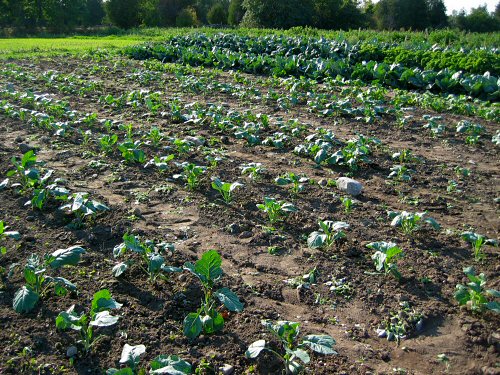
On this bright and shiny Sunday, we finally released the last of the season’s brassicas from under row cover. The flea beetles have almost vanished and the plants need all the light they can get if they’re gonna make it to harvest. It’s still a bit of a long shot for the broccoli and cauliflower, but the early and prolific Red Russian kale should do fine. For what it’s worth, the long range forecast calls for a warm September—I’m still starting to slip into frost watch mode!
Crops for Fall
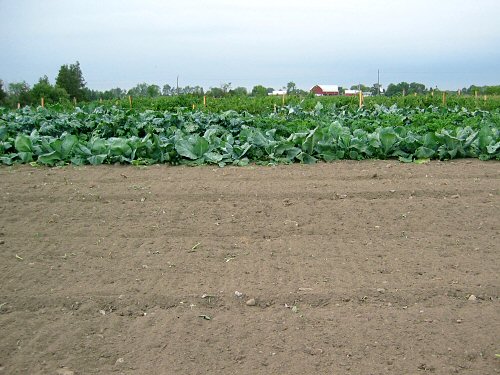
Newly released from row cover, five new beds of brassicas (cabbage, broccoli, cauliflower, kale) get ready for Fall. Beyond, tomatoes (and beyond that, the farm across the road, they gather honey). In front, a vacated section that contained the season’s first planting of peas seeded way back in April, and is now awaiting a mid-August green manure cover crop of…oats! And still, no rain…
More hands on deck
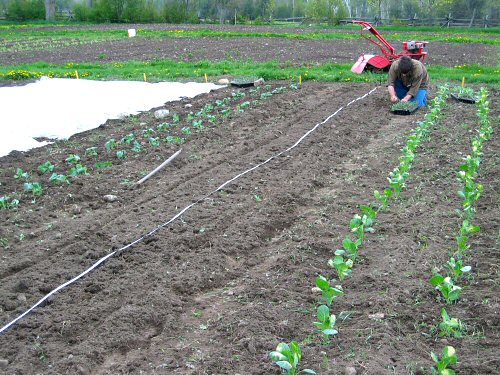
Conall, the all-new organic grower, is back after being unexpectedly called away two and a half weeks ago. That happened after we’d worked together for seven days straight. For me, making the transition from essentially solo tiny farming to having regular help was that quick. Having everything bouncing around in your head, with little need to explain it, is a luxury and efficiency of sorts. On the other hand, if you have people who you can sync with, sharing the gardening in an ongoing way seems like even more fun. And you can grow MORE STUFF with LESS WEEDS!! :) It’s a really welcome return. FREAK FROST: Three nights ago, according to the min/max thermometer, the temperature bottomed at a little below 0°C (and there was no reported cold snap or hard killing frost), but some of the brassicas (Brussels sprouts—see the whitish spots on the leaves on the right of the pic, bok choi, cauliflower) and two out of three varieties of peas got fairly toasted, burnt by the cold. Many of the pea leaves were totally killed off. I only noticed the extent of the brassica damage when we took off the row cover today. This is something I’ve never seen, and Bob, with 40 years of farming, hadn’t either, especially with peas, which can grow in the snow. The additionally odd thing is that some varieties (one of the peas, broccoli) weren’t affected at all. These are all plants that can normally take an overnight freezing and bounce back no problem—temperatures around zero should be nothing. Weird. My random theory: a very rapid temperature drop, many degrees in a few minutes, that didn’t give the plants enough time to adjust…? Anyhow, everything’s recovering just fine! The crazy weather effects continue…
Heading out…
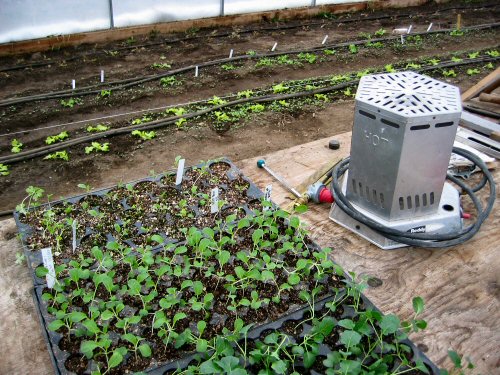
The cold spell seems to be broken, the nights are going down to zero F instead of -10. Time to start moving the main act to the hoophouse. First out, some hardy brassicas: a tray each of broccoli and bok choi, and a mixed tray including some parsley that I set out a couple of days ago as an extreme cold test. This is my first year for early season brassicas, so I’m a little cautious, although I’m well familiar with their general hardiness in the fall. These probably could’ve been out earlier. In front of the table, the lettuce, with the carnage renewed. Overnight, the voles tore apart another 10 seedlings, and I noticed they’d eaten the growing points off another dozen of the red lettuce, taking the toll to 30-40, depending on whether a few recover. Measures, as in, more strategically positioned snap traps and filling in the perimeter, have been taken. In any case, no worries, there’s lots more on the grow! OK, sitting beside the trays on the table, there’s the Heater, intended for construction sites and the like, which hooks up to a regular BBQ propane tank and provides a good amount of heat for surprisingly little gas. It’s not needed yet, but when the tomatoes and other tender guys come out, it will likely be on at night.