
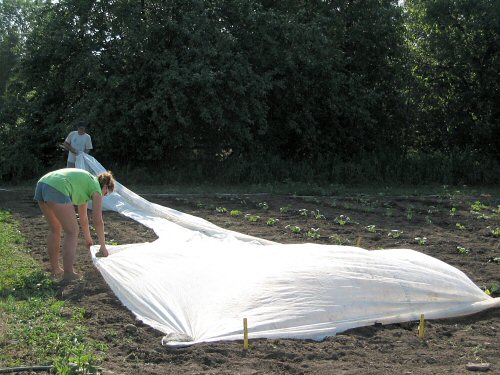
Protecting a final planting of the season, Jo and Conall lay row cover over a selection of summer squash. Also transplanted today from the squash family, more cucumber, an extra early muskmelon, and a couple of early maturity winter squash because there’s space. All of these are pretty much risk crops, with 50-65 day maturity up against our average first frost of around Sep. 20. They could have gone in a week or two earlier, but I’m gambling on another warm fall, with only a mild frost or two to get in the way (against which, row cover once again!), and MAYBE a harvest through October. Of course, the weather can be relied on less than ever, BUT, warm autumns seem to be a good bet. If this pays off, I’ll have some interesting veggies after the standard, safe season for ’em is over. Nothing ventured… You take your chances!
Conall
Sort, bundle, bag
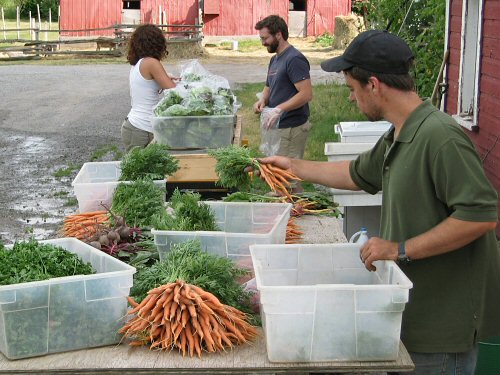
Fridays put this tiny farming system to the test, if we don’t get everything done for market and CSA shares, things would simply…CRUMBLE!!! Rain or shine, Friday is the main day for bringing in the weekly harvest, when we have to pick, sort, rinse, and bundle or bag 60-80 of everything that’s ready for the Saturday farmers’ market (about half of the CSA shareholders also pick up at the market). This week, the veggie selection is still small: beets, carrots, shell peas, green onions, mesclun, parsley. Here, at 6 pm, the picking, digging and pulling part is mostly finished and it’s mainly post-harvest action in the shade of the barn: Erin and Mike (not me, another Mike) bag and weigh just-rinsed mesclun, while Conall bundles baby carrots.
Doing the rounds
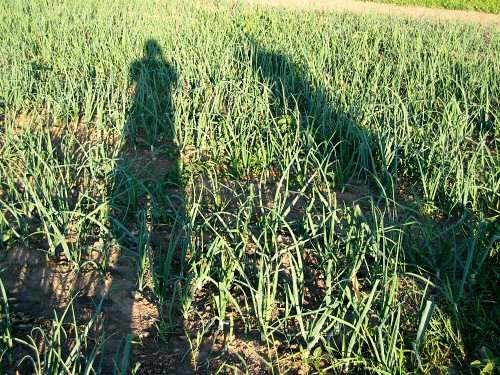
Since the start, the idea of a daily full garden inspection—”doing the rounds”—seemed to make sense. It sounds easy enough, but somehow, it doesn’t get fully done all that often, there’s almost always something that seems absolutely pressing to do early in the morning or in the evening when a stroll about is most practical and pleasant. But of course, I do get around to see everything every couple of days at least: checking for weeds alone insures that. Today, Conall and I managed to do a pretty full walk about. You look to see how things are doing in general, check for the start of new weeds and pests…it’s amazing how things can creep up and then jump out at you if you’re not watching closely. Here, we’re checking out the onions. So far, they’re doing well!
Beet greens harvest
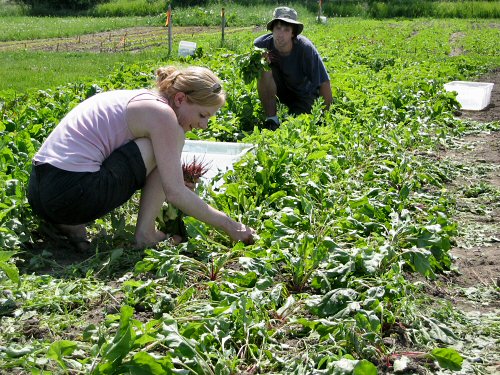
Andrea and Conall harvest Cioggia beet greens in the hot mid-afternoon sun. In tiny farming, it seems that every action has several different effects and offsets, some good, some not so, and a balance, hopefully leaning to the positive side, is struck each time. Here, harvesting greens in the heat is not the greatest for the freshly pulled leaves or the plants that remain, but this is the time we had (a cloudy afternoon with a mild, refreshing breeze every harvest day would be nice!). A quick bath in cold well water instantly refreshes the harvest, and the plants will recover overnight. This particular bed of beets had gotten quite weedy, so weeding while harvesting slowed things down. But, the fairly dense piles of pulled weeds, spread between rows, dries into a decent mulch that’ll help retain moisture and prevent more weeds from germinating. And, the harvest is also a thinning session, giving the remaining plants the space to fill out into proper beets. It all works out…!!
Working in the rain
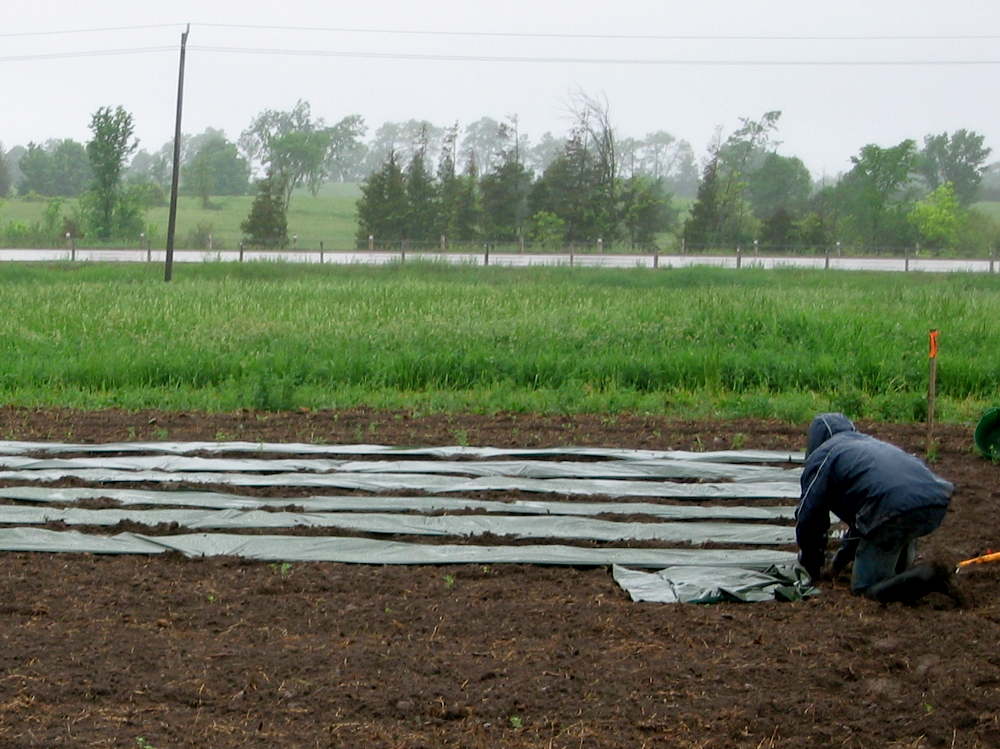
The rain is good (15mm over the last day), the chill (there’s a frost warning for tonight and tomorrow) and sticky clay-loam mud are not so good. But the calendar is flipping and there’s really no time to take shelter. Conall puts in plastic mulch for melons, anchoring it every few feet by scooping out soil, pushing down the plastic, and replacing the soil. We’ll cut X’s to transplant into, and water by hand around each plant as necessary. Labor-intensive, but it’s the most reasonable way to decent melons I’ve found so far, and it worked out well two years ago. After experimenting with straw mulch for tomatoes and melons last year, I’m back to using plastic for melons, and that’s it. Straw is great, but the extra work of spreading and then the fall clean-up seemed like stretching it for everything else that has to be done this year.
Fieldwork!
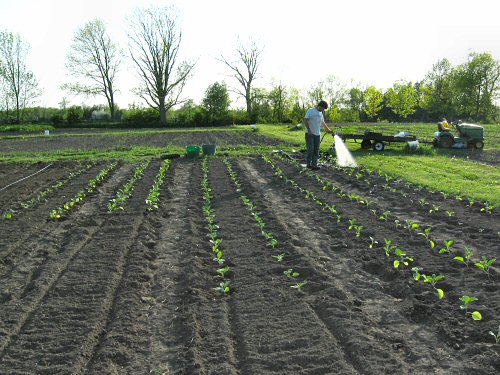
Towards the end of the day, Conall waters in newly transplanted eggplant and peppers. Over the last week, focus has moved almost entirely to the open field. The seedling room is empty, the last of the seedlings are now in the greenhouse, and the push is on to get things in the ground as quickly as we can. My juggling of HELP is on-going. Word-of-mouth recruiting has gone surprisingly well, there’s quite a list of willing workers, and it’s tempting to call in a whole crew to transplant all at once. On the practical side, having to explain and coordinate takes a lot of time, I don’t yet have a System that works for several people in the garden at once, so I’m going along more carefully, working with Conall and at most one or two others per day. And one can’t forget the budget. In any case, everything should be in over the next 10 days. Think fast, take it slow!
Tomatoes go in
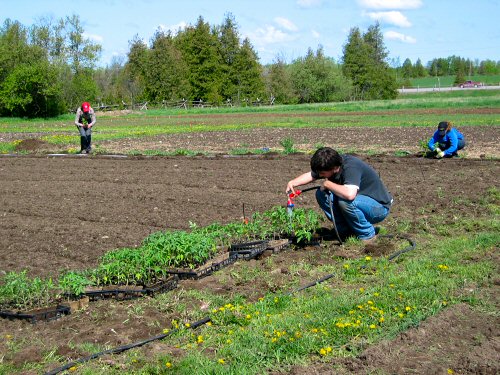
The first of the tender, warm season transplants—tomatoes—hit the field today! About 175 seedlings went in: Juliet, Striped German, Stupice, Emerald Evergreen, Mule Team, Yellow Stuffer. On the transplant team: Conall, Sherry and, new to the season’s crew, Jo. Compared to doing transplants alone or with one other person (my experience so far), this was quite the operation. Teamwork!
Juggling the weather and part-timer scheduling, I took a bit of a risk transplanting today, with patchy frost forecast for tonight. Still, the plants have been through highs and lows in the greenhouse, row cover will help, and tomatoes have…never let me down. I’ll be up at dawn to see how it went. Everything’s a gamble!