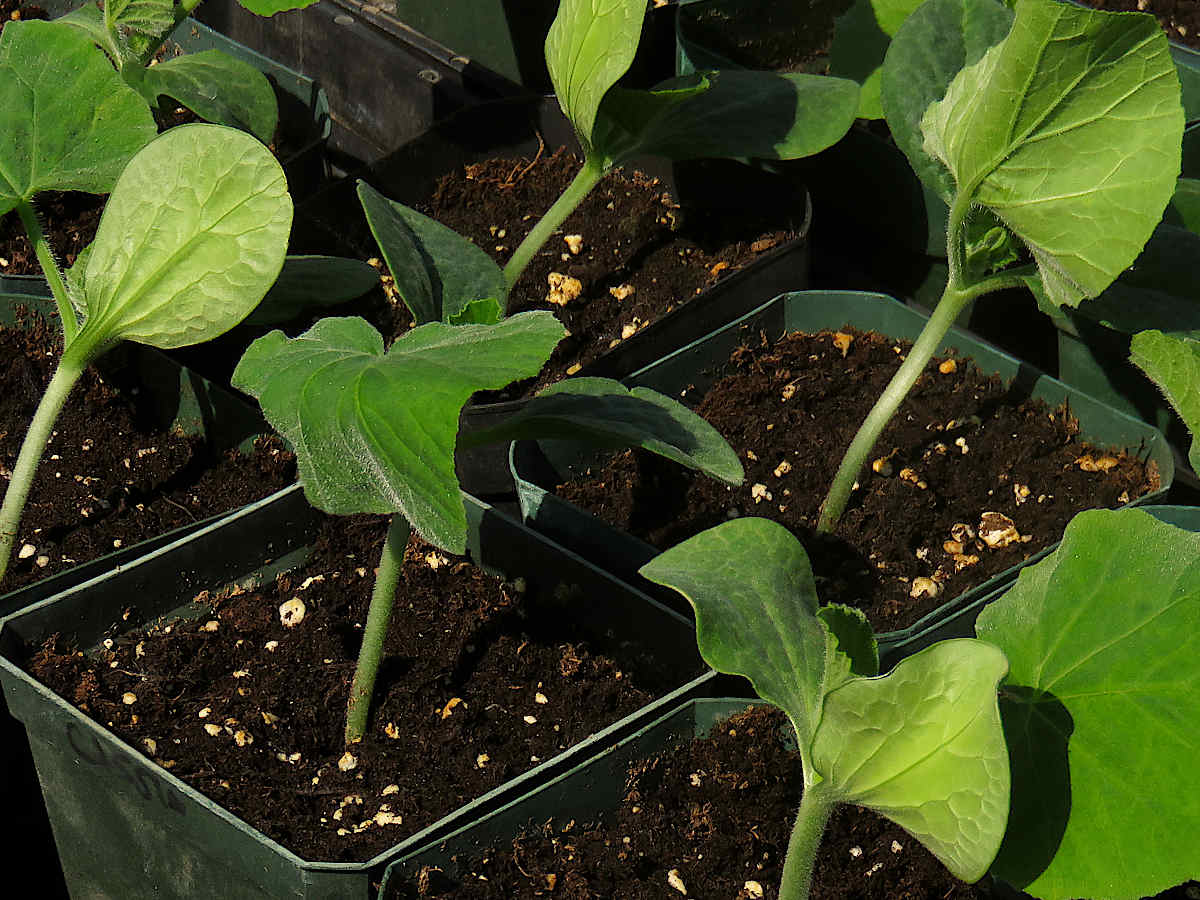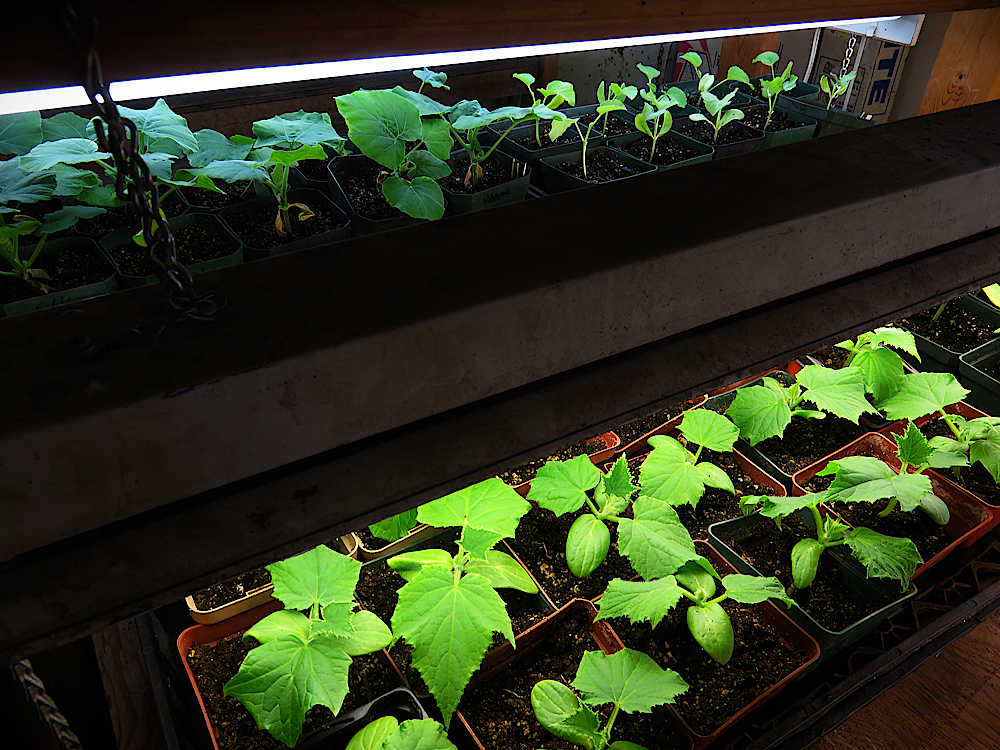
The seedlings are filling out fast now, with full days in the sun. Feels like they’re raring to break out! Stuck in their little pots, they could be being called to by their siblings already transplanted out in the field. Who knows?! One thing for sure is how fast they’re soaking up water now. Of course, it makes sense, it’s no surprise—but the little routine meter in my head sees that a good watering lasted a couple of days just a week ago, and now, especially in the tiny plug sheet cells, the surface is dry in hours and the trays feel light. There’s the sun and the wind to help evaporation, but still—thirstier and thirstier as they wait for the field!
cucurbit
Thigmomorphogenesis
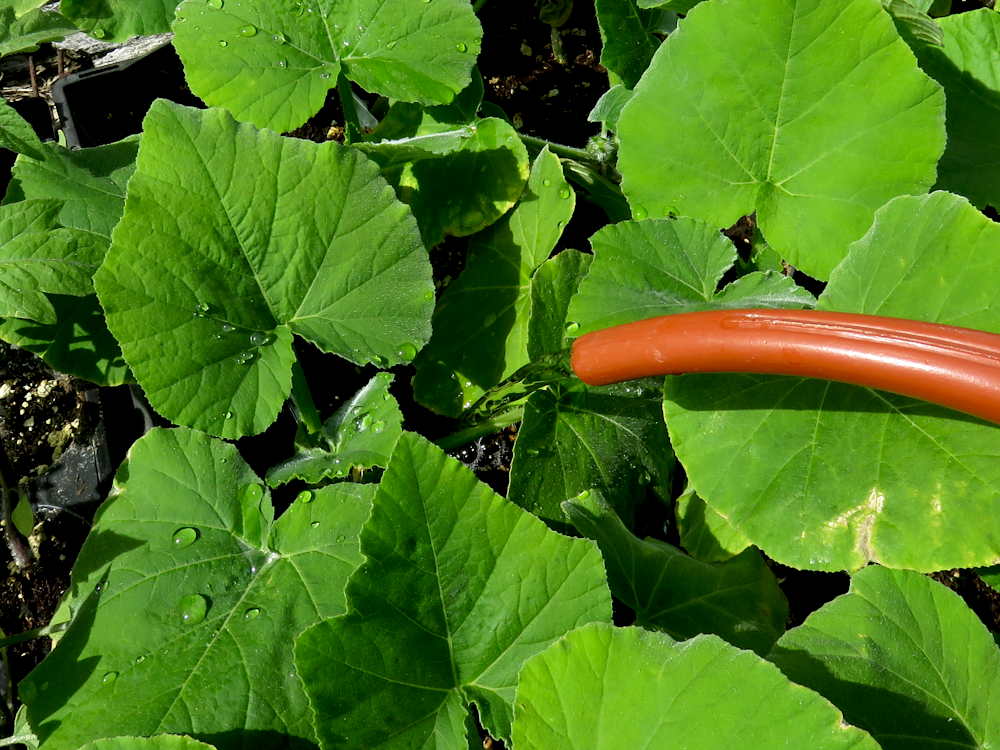
Squash seedlings in a stiff breeze—gale-force wind would’ve made for a more dramatic image, but thankfully not. This bending and fluttering of leaves is another benefit, besides the sun, of taking indoor-started seedlings out into the real world.
Movement, like blowing in the wind, triggers the catchily named thigmomorphogenesis process in plants, where they dramatically toughen up after getting a little pushed around. It could be wind, a pummeling rain, animals or hands brushing by or moving them about. Makes perfect sense for them to armor up.
I’m not particularly into the details of how they change, develop sturdier stems and whatnot—tougher seems to sum it up just fine—but it’s good to know about (I used to use an oscillating fan in winter). And I really like the term. For most of my life, my casual thought was that knowing everything would be cool, kind of like AI tries to today. At one point, though, conveniently marked by a certain blog post, my thinking flipped to often wanting to know less. Not cheering for ignorance, just comfortably sticking with what’s necessary for the moment. So, thigmomorphogenesis—long, unwieldy, yet surprisingly easy to pronounce after a couple of tries!
Zukes vs cukes
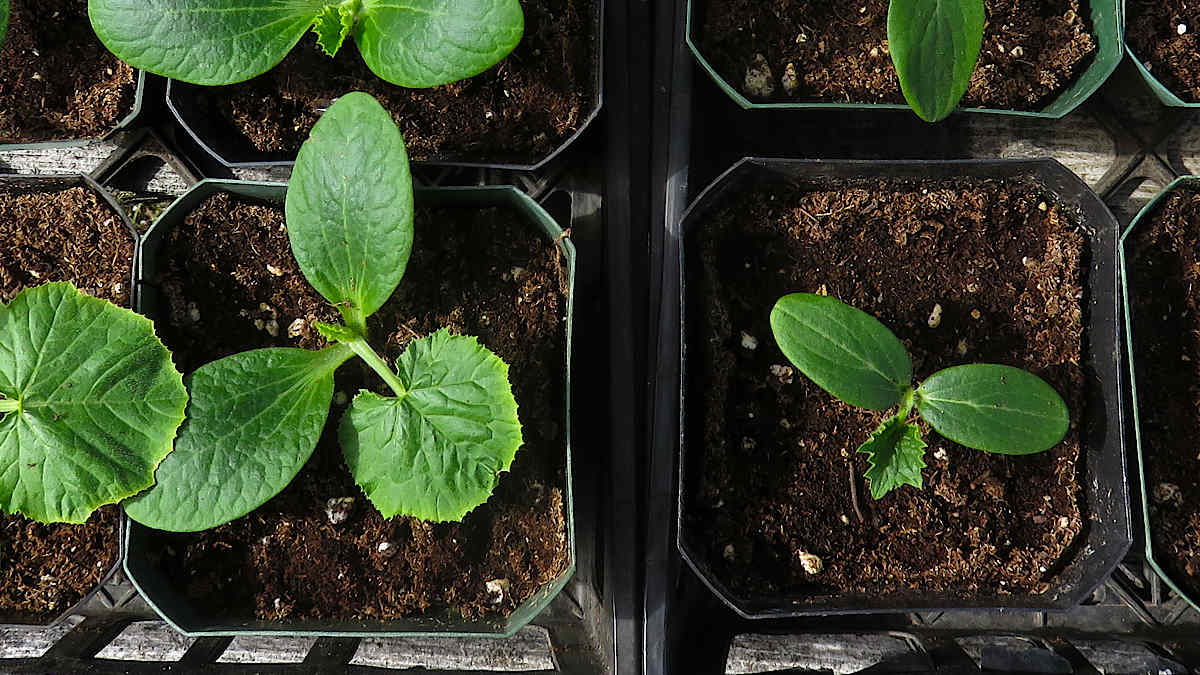
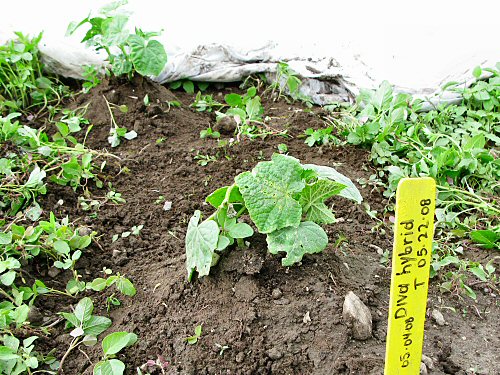
Zukes vs cukes—same family, different natures. On the left, zucchini are big, bold, and prolific with fruit that blow up to dirigible class if you take your eye off of them and stop harvesting more or less daily. On the right, cucumber, more modest in appearance, preferring to vine out than shoot up, unless trellised. Cukes are about equally prolific in the quantity of fruit as the zukes, but not so prone to expanding when left unharvested. Here, barely two weeks from being seeds in a package, with very similar seed leaves (the first two leaves to come out), the difference in their true leaf size already displays their separate ways. Today, they’re out in the sun.
Cucurbits!
Cucurbit, from Cucurbitaceae, is a useful word! How else would you refer to the large squash-and-melon family that includes winter squash like acorn and butternut, summer squash like zucchini, pumpkins, gourds, melons (cantaloupe, watermelon, and so on), cucumbers, even the fruit that dries out to become loofah sponges. All the same plant family, all with similar-looking leaves and sprawling vined growth. I’ve on and off wanted to learn the scientific Latin-word plant classification system. I’ve even semi-memorized the basics more than once, then soon forgotten, because there’s no actual use for it in my day to day. But some terms, like cucurbits, do come in handy…
Weekly Harvest Share #2
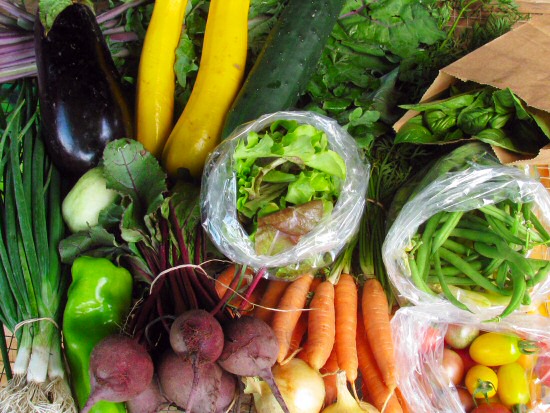
A pretty satisfying second installment of our “experimental” Weekly Harvest Share: “Like CSA, but one week at a time…”! Satisfying because, for the first time this season, harvest day felt kinda normal, with around 20 items harvested, enough variety to have to pick what went into the shares. And the winners, the veggies that made it through thick and thin: kale (Red Russian—no worries about running out of RR…), beets (Kestrel), carrots (Nelson), zucchini (Golden Dawn III, always there in numbers), cukes (Fanfare, Lemon), baby leaf lettuce (house blend, and a nice first cut!), beans (Jade, Indy Gold, first picking of this planting), assorted cherry tomatoes, green onion (Ramrod), sweet pepper (Cubanelle, picked young and green), onion (yellow cooking, from sets, kinda…compact), peppermint & spearmint (bagged, for tea!), and eggplant (old reliable Dusky). So, better late than never!
Checking under row cover
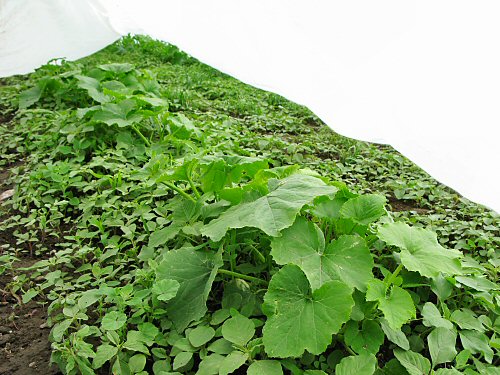
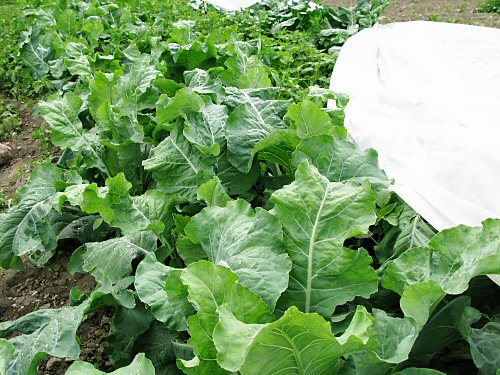
Three weeks ago, it was floating row cover everywhere. So, what was it worth? Today, I checked things out. Overall, growth has been startlingly slow, due to the lack of sun. This is really noticeable in the summer squash (above), which could be huge at this point, but…aren’t. Under cover, these zucchini (I didn’t check the variety) are doing fine, no cucumber beetle damage, but of course, weeds are doing fine as well: unmolested under there, pigweed runs rampant. I’ll take the cover off here in another week or so, and then there’ll be a whole lotta weeding to do… I removed the cover from the first beds of cauliflower (Snow Crown) and broccoli (below), they’re big enough to take a little flea beetle munching. The leaves have shaded out much of the potential weed action in the beds, but you can see a nice collection in the path (top center, where the row cover ends). The plants look untouched, although the flea beetles managed to get under and at the kale and collards, (they’re out of sight just to the left)—I left them covered, back in a week. If there’s any doubt about what the FBs will do, just check the radishes, which grow MUCH faster than these guys and can survive the damage…
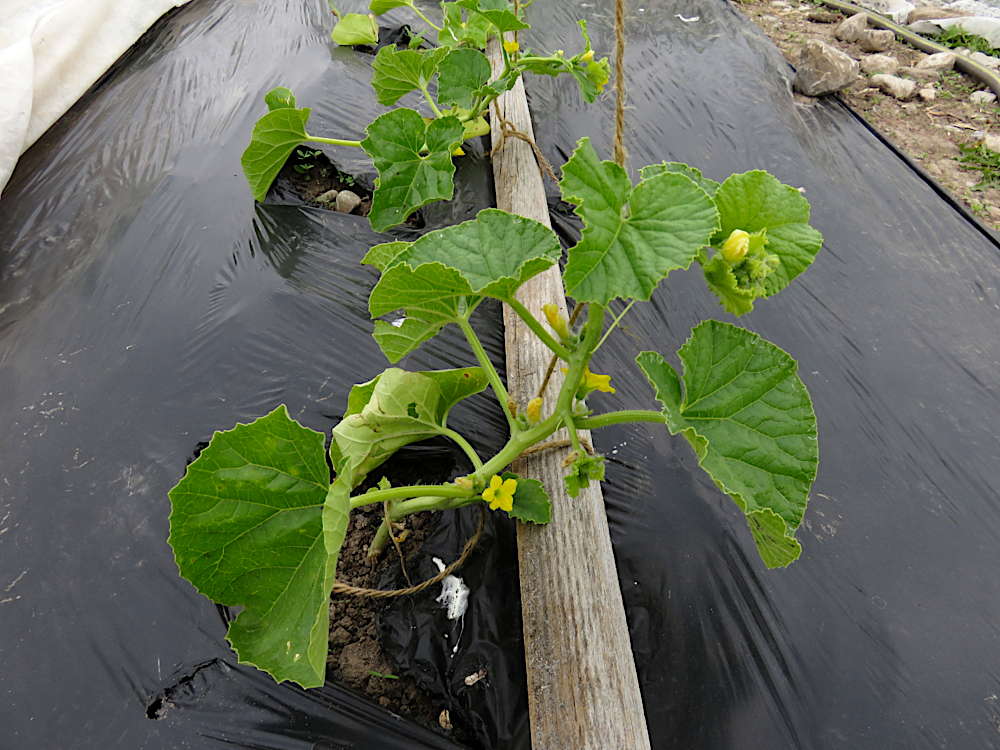
Back with the cucurbits, the cucumbers are the most noticeably slow: after a month, they’re hardly bigger than the transplants they started as (hope it’s all going into the roots!)… I’ve cleared away the weeds between a couple of the plants, beetle damage is minimal (they tend to get in at the ends of rows, where the cover can get blown up by the wind), but there are weeds everywhere. Cover goes back on here for a while. Weird stunting weather and floating row cover: not the most peaceful and inspiring natural garden combo, but it should all straighten out in a bit… ;)
Row cover everywhere
It was impossible to capture all the floating row cover outposts scattered around the feel in just one shot. This pic shows maybe a third of the area under the light, white, spunbond polyester protection. Right now, it’s being used as protection from two separate things: frost and bugs. Let’s see, it’s on all the cucurbits (so far, that’s cucumber, summer and winter squash, and pumpkin) to protect from the cold and striped cucumber beetles, on tomatoes against cold (and coming off in a few days), on the brassicas (broccoli, cauliflower, and the like) against ravaging flea beetles but not the cold (coming off when the plants are fairly big and can withstand the FBs). I’ve used row cover from Year 1, far as I can remember (there are NOTES and even pics…somewhere). Initially, I really didn’t like it, it looked so…unearthy, synthetic,…not part of the garden. BUT, the alternatives, like planting later, ending harvest earlier in fall, temporary wind breaks and cold air channels, trap crops, and all sorts of complex interplanting (so one crop protects another), encouraging beneficial insects, more elaborate timing (basically, closer second guessing of insect cycles and the weather), not to mention a completely adapted, semi-permaculture set-up where everything is at home no matter what, were all way out of what I could handle as I dove into tiny farming with the intention of heading to the farmers’ market in the first season. Floating row cover lets me extend the season by at least a couple of weeks at each and, and I can avoid all pesticides (and there are some killer insecticides allowed even in certified organics) and a lot of bug grief (stemming from lots of LOSS). I still don’t really LIKE row cover, though, the way I like, say, my Sneeboer three-tine cultivator or even the Horse rototiller (I can understand how the Horse is built, get if fixed, or do without). More and more lately, I wonder when FRC will become insanely expensive, or real scarce, or just plain run out… It’s as oil-based as they come, and kind of in a high tech product class of its own. This year, in a small fit of…paranoia (?), I actually ordered a new 1,000’x14′ (300mx4.3m) roll, even though I have enough for this season at least. It’s not much of a stockpile, but, carefully managed, it could get me through 3-4 more years along with what’s on hand, at this tiny farming scale… Oh, well, the more you know, the less you need is what I believe. I’m learning as I go. Keep farming long enough, and I’m sure I’ll get beyond the cover if it doesn’t run out on me first…! :)