
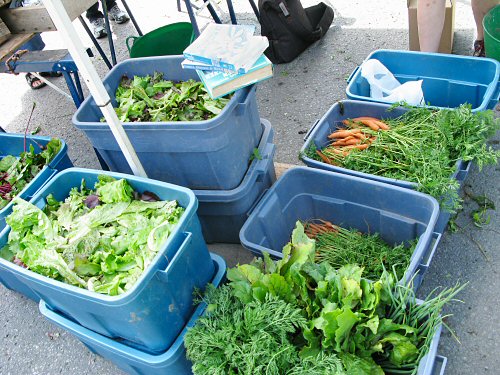
Rubbermaid storage bins are the main harvest containers again this season (I suppose that’s a plug for Rubbermaid, unintended, it just seems like they’re the only company in the plastic storage bin market!). They’re inexpensive (around $8 each), hold a little over a bushel, and the lids fasten well. They’re easy to clean, and they stack well, loaded and covered, or empty. And they’re durable. I somehow ran over one with the Kubota compact tractor, pulled it back in shape, and it’s in service again. They’ve changed color this year, the new ones available around here are a kinda tacky metallic blue, but that’s no reason to give ’em up. We have about 25, along with a dozen or so green bushel trugs…so I guess that’s the cap for the maximum harvest haul for now! Today at market, there were about 15 of ’em full… Balanced on the edge of one is a stack of three selected gardening books, brought to market for customers to check out…
marketing
Dirty hands at the farmers’ market
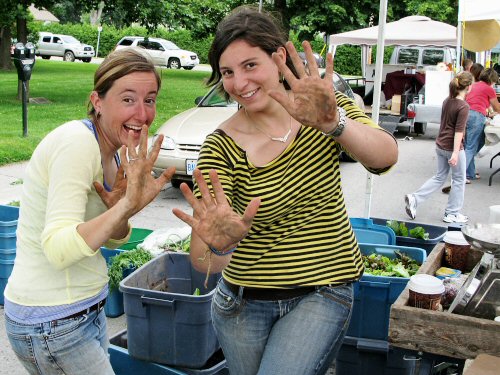
Over the last couple of weeks, we’ve been experimenting again with rinsing versus…not rinsing. This comes up a couple of times every year, where I think (or someone suggests) that rinsing various veggies is not necessary: to save time, to improve storage, to preserve nutrients,…the reasons vary. (For me, the time-saving is always a big attraction!) Sometimes, crops just have to be rinsed to cool them down quickly if harvested in the heat, or because they’re really mucky from heavy, mud-splashing rain. In any case, this week, we didn’t rinse the carrots, beets and beet greens, so sorting at the market was a bit messy. That’s Lynn and Maria, happily dirty-handed… The conclusion is usually the same: when the harvest is really kinda muddy, which is often the case this year with all the rain and wet ground, a quick rinse is better all around, for handling and for presentation. Still, the experimentation continues!
Plastic…fantastic?
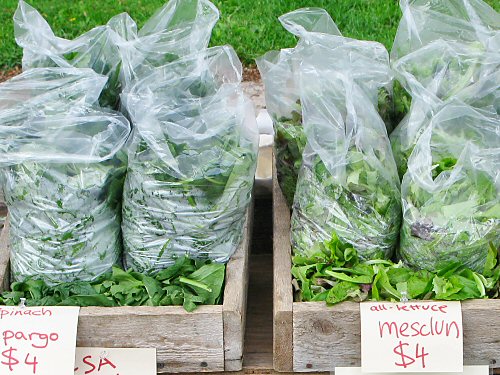
At the market today, greens were finally in great supply, with loads of mesclun and spinach: two giant, clear leaf bags full of each. I went home with quite a bit—no sold out sign this week!—which was great, ’cause I was selling right up to the end. And, as usual, I noticed all of the disposable plastic involved…
Greens, and market/CSA share harvests in general, usually involve lots of PLASTIC BAGS. In the beginning, this didn’t overly concern me on any level, other than that buying bags by the hundreds and thousands was kinda costly. But being on the dispensing side of this steady stream of plastic gradually made me realize how much of it is continuously being tossed out there FOR NO LASTING PURPOSE.
What got to me first wasn’t the environmental issue, but the fact that people were profiting off of this useless mass consumer habit of taking tons of “free” bags at every stop… Don’t like being fooled again and again… This culminated in one way for me about two years ago, when I stopped taking shopping bags for, like, 98% of my store shopping. Last year, I started cutting down on the way I offer shopping bags at the market: instead of automatically grabbing a bag for a customer as I asked if they needed one, I ask in a leading way, kinda eying what they’re carrying already—not surprisingly, with all of the anti-plastic bag attention lately, the majority of people so far this year bring a basket or cart, or fit their purchases into a bag they already have.
I mean, to grow greens, it takes 40-60 days of watching, watering, weeding…and suddenly, in less than 24 hours, they’re harvested, bagged, distributed, and, hopefully, within another 2-3 days, EATEN. And the really useful life of the plastic in a bag of fresh-market greens is more like a very few hours, because once you’ve gotten your greens home, there are many more efficient ways to refrigerate them (like in a nice cotton bag, in a salad spinner, in a big bin,…). But there’s nothing that easily replaces the convenience of plastic for that last little trip between stand and home (a couple of people have asked that everything, greens and all, be tossed loose into their own shopping tote, which is kinda cool and should work no problem, but doesn’t sound too easy to encourage amongst ALL…).
So what am I getting at exactly, besides the OBVIOUS? Well, I guess it’s that plastic is curiously useful stuff, I’m not about to outright REJECT it in all its many handy shapes and forms, but I should learn more about it for a start… More as it unfolds! ;)
Finally, a field harvest…
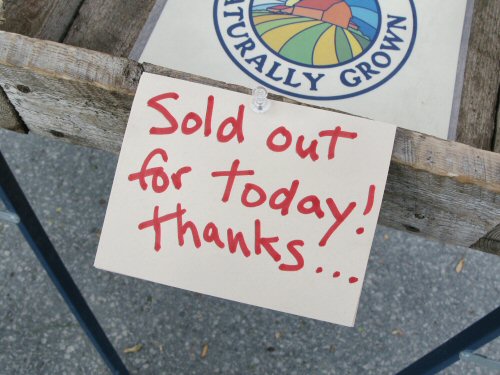
Finally, this year’s field-planted all-lettuce mesclun and spinach were ready for harvest, and that’s all I brought in to the farmers’ market, but in decent quantity. Unfortunately, I still underestimated and was sold out by 10:30 (the market runs 7:00am-1pm). It kinda looks good, being sold out, but really, if you’re doing things right at the market, you want to go home with a very little bit left over. That means you’ve brought enough for everyone who comes by, and have enough to display more than the last one or two of each veggie—it’s a pretty tried-and-true rule that selling the last of anything is harder, one of the few rules that seem useful to me. Overall, I don’t give much thought to sales tactics: with really fresh, high quality veggies, clean presentation, and a (genuinely) cheerful, helpful presence, word of mouth should do the rest. But making the food look attractive I think is a pretty basic part of food enjoyment and…celebration, and having enough for an inviting display right till the market ends is part of that. Of course, selling all you can is another part…the farm may be tiny, but there are still things to buy and normal-sized bills to pay! ;)
Veggie Outpost 2
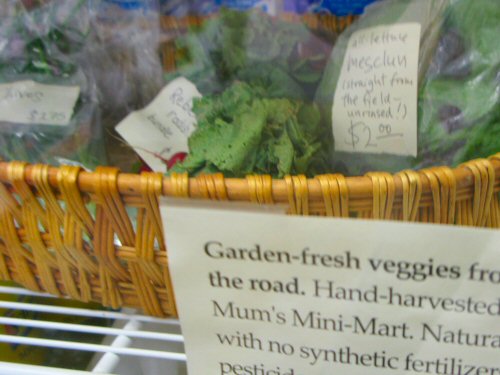
Last year, a little experiment with veggie sales in a town 12 miles (19km) away didn’t go so well. I guess you could sum it up as No Quality Control. This year, in line with the tiny farming trick of thinking SMALLER, I had the sudden idea to put some veggies in at the convenience store three minutes down the road in the village. This is now the only store for quite a ways around, and it has the post office where everyone in the village picks up their mail. Since I’m always meaning to get the farm stand fully open, putting veggies out a couple of minutes away hadn’t quite made sense, but the way it came to mind now was a little different. If I could get a single shelf in one of the coolers, this would be an interesting, easy way to learn about veggies and refrigeration, and even be able to watch a mini version of the supermarket, convenience-shopping experience, by seeing what sells, the effects of labels and pricing, and…whatnot. All on the most casual level. Refrigeration is, of course, yet another of those many worrisome topics that come up along with Peak Oil and the generally somewhat alarming state of the world, BUT, fridges will likely be around as long as any number of other taken-for-granted things, I figure, so whatever’s learned from a little, low-impact experiment like this should be worth it. It’s an extremely simple set-up, with a small sign taped to the inside of the cooler door, hand-labeled bags, and an honor-system account book for inventory. I also like the idea of super-fresh garden veggies popping up in this most unlikely place, just below the shelf where a few supermarket-purchased veggies are kept for resale. Outpost 2, the Shelf, has been open for around three weeks now, stocked with ones and twos of mesclun and spinach, a few radishes, some herbs. I’m by there every day anyway, so I check the veggie condition often…and things are selling… Interesting enough…!
Potting for market
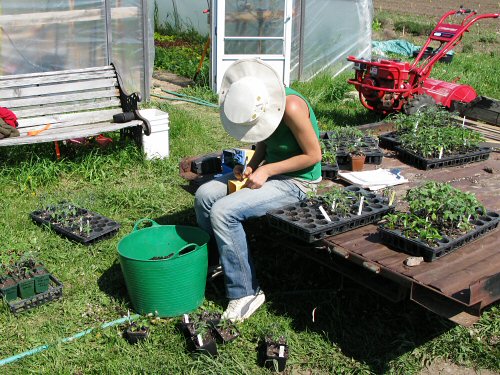
With the recently warming weather, field crops have started to grow more quickly, but nothing but radishes will be ready for this Saturday’s farmers’ market, and the early lettuce in the greenhouse has gotten pretty low after two weeks of harvesting. This is a first: by the end of May, mesclun and usually spinach have been ready in the field. Not this time. Sooo, we decided to fill out the week’s market stand offerings with seedlings. Selling my extra insurance seedlings at the market is something I’ve avoided until now: for the few dollars more, it didn’t seem worth the chance of complaints if anything goes wrong (I’ve heard people blame all kinds of things on the plants they buy)—usually, I’d sell or give only to people I know. There’s always a first time, so Shannon potted up and labeled a couple of dozen spares. We’ll take a walk on the wild side and see what happens… :)
Farmers’ market: Day 2
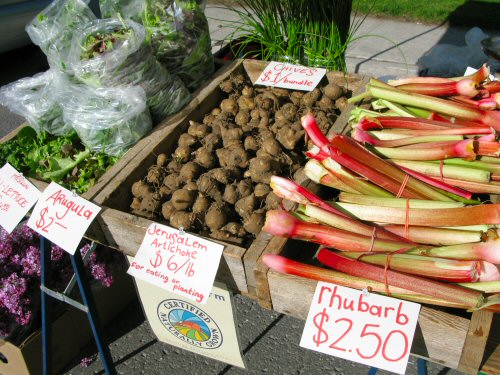
Really fine weather for our second market day of the season: sunshine, warmth, a pleasant breeze…! A bit more variety than last week, with all-lettuce mesclun, spinach, arugula, Jerusalem artichoke, chives and rhubarb, but still not much quantity of anything. We were sold out by around 10 a.m. Hanging below the chokes bin is the “Certified Naturally Grown” sign. It’s a new certification this year, in addition to our “certified organic” status. Naturally Grown is a grassroots, farmer-to-farmer program, started in the USA, and entirely voluntary and at no charge, where farmers’ certify other farmers according to essentially the same production standards as the government-regulated organic program. Instead of a lot of paperwork and fees, it’s simple and straightforward, but of course the legal word “organic” can’t be used, so it’s…”naturally grown” instead. Since there are only a couple of other NG farms in Ontario, and none close by, the inspection for this tiny farm will be done by CSA members. I’m still maintaining regular organic certification, but for what we’re doing, selling local food direct to people, Naturally Grown makes most sense to me…