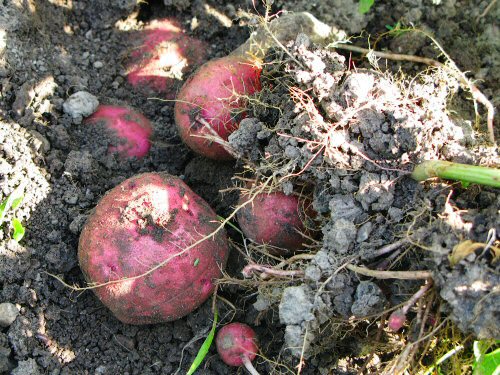
Thursdays are potato harvest days. Without a walk-in cooler, the main weekly harvest for CSA and Saturday farmers’ market is mostly confined to Fridays, with potatoes being one of the few crops that can be done a day or two ahead. Towards the end of the season, we dig up all the remaining spuds in one shot, but until then, it’s easier to go weekly. And since I don’t sell potatoes in bulk, curing them for storage is not an issue. It’s a tiny harvest, and the method of choice goes with it. Simply pull up each plant—they’re at 12″ (30cm) spacing—and scrabble around! Fingers work great. I used to use a digging fork, but that’s more work than it’s worth, and potatoes often get skewered. By hand, it takes 20-30 minutes per bushel (about 50lbs/23kg), really fast this year with quite huge potatoes after all the rain, and sometimes stretching to maybe 40 minutes if they’re small and the ground is drier and harder (this’ll happen in a really dry year, where potatoes get little or no irrigation). When the ground is dry, especially in clayey soil like ours that can get really hard, a hand tool like a trowel or tined cultivator can be good to break things up here and there after pulling. I kind of like how primitive the method is, and most people who try it REALLY seem to enjoy it. For the 2-3 bushels we need most weeks, it’s quick and effective! The variety here is Chieftain…
marketing
What’s new at the farmers’ market…
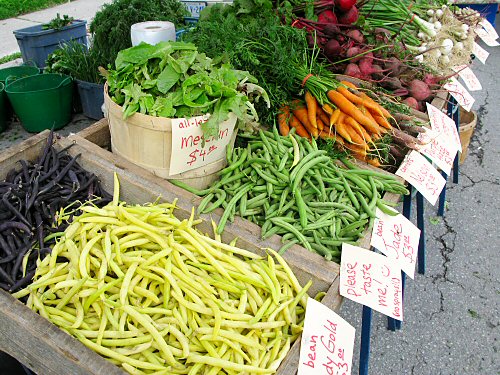
Ahhh, something new on the farmers’ market stand: BEANS in three colors (we had the first green beans last week)! There’s yellow (Indy Gold), purple (Royal Burgundy), and of course, green (Jade). One way I watch the season unfold is through the debut market days for the headliner crops, the big people pleasers. Lettuce is always the first up, a hit partly because it’s the first fresh veg of the season. Then, roughly in order, there’s spinach, peas, carrots, beans, garlic, and tomatoes. Strawberries and corn are also standard hits around here, but we don’t grow berries, and when we do have corn, it’s only for CSA shares. I find it odd that these particular veggies are so generally popular. What about delicate and delicious summer squash, lightly grilled? Versatile and tasty beets, diced and broiled, or grated raw with carrots in salad? Beet greens and Swiss chard, sauteed in butter and olive oil? The list goes on and on… Just about ALL of the 20+ basic garden veggies we grow are equally great to me, but that’s not the case for most people. Curious…
Pigweed rehabilitated?
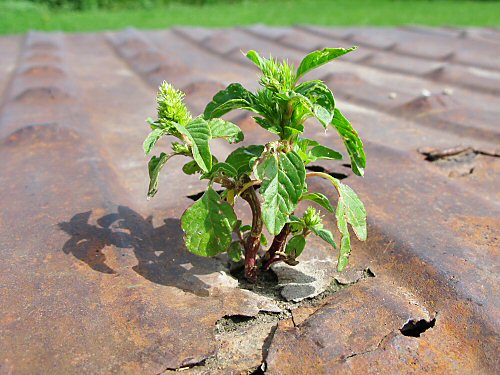
You’ve gotta respect pigweed. It’s resourceful, extremely flexible and adaptable, prolific…it just keeps on coming! It’s managed to grow in tiny dirt deposits, through rust holes in the trailer we use to get things around the field. It’s also run wild in one of the potato sections, where we’ve taken to hand-pulling it in one-hour concentrated weeding missions—it comes out by the trailerload…
The strangest development is that, this season, pigweed seems to be turning into a FOOD, a gourmet crop, even. Going down the lambs’ quarters urban trendiness path, I suppose. I started to hear about it from a couple of people, that it was being sold in Toronto (big city) farmers’ markets. There was even a comment here on the blog… Finally, browsing the web site of a farm not so far from here a couple of days ago, I read how they harvest PIGWEED at 12″ (30cm) and sell it as a tasty and nutritious cooking green…and they named it: Amaranthus retroflexus. Wow. Pigweed is the common name for a couple of varieties of amaranth, retroflexus being one of ’em. I’ve learned a fair bit about amaranth over the last few seasons, and there’s lots to like. There are many varieties and four general classes: vegetable (eat the leaves), decorative (the seed heads make colorful filler for cut flower arrangements), grain (more protein than wheat!), and…the WEED. Yes, I know a weed is only what you make of it, and it’s great to discover that we can EAT a plant rather than destroy it…but after all our hard-fought pigweed battles, this is hard to swallow. I CAN’T IMAGINE harvesting pigweed (that is, the weed varieties of amaranth) as a market crop. I mean, it would take some getting used to. And could I find a wholesale buyer, because I have a lot…? This year, I’m growing a couple of varieties of decorative amaranth in the cut flowers beds, last year, I grew one type of vegetable amaranth as a trial salad green, and a while back, I grew a couple of beds of grain amaranth, all from purchased seed, and all the while, weeding tons of pigweed… Weeding amaranth from amaranth. OK, I’m ranting a little… Maybe I’ll stroll out and gaze upon the mountain of pigweed for a while (that’s last year’s pic, it’s bigger now)—eventually, perhaps, I’ll get to a place where I’m simply wondering about all that wasted harvest… (Guest photo of trailerload of pigweed by Maria)
Farmers’ market cruises along…
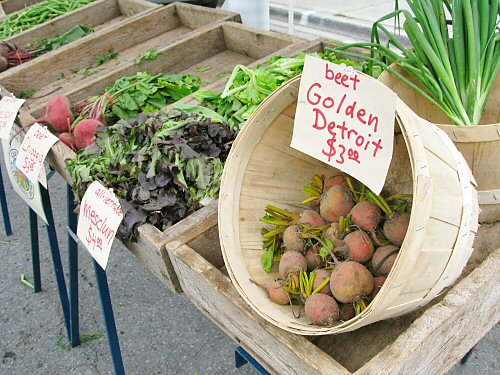
It’s 11 am and most of our harvest is sold. This is good, because the quantities of what we’ve been bringing have been fine. Still, with no early tomatoes, late green beans, not much summer squash, a wiped out first planting of cucumbers, and hail-killed first round of much of the peppers and eggplant, the pickings feel a little slim. It’s funny how variety seems to work at the market (and probably in the CSA shares as well): the greater the selection, the happier people seem to be, even though they don’t really buy more, or still buy mostly the same things. Maybe it’s because, as consumers (here in North America, at least), we’re so accustomed to being wooed by apparent choice, a regular parade of the “new” and the “improved” and cleverly repackaged, that having the same staple crops for a couple of weeks in a row makes the stand seem a bit stale. It’ll be…amusing to see outlooks change if (when) fresh food starts to get scarce. Well, all in all, a good day at the farmers’ market!
Laid back Friday harvest…
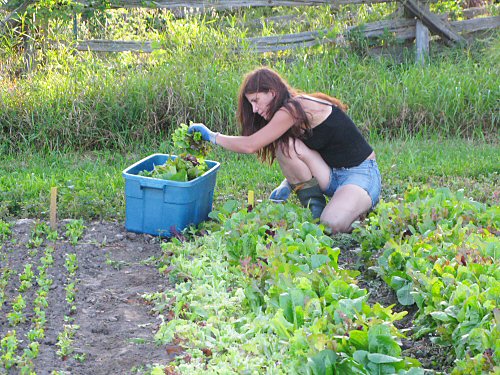
With the poor weather-driven slow growth and setbacks (like, hail), Friday harvests so far this year have been nothing like last year, much easier, less to do, relaxed. There are usually three to five people for all or part of the day, compared to six to eight last season. Comparisons don’t mean much on a practical level—the season you’re in is what you’ve got!—but it’s interesting, and human nature, I guess, to rank and rate and contemplate. Michelle has become this year’s mesclun cutting specialist, cruising in later in the afternoon and slicing up 60-70 lbs (approx. 30 kg) in no time. This year, depending on the veg, we’re doing about 20-40 units for sale, and around 30 for CSA shares for pick-up at the farmers’ market. Harvest on!
CSA share check-in
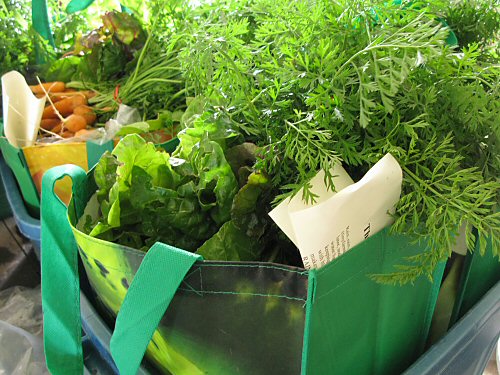
Monday morning means a quick small harvest for about half a dozen CSA shares. What’s in each share is my main harvest concern each week. The goal is to maintain the basics, like lettuce, carrots, onions, and also have some exciting new stuff each time. In a year like this one, with slow growth, this can be tough. But we’re doing OK so far. Today’s veggie menu, taken directly from the CSA newsletter: “In your share this week: basil (sweet); bean (Jade); beet (Scarlet Supreme); carrot (Touchon); garlic (Music); green onion (Ramrod); mesclun (all-lettuce); parsley (curly & flat-leaf); potato (Yukon Gold); Swiss chard (Bright Lights).” This season, shares are packed in really nice reusable shopping bags from one of the supermarket chains. They’re big and roomy, decorated with an assortment of veggie and fruit photo blow-ups, cost a buck, and can be replaced free of charge when they wear out. Much cooler than the hundreds of plastic grocery store shopping bags with the farmers’ market logo on ’em that I used to go through, and we also pass on the bags at cost at the market.