
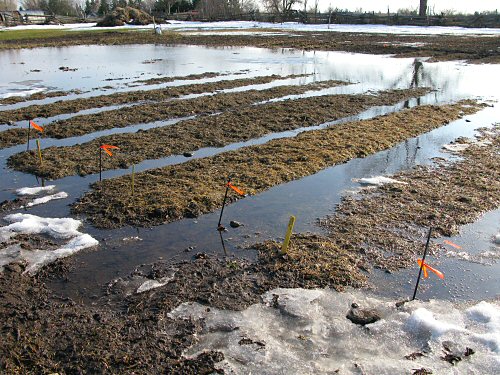
For all of the melt-off’s magical moments—garlic tips emerging and big puddles that look like tiny seas—there are mild melt-off concerns as well. About one third of the garlic beds have been fully submerged for nearly two days now, and may stay that way for 2-3-4 more, especially if it rains tomorrow as promised. (This area usually doesn’t get flooded with runoff, but I should’ve paid attention to the natural gully and not rotated the garlic there, just in case.) I doubt being underwater for a while will affect the garlic, but I don’t know for sure… How long garlic can hold its breath is another thing I’ll soon find out! And elsewhere, I discovered the handiwork of VOLES (it had to be them) in the herb patch. Under cover of snow, they’d neatly excavated 25′ feet of parsley roots, methodically working their way down the double row. These aren’t tunnels, just holes that go down about a hand’s length. Interesting. Another first. And no loss. But could this be population explosion year in the local vole cycle? Last year’s spring lettuce raids in the greenhouse were nothing compared to organized action like this… Good thing they don’t like garlic!
melt-off
Field wakes up…
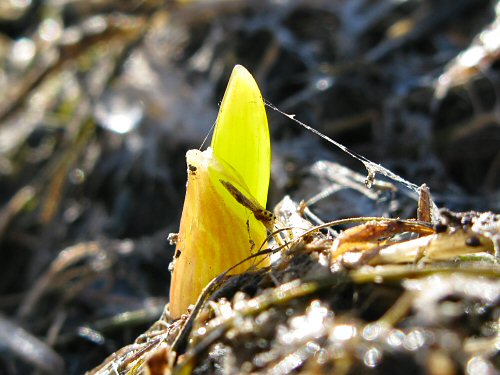
There’s a kind of magical moment between winter and spring, as the snow rapidly disappears and the water runs off. It lasts only a couple of days. Unusual sights are everywhere you look. I watch it closely every year, but this time around, with the blog-and-camera habit by now well-ingrained, I’m appreciating it more. I found garlic earlier than ever, only a few hours after emerging from months buried under snow with little or no light. The color is odd, I’m used to GREEN, but they look healthy, so I guess they need some sunlight to put on a little color. At the lower, south end of the field, the melting snow runoff gathers in a giant puddle, 40 or 50 feet (12-15m) across at its widest, and a few inches deep. This field has good drainage, so the puddle doesn’t stick around long, shrinking by the hour and vanishing entirely within two or three days. This year, the residue of the oats cover crop added a bit of a surreal dimension, as a bleached gold beach, and wavy underwater like seaweed. When you focus tightly and think miniature (like a kid would!), it’s a crazy little inland sea-for-a-day… All over, the little details of melt-off, looked at up close, are entirely odd and gone soon…
Ah, SPRING!
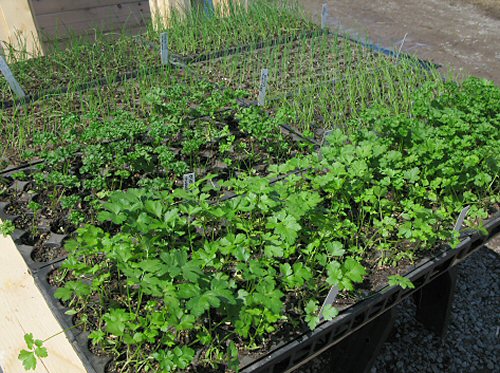
Man, what a difference a day and a bunch of degrees can make! The temperature didn’t exactly shoot up, but it went from hovering around daytime zero, to around 10°C (50°F). This was one weather trend, predicted on the 15-day-forecast weather site, that I figured wouldn’t suddenly go south (it’s gotta warm up sometime), so I’ve been waiting for it, to the day, for a couple of days now. It’ll get steadily warmer for a week or so, than maybe drop a bit, but even if we get another BLIZZARD, the ground will have warmed up enough that new snow won’t be able to stick around for long. So, I do believe, SPRING IS HERE!!!
I woke up to sunshine, and without even checking the temperature or confirming the forecast, set up a table outside the Milkhouse and out went the leek, onions and parsley for a little rapid hardening off. Getting them out to the greenhouse in a couple of days will free up a lot of rack space!
Wandering around the field a bit, checking the melt-off’s progress, I poked around the edge of the Jerusalem artichoke bed. The ground was still fairly frozen, and had melted to clayey muck only in spots. Poking around in a soft spot at the base of one of the plants, I came up with a handful! First harvest! The tubers look beautiful, the ones in the front of the pic about marble size, the biggest in the back, like a golf ball. As seed stock, there’s going to be a ton from the 45 pieces planted last year. I didn’t end up harvesting any in the fall; now, I’ll get to for the first time eat ’em!
Herbs return
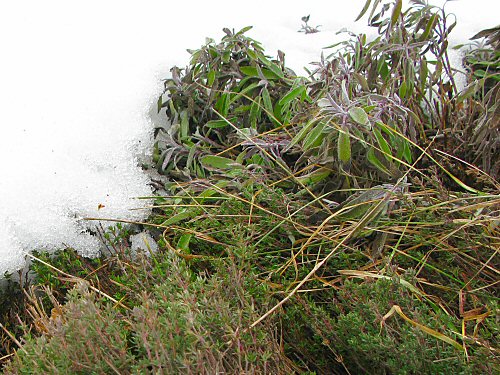
Sage and thyme don’t look like much as they roll out from under the snow, but they’re good to see. Another chilly day, slightly above zero, but COLD. Still, the sunny days lately have been heating things up, and the snow is slowly receding. It’s pulled back from around the greenhouse, and it’s starting to retreat over the herb patch (that’s sage and thyme at the far end). The REAL melt-off starts tomorrow…!
Field appears
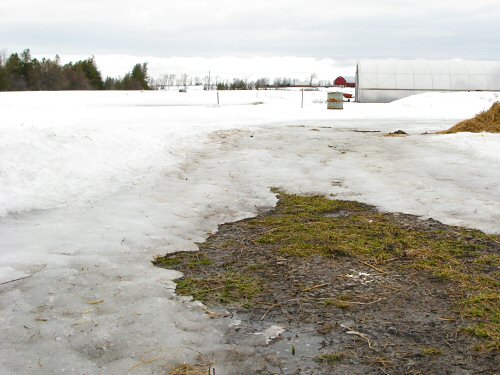
Finally, a bit of a change in the weather: several degrees above freezing and steady on-and-off light rain. Although the air has been cold for the last couple of weeks, the sun has been doing its thing, heating up any patches of open ground and slowly melting the snow away from underneath. So, just a little extra help, and we see ground in no time. This drawn-out melt-off means water is puddling everywhere, freezing and thawing overnights, gradually seeping in. I think this is a good thing: our clayey (clay-loam) soil, with its high water-holding capacity, will be saturated to the max, and hold water longer, well into spring, a good break for the first seeds in. This is my theory… Y’know, there’s an upside to almost everything!
More weather
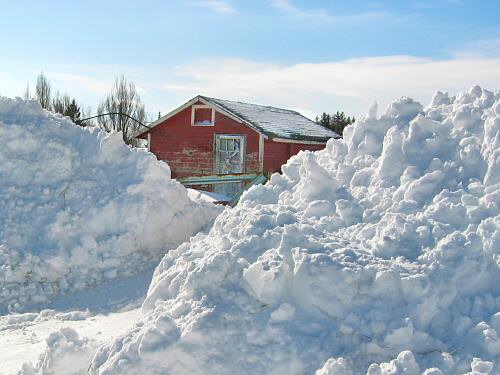
This February, tiny farming for me is mostly about, inside, watching seedlings in a growing number of plug sheets under lights, and outside, watching the weather. In this zone, Feb is a little early for thinking about garden conditions. Well, “normally”, it would be. Now, given the increasingly erratic winter, I’m trying to figure out a new early season production strategy. Conceivably, end of March could be shockingly warm and the ground dry enough to work, and instead of just seeding early peas, I could try some super early field transplants. But then, what if winter happened to come back, not for a day or two of April snow, as sometimes happens, but for a week or two, with freezing temperatures. Early plantings could get killed off, and then I’d need a second set of seedlings! This is how I’m kinda starting to think, about trying to plant around the weather, take advantage of unpredictably good conditions, while expecting some weird bad turns as well. What do last and first average frost dates really mean, given the last five years? Is a 30-year local rainfall average still in any way a useful guideline? Am I…exaggerating? Two days ago, it was 40°F (5°C) and raining right through the night. I was sure the forecast for an even warmer Wednesday would come through to finish off another, fourth big melt-off. Instead, yesterday morning it did a sudden 180, froze up and dumped a ton of snow. Today, there are 7-8′ snowbanks all around the barnyard (from snow plowing). The once and future chickenhouse practically disappeared… ;) Will spring and summer be different from that?!
Riding the weather
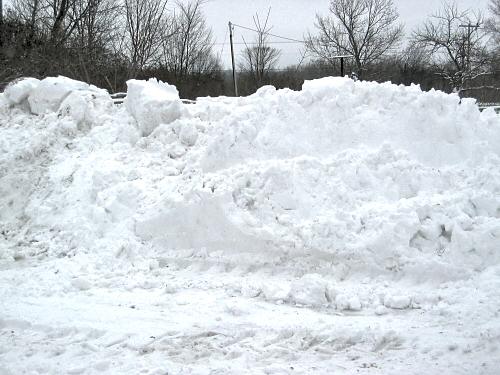
If this first half of winter is any indication at all, the upcoming growing season could be a really crazy ride. After the extensive one-day melt-off, just four days ago, followed by an immediate plunge into bitter cold, the snow came back just as quickly with a one-day storm yesterday and through part of last night. I deliberately don’t watch much news anymore, but I did catch the weather report of this massive, North America-wide blizzard and/or ice storm, depending on where in its path you happened to be. (At the same time, I saw reports of weird heavy snow stranding millions in China, and freakish winter tornadoes somewhere else.) Well, here we didn’t get that heavy a blast, maybe six or eight inches, but enough to instantly restore classic winter conditions. The photo below is snow plowed aside in the barnyard this morning, the rail fence peeking out from behind is 5′ (1.5m) high. Now, it looks like 50°F (10°C) and rain for at least a day or two mid-week. If that happens, IT’LL ALL BE GONE AGAIN! This is the THIRD major full-snow-no-snow cycle so far this winter, and it looks like more to come. I know this extreme weather is a global thing, we’re ALL feeling something wild, but I figure, keeping a daily-or-so journal of what’s going on on THIS tiny farm, I ought to get it down anyway. For the record! :)