
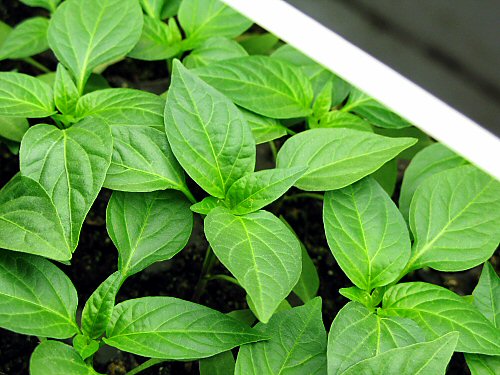
The weather’s been warm, sunny, essentially FANTASTIC for the last couple of days, and the forecast for the next few looks just as good. Indoors, many of the earliest seedling starts are putting on growth spurts, quite suddenly crowding each other and grabbing for the light, like these Gypsy sweet peppers. That means hundreds of seedlings have to be potted up, hardened off a bit, and headed out to the greenhouse, NOW—it’s not good to constrain their growth in small cells, and once they’re in bigger quarters, there isn’t room for them all under the lights. It’s no coincidence that, just as you’re driven to seed a dozen crops into the field RIGHT AWAY, the transplants are ALSO blowing up and demanding immediate attention—it’s the miracle of the garden plan working. They’ve been timed to be at this stage right about now. This is the way it goes. I’m so completely swamped with things to do, not just planting, but building and repairing things, working on the new farmers’ market stand, setting up the irrigation, and on and on. It can be quite overwhelming. Often, it doesn’t seem possible to get it all done in reasonable time. But you plug away—if you’ve done it before, you can do it again!—and eventually things ease up, and you get to survey your first crops setting up in the field—not to mention, EAT STUFF, like a perfectly crunchy spring radish…just brush off the dirt—and at that point, the deep feeling of satisfaction and simple happiness at having done it all is really, truly, have-to-experience-it excellent. MEANWHILE, that’s a good six weeks away, and until then, it’s the full-on SPRING RUSH! :)
peppers
Peppers!
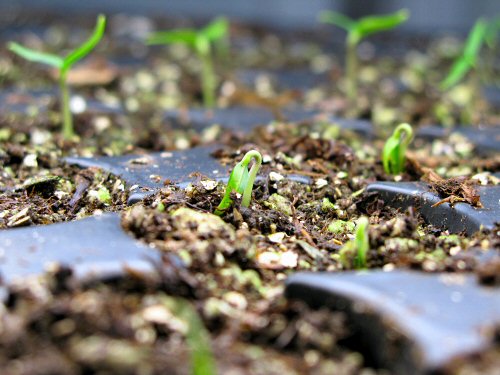
Another little new-season milestone: the first of the original veggie gang has appeared. These are Gypsy (hybrid) sweet peppers, seeded six days ago, along with other varieties of pepper and eggplant. They started to poke up in the last day or so, and by this morning, the first leaves had unfolded. Along with tomatoes (soon to be seeded), I think of these three—toms, eggplant, peppers—as my original crops. These are the veggies I started first (and way early) in Year 1: winter was storming along outside, while these brilliant little splashes of green were popping up in the warm, bright bubble of the first seedling room (a side room in the farmhouse). I was fascinated and kind of amazed. I used to come downstairs in the middle of the night to check ’em out, make sure they were still alive and growing… Actually, it’s not so different even now! :)
Tea and fungi
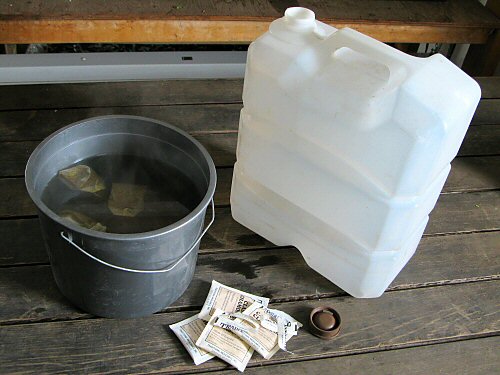
Chamomile tea prevents damping off—I’m a believer! It’s one of those natural but-do-they-really-work remedies, used where more product-minded folks would fork over a few bucks for a bottle of No-Damp fungicide… I brew up a batch of tea, dilute it by eye to a pale gold, and apply every couple of days with a fine-misting spray bottle. I’m pretty casual about the recipe, and keep spraying until the seedlings are established (that’s my method, there are more precise instructions around as well, search online).
Damping off is the name for a bunch of different fungal infections that can hit seedlings in trays with similar effect. In my encounters, the damage appears right below the soil line, strangling the stem just out of sight. Dig up a stricken seedling and there’s a small section of the stem, all pale and shriveling to nothing, while above and below, all looks well (the symptom’s called “wire stem”). It’s pretty shocking to see in action. One minute, your seedlings are looking all perky, and then you touch one…and it topples over! Whooaa!
Up to a couple of years back, I’d lose a few seedlings, usually PEPPERS for some reason, never anything major, parts of a tray or two, but enough to be scary. I seed-start in soilless mix (so it should be disease free), trays and tools are given a good disinfection at the beginning of the season, there’s always plenty of air circulation, and I make sure the soil surface doesn’t stay wet—all the things these soil-borne fungi don’t like. Still, damping off was sneaking in, until chamomile tea spray came along… Coincidence?
Heat!
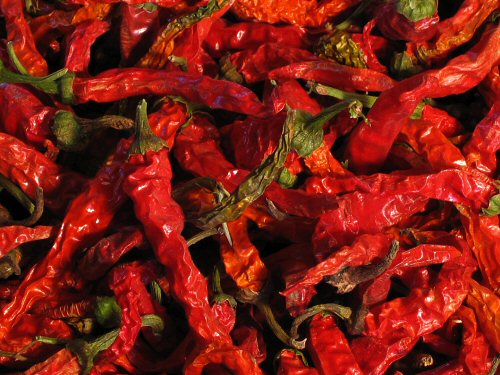
Finally finished a bit of hot pepper harvest, now there’s a convenient pile of dried heat! A few weeks ago, wondering whether to cover for frost, I decided to also pull up some hot pepper plants, roots and all, instead. An experiment! We loaded about 20 of the Cayenne Long Slim on the cart and dumped them in the Milkhouse, heaped on the grow racks that we’d been using, with the lights removed, as summer storage shelves. And there they sat, blending into the decor, drying, the peppers that were still green maturing to red. Until today… (This is the kind of thing you can do in a Milkhouse, not so acceptably in a real house…) They’re satisfyingly high on the heat scale, delivering a little pain if you don’t sample carefully. Great!
Compact tractor tricks
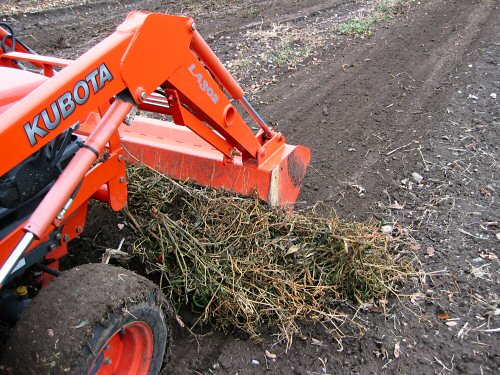
For some reason, I always feel a little guilty when I use the Kubota compact tractor in ways that make things way too easy. For instance… Probably the worst is the clearing technique I came up with a couple of years ago when it was cold and hand work was going slow. If you set the bucket of the front end loader pointing nearly down, and drag backwards, you can completely clear old plants in NO TIME AT ALL. Here, I’m removing a 50′ bed of hot peppers in one pass (the sweet peppers, in another section of the field, were lower growing and got tilled under a couple of days ago…). Is this gratuitous soil compaction, driving the machine over the beds unnecessarily? Well, maybe. But it’s so QUICK, and not an all-the-time thing. Does it drag off valuable topsoil? Not if you start feathering as you go, lifting and lowering the bucket a few inches lets the tangled mass of plants roll, freeing the soil. I try to do most clearing by hand, but sometimes, well, you take the shortcut…!
Bye-bye, sweet peppers…
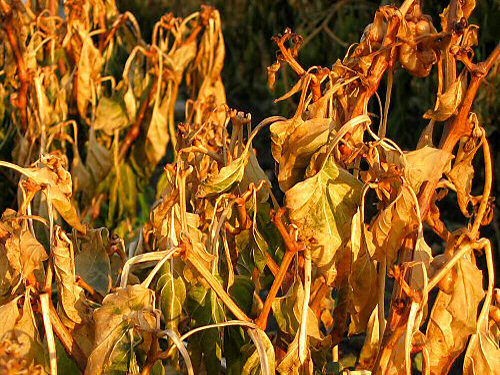
A mildly golden late afternoon sun turned the beds of dead peppers into a stunningly rich sea of color amongst the greens and browns. Peppers seem to have their own way of dying off in the cold (at least, under row cover, where they usually are in autumn). Instead of turning a sickly, muddy green, then quickly to grayish-brown as they dry out, like eggplant and tomatoes, the peppers tend to fade from green to greenish-yellow and dry in pale golds and tawny browns. Interesting… I’m not sure if this is standard behavior, but it’s how they seem to go around here! After rolling up the last of the row cover and snapping a couple of pics, it was on to the Kubota compact tractor for a quick tilling, and this year’s sweet peppers are…gone!
Killing frost, kinda
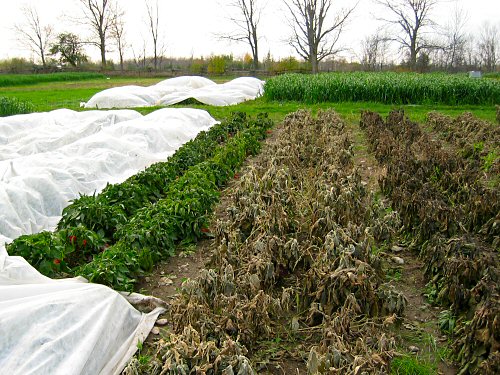
Yes, the weather’s crazy. According to the min/max thermometer outside the greenhouse, last night’s low was a chilly 18°F (-8°C), cold enough to kill off all but the hardiest. Finally, and only six weeks or so late—the endless autumn harvest is interesting, great for personal use veggies, but otherwise, it mainly throws off the fall clean-up schedule (I haven’t changed zones, have I?!). Here, the eggplant is clearly toasted, while the peppers, which had been under fairly light row cover (I pulled it back today to harvest some), came through in relatively fine shape . And the oats, well, it’s a monster, lush and green and if not exactly growing anymore, it seems to be getting thicker. It’s fascinating the way cold works in the field. Wind, cloud cover, mini-windbreaks, slight elevation, all kinds of factors add up differently in spots only a few feet apart to determine life or death by cold. Anyhow, can’t wait around forever. I’m soon going to roll up the row cover and till it all down!