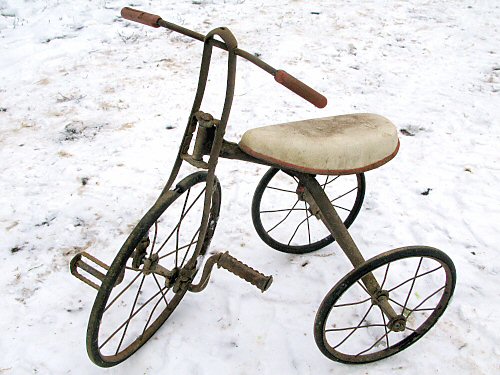
All sorts of old things are being unearthed as the entire farm gets a thorough, top-to-bottom, no-drawer-unpulled going through, something that probably hasn’t been done in a century. There are all kinds of finds, like horse-drawn plows and a farm-built chicken defeathering machine. Today’s most intriguing item for me: an old, iron tricycle (with an upgrade, a much newer seat). No-one here is sure, but the guess is that it’s gotta be a good hundred years old. Except for the plastic seat, which looks more like the last 30-50 years. It’s cool because the design and construction are soothingly simple (and easily fixable), although it looks like it delivers a bumpy ride on those solid rubber tires, especially on gravel in the barnyard. For some reason, though, I also find it mildly creepy… Imagining the squeakily-pedaling ghosts of farm children past, I guess. Yikes… :)
unusual
Bringing in the pipe
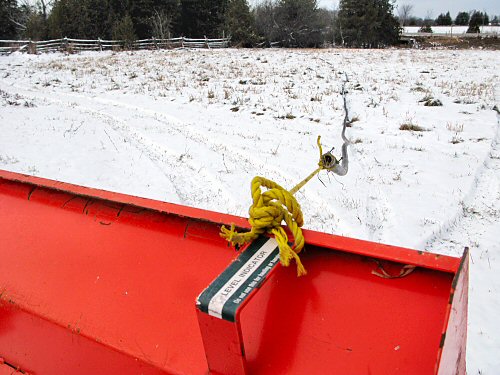
Bit of unusual fieldwork on the menu today, something we don’t do every year. Bob and I brought in about 1,000′ (305m) of 1″ (2.5cm) and 1-1/2″ plastic irrigation pipe, that ran all the way from the pond to the gate into the garden field. Why wasn’t this done in better weather, when, besides having no snow to deal with, warmer plastic would’ve been a lot easier to handle, especially to BEND? There’s no good answer, except maybe, “Didn’t think it’d be this cold and snowy so soon!” Anyhow, it got done, and probably in exactly the same time…
I used the Kubota compact tractor to drag the pipe in three 300′ sections, right into the barnyard (the rope is tied to the front end loader bucket; in the pic, this is at the very end of the garden, where it meets the hay, so all that stubble is mainly long grass). Backing up down the field, I worked it from the far end for the section that lay in the unmown grass right near the fence, so that it could more easily tear its way out of the overgrowth. Then, some coiling (that’s Bob), tying off the loops every few turns with baler twine (plastic twine used to bale hay, it’s all over the place)… Easy!
It’s really cold
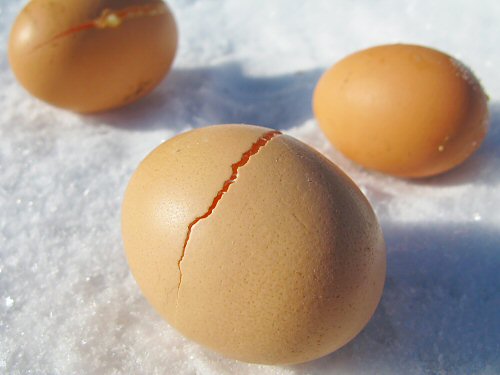
It’s taken a couple of days of this pretty intense cold snap for me to realize it’s yet another whimsical display of the crazy weather we’ve been having for the last six years or so. It’s not that overnight temperatures around -14°C (7°F) are unusual for southern Canada, just not in November. This time last year, there was a ton of snow, but without the unreasonable deep freeze. The winter before, I posted here in mid-January that “winter’s a no-show”—I was still digging carrots! Interesting… Inspired by the cold, I decided to see what it would do to chicken eggs and left a couple out overnight (there was a kinda practical purpose, it’s pretty cold in the chickenhouse). Of course, they froze as hard as hockey pucks. And cracked..
Flies to heat
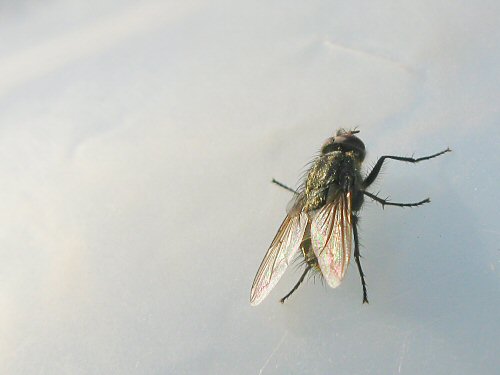
It’s summer again! At least, it’s suddenly a whole lot warmer than it’s been for a while, as any fly can tell you. I headed out to the greenhouse in the late morning to find flies all about, buzzing to get out, and basking on the plastic outside. It’s kinda creepy how they slow as it gets colder, like some sort of tiny machines winding down, eventually disappearing off somewhere to hibernate (I think that’s what they do), only to suddenly reanimate given a little heat. Anyhow, a few days of 60°F+ (15°C) and sunshine are in the forecast, and I believe it!
Tossing onions
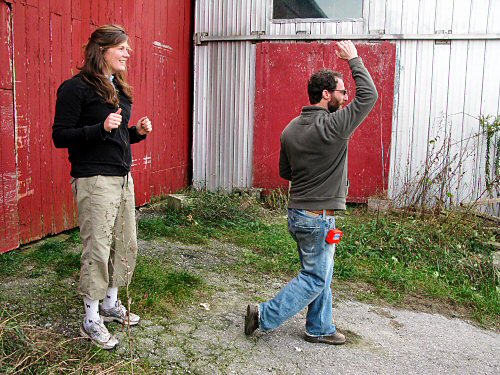
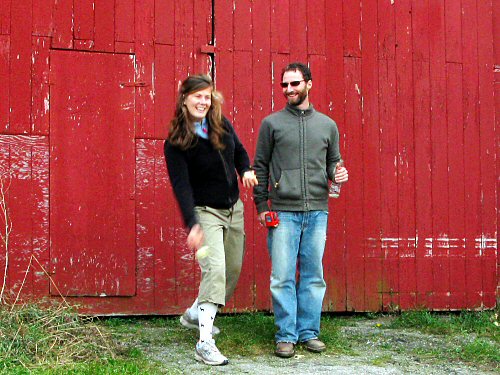
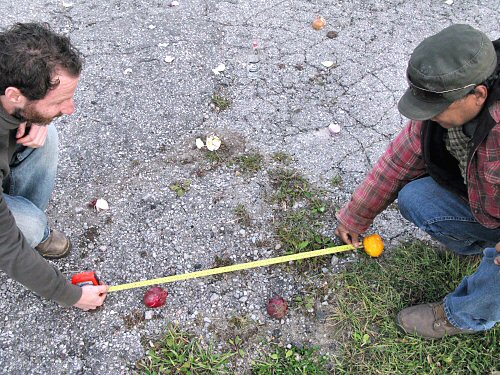
Well, Friday harvest is over…what to do? A few onions and a little winter squash you’re set for ALL-TERRAIN ONION BOCCE. Libby used yellow cooking onions (Stuttgarter), Grant took a mild white (Superstar), I went red (Red Wing), four onions each. A stunted orange acorn squash (Table Gold) served as the target ball. Toss away!
The rules are simple: the player with the closest one or more onions to the squash scores a point apiece. The all-terrain part means the winner of a turn gets to toss the squash anywhere. We played up and down the gangway to the barn, through gravel, long grass, chicken hazards (roosters peck onions)… Good thing no-one got really competitive, ’cause onion bocce is pretty imprecise, what with eventually exploding onions (largest piece counts), and ragged edges that make down-to-the-millimeter measuring kinda futile. Still, we did get out the tape measure… Wholesome outdoor fun on the farm. With veggies. Must be a new age of innocence! :) (Guest measurement photo by Libby)
Big egg
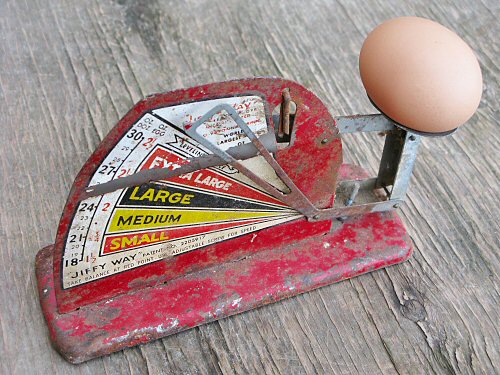
Every few days, at two dozen a day, along comes one very big egg. It’s hard to see with the chipped paint on the old egg scale, but these big guys take it right off the chart. Beyond measurement by this technology. Poor girls (I think, or maybe not). They’re too big to fit into extra-large egg cartons, they won’t let the cartons close, so I put ’em aside and eat them. They’re pretty big, fat eggs!
Root love
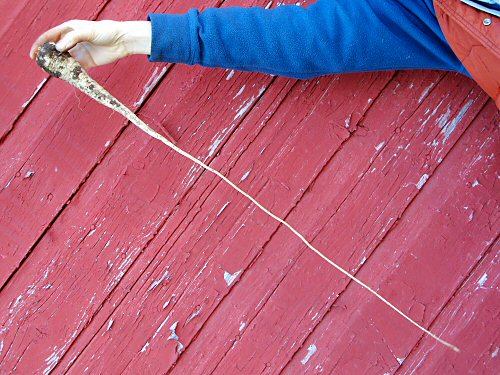
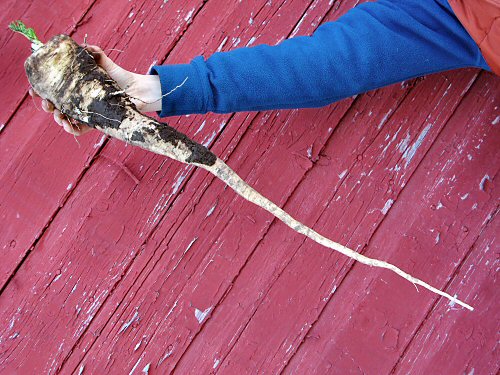
About the last thing anyone is likely ever to see first-hand is the amazing root structure of plants! I’ve been fascinated by the massive size and complexity of ROOTS since I first saw a sketch of a full root system, and way more so after browsing the wealth of technical drawings of garden veggie roots in the fantastic and fully-online Root Development of Vegetable Crops. Root systems can be VAST, but they’re incredibly difficult to actually see since the mostly fine filaments that tunnel everywhere simply break off when you dig up a plant. Today’s parsnip harvest yielded a couple of unusual, still very partial root specimens that only begin to illustrate what’s going on down there. Who knows how just a few managed to come up with so much intact… For parsnips, according to RDoVC, after a season’s growth, “at the 8-foot level roots were common and a maximum penetration of 9 feet was determined.” In the top 10″ (25cm) of the soil, lateral roots extended up to 3′ (90cm). Pretty cool, huh?! (Thanks to hand-and-arm model Lynn.)