Archive for August, 2008

Farmers’ market set-up
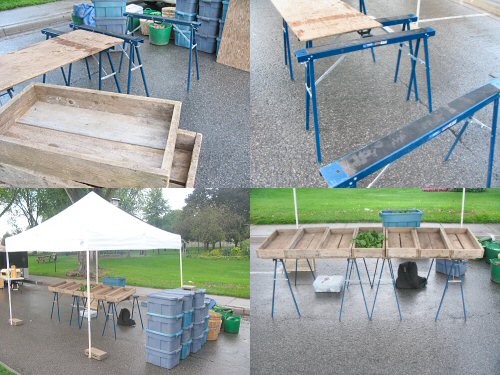
Setting up tables at the farmers' market

Settting up at the farmers’ market is definitely fun, although I tend to be in a mild daze with an average of literally three hours sleep before getting up at 5:30 (that’s just how it always works out for me :). Today, I planned to take pics of the whole routine, but forgot to start snapping from the beginning. At this point, the truck is unloaded, the canopy’s up, and we’re setting up the tables and trays, and starting to load up the veggies! Unfolding the sawhorses and placing the boards and trays takes maybe 10 minutes tops. Then, it’s on to placing the produce, after that, the price cards and signage. Stay tuned for more complete coverage…maybe next week!

Loading veggies on the farmers' market stand

Comments (5)

More post-harvest action

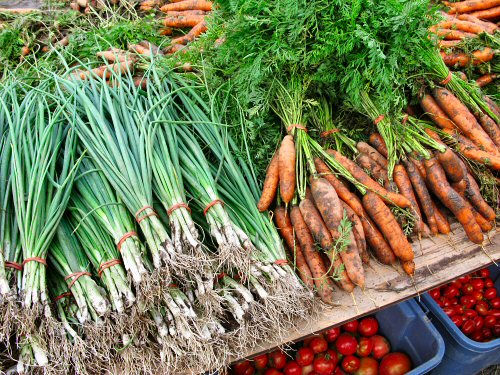
Post-harvest: green onions, carrots and tomatoes

If it’s Friday, it must be time to harvest! After a beautiful weather week with barely a cloud in sight, an otherwise welcome gentle rain today meant a bit of a muddy harvest. Here, the picking and pulling has all been done, and we’re about halfway through the sorting and rinsing. Ramrod green onions are all bundled and ready for a quick rinse. Nelson carrots are underway. And, a couple of several bins of tomatoes, with Juliet saladette in one, and a mix of smaller heirlooms in the other. With toms, we only fill the bins 2-3 layers deep to avoid squashing and splitting, especially with big heirlooms. (I suppose getting cardboard tomato flats, one tomato deep, would be more space-efficient, ’cause the pick-up truck that we use does get full around this time of year, but so far, we managed without.) Everything’s looking and tasting good!

Comments

Onions from seed!

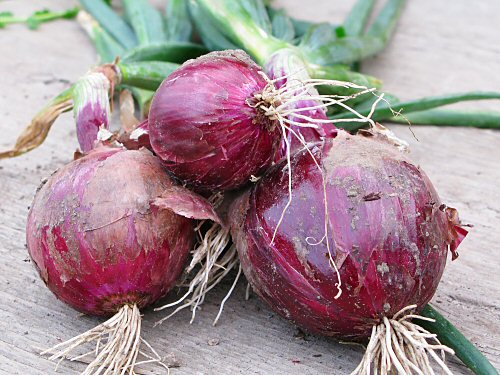
Red onions grown from seed

This is the first year I’ve tried growing onion from seed, and they’re doing fine. Today, I pulled up one multi-planting of Red Wing to check ‘em out. Multi-planting onions was also a first-time experiment, with 3-4 seedlings transplanted in one spot, at 12″ (30cm) in-row spacing. They’ve done a good job of pushing themselves apart, they’ve stayed pretty round, not flattening out where they touched. Another thing I was a little concerned about didn’t come to pass. For around a month, the onion seedlings had already been under the usual 14-16 hours a day of fluorescent light on the grow racks, when I read about their daylength sensitivity. When the amount of sunlight reaches a certain threshold, over 12 hours or so for long-day varieties, the onions move from leaf growth to producing bulbs. A couple of sources said that premature bulbing can be triggered by too much light too early on, even at the beginning seedling stage, and you’d end up with tiny, marble-sized onions after a season in the field. Other sources disagreed, but in any case, that didn’t happen here! Still, in future, I’ll start long-day onions under reduced artificial light…to be safe.

Multiplanted onions

As usual, the cracked surface of our clayey soil looks rougher than it is: it isn’t really hard, only a thin, dry layer with moist soil right underneath. Here, four out of five seedlings have pushed apart, rotating the stems outward, and grown into decent-sized…onions!

Comments (4)

Potato fruit

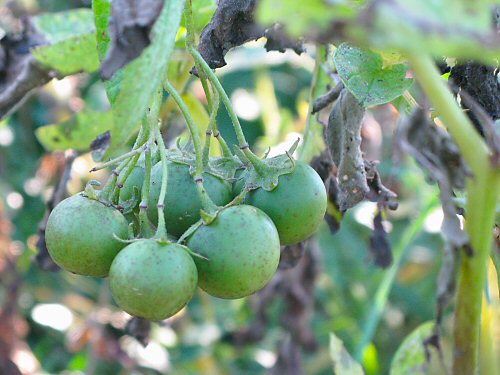
Potato fruit on Chieftain variety

Here’s something I haven’t seen before in my, uh, six years of growing potatoes: green, tomato-like, walnut-sized potato fruit. Bob hadn’t seen ‘em either, in 40 plus years of farming. I hit the web for education. These are genuine fruit, but not that common. Usually, potato flowers just drop off. When fruit do form, they’re more likely found on certain varieties, like Yukon Gold. Here, there were fruit on just about every Chieftain plant, here and there on the Kennebec, and none that I noticed on the Yukon Gold… Each fruit contains 300-500 seeds that don’t come true: planting them doesn’t result in the same potatoes as the parent plant, there’s lots of genetic variation. Potato breeders plant out thousands of seeds, check out the results, then replant the most promising for 10 years or so to get stable new varieties—apparently, this is the way new potatoes are bred. And, the fruit are poisonous, rich in solanine, not for eating (potatoes, tomatoes, peppers, eggplant and tobacco are all members of the “deadly nightshade” family, all prone to having toxic parts). Interesting! Since they suddenly appeared this year on two varieties, I’d guess it was about the weather!

Inside the potato fruit

Comments (10)

Odds-and-ends omelet

Omelet slice

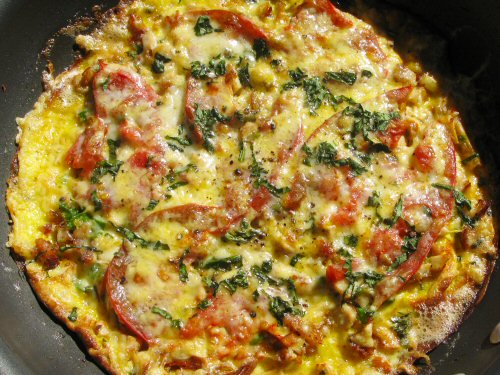
Preparing and gazing at food can bring as much enjoyment as growing, sharing and eating it! I’m really not a cook, but with fresh, quality ingredients, whipping up something appetizing is…simple. For our field lunch today, an omelet made from stuff at hand: eggs, cooked chicken with a little store-bought prosciutto, a black tomato (from Raechelle’s home garden), garlic, onions, basil and 4-year-old cheddar cheese. Chopped garlic and onions were sauteed in extra virgin olive oil, then the chicken and prosciutto were added to warm up. Out with the filling, in with eggs, lightly beaten with salt, pepper and a little powdered cayenne pepper. As the omelet started to set, the meat was sprinkled on, and the whole thing topped with thin slices of tomato, grated cheese, and basil. Quick, easy…

Omelet topped with cheese and basil

…and pretty tasty. Everything except the ham, salt, pepper, cayenne and oil came from the farm, or nearby. We ate in the field… :)

Chicken and veg omelet

Comments (2)

Weighing eggs

Egg scale

Egg production has been moving along smooth as anything. The girls are great, easy going, seem to be having a good time, and they’re pumping out 23-25 eggs a day. Besides giving them out to everyone around here, there’s been enough to take to market every other week as a CSA bonus, usually, half a dozen per share. Bob unearthed an old egg scale from somewhere in the barn, and I’ve been playing with it lately (for actual distribution, there’s no sizing, everyone gets a mix). Egg size has definitely increased. Where they were mainly medium with a few small at the start, they’re now maybe half medium, half large. The scale is the kind of old school tech that I love, with everything simple, open, obvious, and FIXABLE. It may be a little hard to read in the pic: there’s a little pointer, with a fleck of red paint on it, at the bottom of the open triangle of the indicator—this egg’s Large, just on the border of XL…

Comments (8)

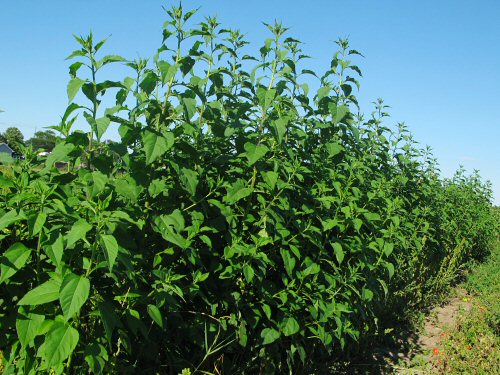
Soaring chokes

Jerusalem artichoke

Jerusalem artichoke is the crop least fazed by this crazy, slow-growth summer of cloud and rain. The chokes have been in the ground since May, through the whole thing, and thrived through it all. This bed is right in the middle of the open field, but neither unchecked wind nor nasty hail has set it back. The tallest plants are approaching 8′ (2.4 m), a record for anything in this garden!

Comments (7)

After the market

Packed up after the farmers' market

Somehow, I always forget to take enough pictures at the market, of things like setting up the stand. It’s really great, how a plain old small town street, in about an hour, turns into a…farmers’ market. For our stand, basic set-up and teardown—canopy, table, sales gear—is only a matter of maybe 20 minutes at each end. Because I don’t drive, our stand is different from most, where a truck or trailer is the usual veggie stand backdrop. Bob drops us off in the morning in a pick-up: a self-contained veggie sales outpost. When it’s all over, with empty containers nested and packing volume much reduced, we get picked up by truck or smaller mini-van. Here, Lynn and I wait for our ride. There are garlic and potatoes left in a basket and a trug, and the four bins contain mostly crop residue, a bit of miscellaneous garbage, and odds and ends of unsold produce. Neat!

Comments (1)

Page 1 of 41234»

TFB & the Web

Locations of visitors to this page

Best Green Blogs

Home and Garden Blogs - Blog Catalog Blog Directory

Add to Technorati Favorites

 Subscribe in a reader

Foxkeh

website uptime