
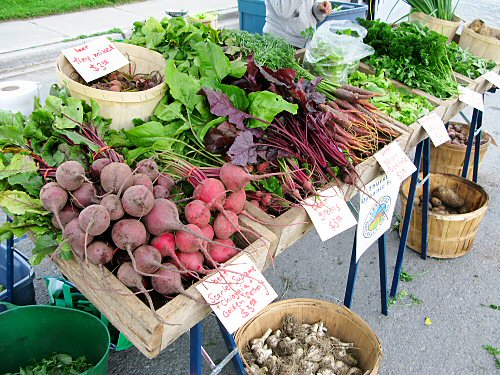
The farmers’ market stand is getting crowded. Actually, it’s been that way for…seasons. Somehow, plans aside, I haven’t yet gotten around to doubling the table area. It’s about time…
Market & Stand
Backstage at the farmers’ market: harvest bins
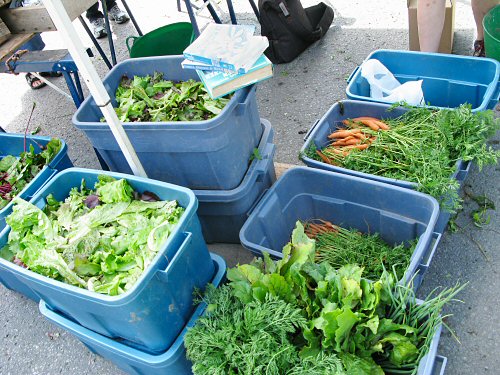
Rubbermaid storage bins are the main harvest containers again this season (I suppose that’s a plug for Rubbermaid, unintended, it just seems like they’re the only company in the plastic storage bin market!). They’re inexpensive (around $8 each), hold a little over a bushel, and the lids fasten well. They’re easy to clean, and they stack well, loaded and covered, or empty. And they’re durable. I somehow ran over one with the Kubota compact tractor, pulled it back in shape, and it’s in service again. They’ve changed color this year, the new ones available around here are a kinda tacky metallic blue, but that’s no reason to give ’em up. We have about 25, along with a dozen or so green bushel trugs…so I guess that’s the cap for the maximum harvest haul for now! Today at market, there were about 15 of ’em full… Balanced on the edge of one is a stack of three selected gardening books, brought to market for customers to check out…
Dirty hands at the farmers’ market
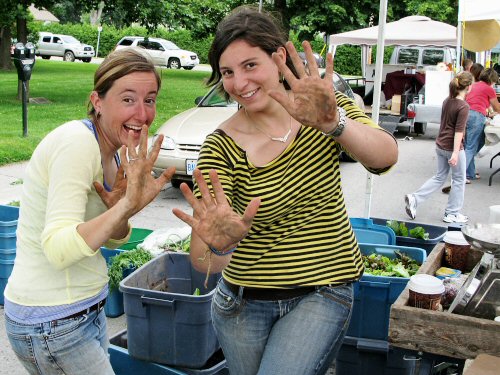
Over the last couple of weeks, we’ve been experimenting again with rinsing versus…not rinsing. This comes up a couple of times every year, where I think (or someone suggests) that rinsing various veggies is not necessary: to save time, to improve storage, to preserve nutrients,…the reasons vary. (For me, the time-saving is always a big attraction!) Sometimes, crops just have to be rinsed to cool them down quickly if harvested in the heat, or because they’re really mucky from heavy, mud-splashing rain. In any case, this week, we didn’t rinse the carrots, beets and beet greens, so sorting at the market was a bit messy. That’s Lynn and Maria, happily dirty-handed… The conclusion is usually the same: when the harvest is really kinda muddy, which is often the case this year with all the rain and wet ground, a quick rinse is better all around, for handling and for presentation. Still, the experimentation continues!
Rainy day market
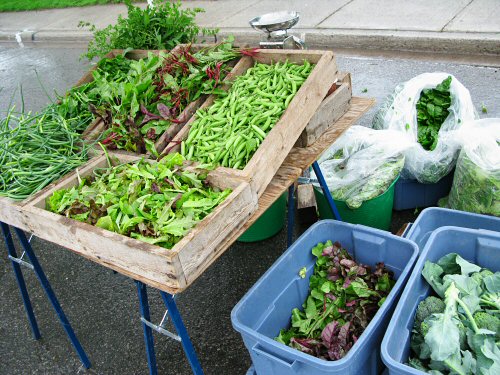
Rain, rain, go away… Not something you’d actually hear me say, or even think, lightly. This morning’s market didn’t quite qualify, although it rained heavily and steadily for the first three hours. Rain at the market has never been too bad for our stand, people always come out. Today, the stand set-up was still in fully compact mode, across two sawhorses instead of four, but there was a fair bit of veg, including the first 60lbs (27kg) of snap peas (Sugar Ann), around 40 broccoli, and a (relatively!) vast supply of all-lettuce mesclun, spinach (Spargo), garlic scapes (Music) and beet greens from assorted varieties. Enough to just make the minimum return from market needed at this time of year to keep this tiny farm ticking. By the end of the morning, all of the CSA pick-ups had picked up, and most of the veggies were sold out. Which is…good!
A simple (chicken!) sandwich
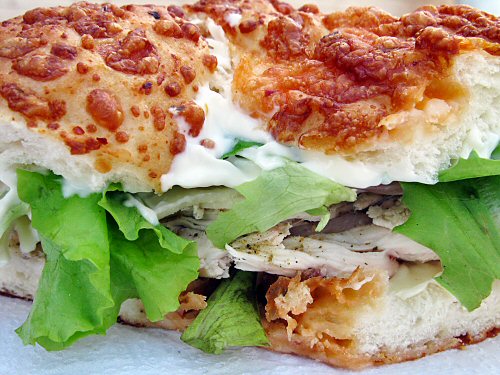
Roasted a White Rock chicken last night, today, got a Spicy Cheese Loaf from Fran, the baker beside me at the farmers’ market. (The market day went well, it was the first day of CSA shares: mesclun, spinach, radishes, garlic scapes, beet greens—it’s still early.) The chicken and the bread naturally organized themselves into a late afternoon simple sandwich…
Looking at it before the first bite, I realized that I’ve been thinking about FOOD a lot more recently. Not exactly my own diet, but on a more personal level than as a local veggie grower, probably something to do with the Endless Salad, more communal cooking and eating lately…
Part of the running stream of thought has to do with nutrition, what I know about it, how much I want to and need to explore further. I mean, do I really have any sort of basic IDEA of what to eat, beyond “lots of veggies, little meat, drink lots of water,” vague general guidelines like that? Do I NEED a plan? Should I RESEARCH? Consult with a nutritionist or a naturopathic doctor (I’ve been considering visiting an ND for an initial workup)? Sheesh, more RULES! All that is really clear is that most people around here (a “developed nation”) don’t know much practical stuff about the food they eat, me included.
The other part is about food quality, and local food. The one thing I’m quite sure of is that it feels way better to eat fresh food that you’ve grown, and to know where the rest comes from and what’s in it, and that wasn’t at all painful to discover. So, I examined this pretty local sandwich. The cheese bread listed the ingredients: flour, water, cheese, sugar, milk, vegetable oil, butter, yeast, dried chili peppers, salt. The chicken was raised here on the farm from two weeks old, fed mainly Purina (Cargill) starter and grower feed (nutritional content in percentages, contact the manufacturer for the actual INGREDIENTS), with some greens from the garden. The lettuce is from the garden. I poured on home-made vinaigrette dressing: extra virgin olive oil from Italy, pink salt from the Himalayas, fresh-ground black pepper, vinegar, Tabasco pepper sauce from…the store. The mayonnaise is from Kraft, it was in the fridge, the bottle says it’s “real.” It’s all ingredients within ingredients… I’m planning to make my own mayo, with eggs from the farm and oil from…Italy. Should I care where the flour in the bread came from? The cheese? The chili peppers? And what about the “vegetable oil,” what’s up with that? Should I make my own cheese and bake my own bread? When do I start looking around for organic chicken feed, how IMPORTANT is that, what’s the priority, how much can I afford to PAY?
I don’t have any neat point to sum up with here, I’m just being a literalist and looking at what I eat. When you start to question your basic eating habits in a very primitive way, they may not hold up to much scrutiny, and that’s unsettling. I’m curious. The story unfolds…
Plastic…fantastic?
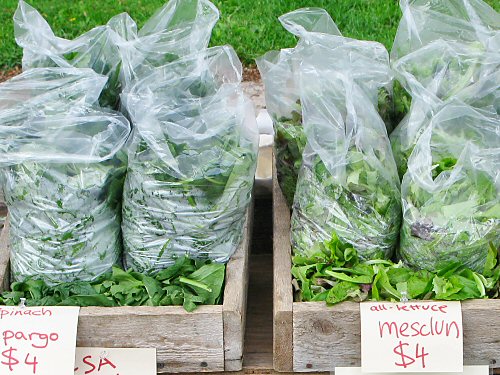
At the market today, greens were finally in great supply, with loads of mesclun and spinach: two giant, clear leaf bags full of each. I went home with quite a bit—no sold out sign this week!—which was great, ’cause I was selling right up to the end. And, as usual, I noticed all of the disposable plastic involved…
Greens, and market/CSA share harvests in general, usually involve lots of PLASTIC BAGS. In the beginning, this didn’t overly concern me on any level, other than that buying bags by the hundreds and thousands was kinda costly. But being on the dispensing side of this steady stream of plastic gradually made me realize how much of it is continuously being tossed out there FOR NO LASTING PURPOSE.
What got to me first wasn’t the environmental issue, but the fact that people were profiting off of this useless mass consumer habit of taking tons of “free” bags at every stop… Don’t like being fooled again and again… This culminated in one way for me about two years ago, when I stopped taking shopping bags for, like, 98% of my store shopping. Last year, I started cutting down on the way I offer shopping bags at the market: instead of automatically grabbing a bag for a customer as I asked if they needed one, I ask in a leading way, kinda eying what they’re carrying already—not surprisingly, with all of the anti-plastic bag attention lately, the majority of people so far this year bring a basket or cart, or fit their purchases into a bag they already have.
I mean, to grow greens, it takes 40-60 days of watching, watering, weeding…and suddenly, in less than 24 hours, they’re harvested, bagged, distributed, and, hopefully, within another 2-3 days, EATEN. And the really useful life of the plastic in a bag of fresh-market greens is more like a very few hours, because once you’ve gotten your greens home, there are many more efficient ways to refrigerate them (like in a nice cotton bag, in a salad spinner, in a big bin,…). But there’s nothing that easily replaces the convenience of plastic for that last little trip between stand and home (a couple of people have asked that everything, greens and all, be tossed loose into their own shopping tote, which is kinda cool and should work no problem, but doesn’t sound too easy to encourage amongst ALL…).
So what am I getting at exactly, besides the OBVIOUS? Well, I guess it’s that plastic is curiously useful stuff, I’m not about to outright REJECT it in all its many handy shapes and forms, but I should learn more about it for a start… More as it unfolds! ;)
Finally, a field harvest…
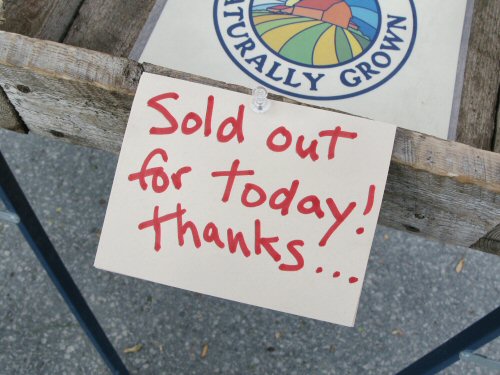
Finally, this year’s field-planted all-lettuce mesclun and spinach were ready for harvest, and that’s all I brought in to the farmers’ market, but in decent quantity. Unfortunately, I still underestimated and was sold out by 10:30 (the market runs 7:00am-1pm). It kinda looks good, being sold out, but really, if you’re doing things right at the market, you want to go home with a very little bit left over. That means you’ve brought enough for everyone who comes by, and have enough to display more than the last one or two of each veggie—it’s a pretty tried-and-true rule that selling the last of anything is harder, one of the few rules that seem useful to me. Overall, I don’t give much thought to sales tactics: with really fresh, high quality veggies, clean presentation, and a (genuinely) cheerful, helpful presence, word of mouth should do the rest. But making the food look attractive I think is a pretty basic part of food enjoyment and…celebration, and having enough for an inviting display right till the market ends is part of that. Of course, selling all you can is another part…the farm may be tiny, but there are still things to buy and normal-sized bills to pay! ;)