
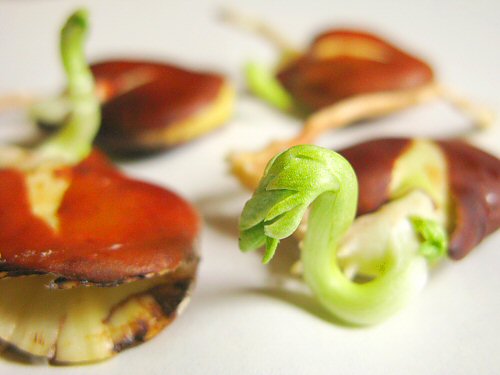
It’s that time of year again when obsession with seedlings somehow takes hold for a short while. I wonder if I’ll ever get over it, that almost overpowering early spring feeling that you don’t want to waste even a SINGLE seedling. Here, I germination tested a few Witkiem fava beans (broad beans) from an overlooked four-year-old supply. Bean seed viability is often rated at three years, but I didn’t doubt that these were fine, they looked and felt great. I tested some anyhow: wrapped them in a paper towel, misted them with water, popped them in a clear ziploc plastic bag, put them in a warm spot. That was about three weeks ago. Sure enough, a week later, the not-so-little white radicles were poking out of all of these big beans. Excellent! So I put them back in the bag and kinda forgot about them, moved them and all. Today, they were unpacked, and even without any light for at least a week, the seedlings were lustily struggling to break free. Now the kinda obsessive part is, I FEEL BAD ABOUT THROWING THEM OUT! This is pretty crazy. There is no good reason to pot them in February and have ’em hanging around for months until it’s warm and dried out enough to transplant. After two-three months in a pot, they’ll be useless as proper transplants, anyhow. Meanwhile, in a couple of weeks, there’ll start to be so many seedlings around here, and this keep-’em-all urge I’m having now will be gone without a trace. So I stuck ’em in some water, just for now… I thought this beginning of the season hang-on-to-every-seedling thing would wear off after a few years, but apparently not yet. Maybe I don’t take this business of tiny farming seriously enough! :)
germination
Cutting spinach
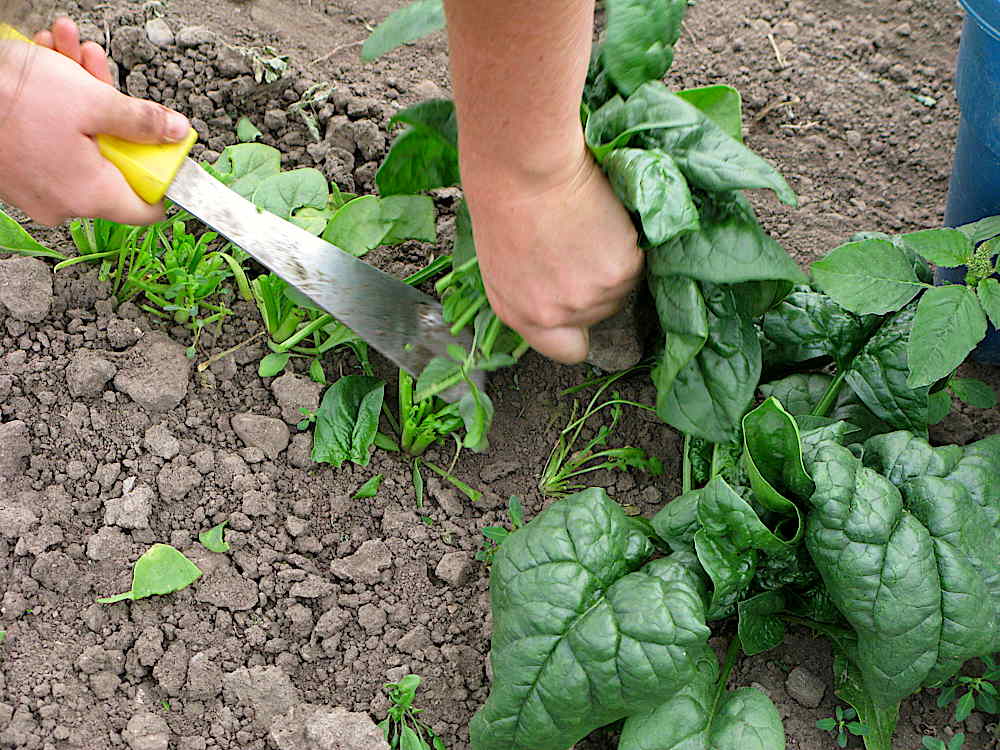
Spinach has kinda been the star of the harvest for the last couple of weeks. After a “normal” summer—hot and dry for the last three years—it’s usually not around at this time of year due to poor germination. This season, with cloudy, cooler days and all the rain, spinach is in abundance: glossy, deep green, succulent, full of flavor. Libby and Lynn chop away, cutting an inch or two up the stems. This technique takes out the small new growth leaves, but it’s fast and efficient, and the plants still grow back for a second harvest. The alternate picking-single-leaves approach is more laid back, great for leisurely field chats—this harvest, we opted for quick…
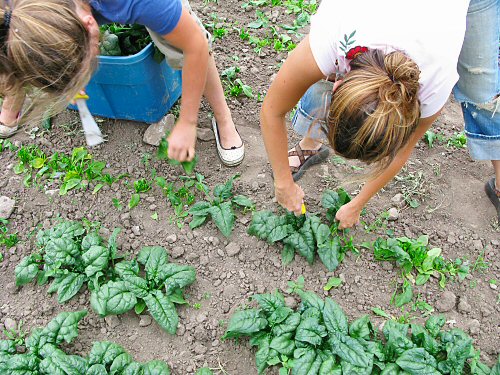
Nothing like teamwork: head down, knife in hand, side by side…
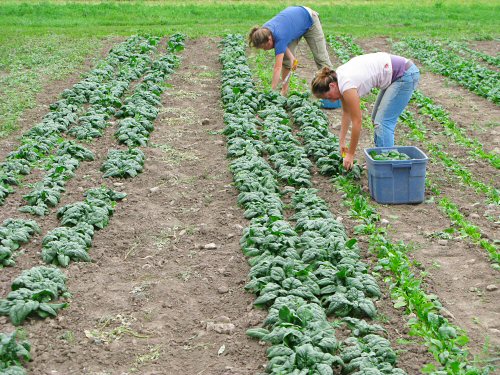
My, what a nice, wide path!
Parsnip surprise
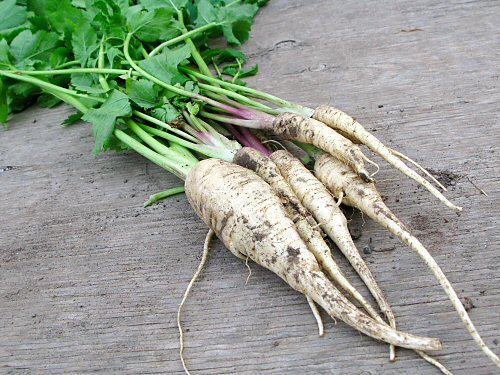
Parsnips, at last! This is a crop I’ve tried to grow almost every year, but until this season, it’ hasn’t come through. Parsnips take a while to germinate, a couple of weeks or more, right in the middle of the spring planting-out rush. Weeds would start to take over, parsnips weren’t a priority, and I’d never find the time to save them. This year’s warm, wet spring made a difference. Germination was quick and the seedlings surged ahead of the weeds! Nearly four months later and, even in dense, unthinned rows, the parsnips are thriving. Yay! Today, I dug up about 6″ (15cm) of a row to check ’em out. With the crowding, there’s a motley assortment of sizes, but overall yield looks good. Another month in the ground, a little post-harvest sorting, and it’ll be parsnips for all!
Bean watch
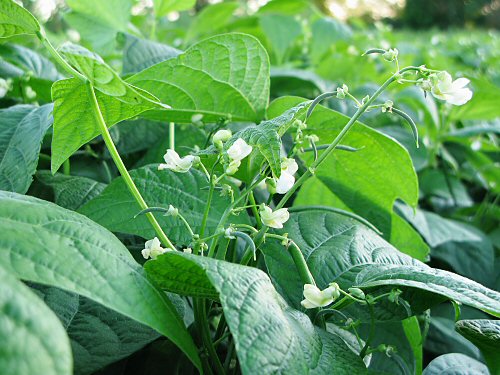
The second bean planting is setting and sizing up nicely, but we didn’t have beans at the farmers’ market today, after a good first and second picking of the first crop over the last two weeks. With succession planting, snap beans are usually a continuous harvest once they start, right through to a killing frost (usually in September, but with row cover, now extended into October in the last couple of years—more of that global warming, I guess). This year, cloudy weather slowed growth and the timing didn’t work out for continuity. There are a couple of ways to insure non-stop beans. Planting really frequently doesn’t work, because if the plantings are too close together, like, only a week or two apart, any two are likely to sync up, either by germinating at different speeds, or catching up during growth (both due to weather), and you’ll have too much one week, and not enough the next. Over-planting is the easiest way to go: if you have a lot ready at once, usually you can hold in the field a week past optimum harvest time and still have good quality, that is, nothing too oversize or woody. Of course, harvesting when ready, then storing in a cooler is the surest way: beans do quite well in cool storage, a good week in the most casual cooler conditions. But of course, there’s fresh and there’s FRESH!
Burlap expires
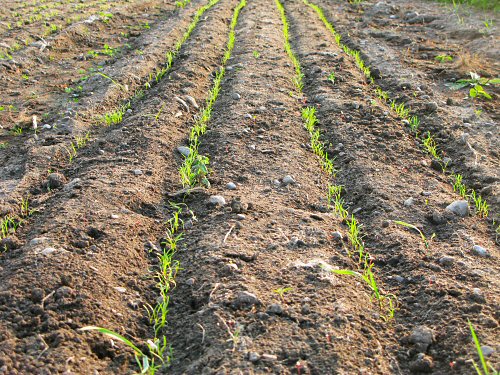
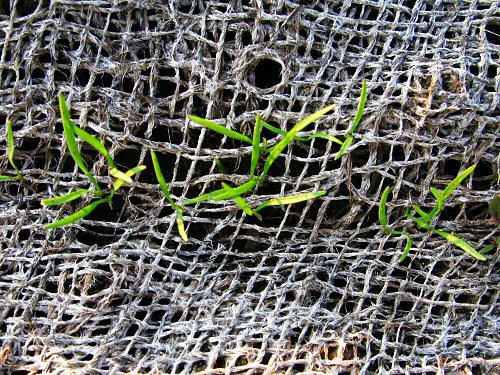
After a nice long ride, the burlap (of the burlap carrot germination method) is finally breaking down, shredding as we fold it up off the final carrot beds of the season.
Even in this wet weather, the burlap makes a big difference, probably because it holds the soil heat—the difference is clear at the ends of the beds, where the seed drills extend past the burlap, and germination has barely started.
I haven’t been keeping accurate count, but this batch has done at least eight seedings over the last two years. At about $30 a bed for a double layer of burlap (100’/30m) over a 50′ (15 m) x 4 row bed, that makes it less than $4 per 200′ (60m) of carrots, more than worthwhile. If we’d taken better care of it during this wet weather, mainly by making sure it dried out quickly, it may’ve even lasted for a seeding or two more.
Like floating row cover, burlap is an outside input that I don’t like to rely on, but for now…it works!
Good germination
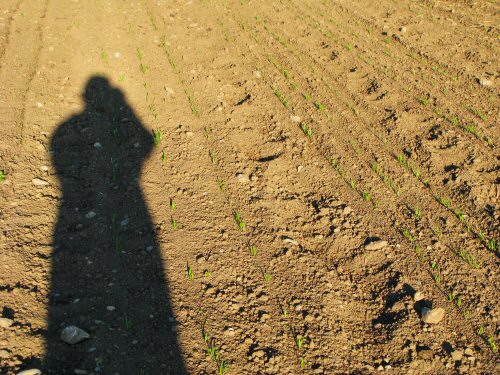
With all the rain, and things finally warming up at night, the evening walkaround was good today, with a fair bit of GROWTH now on display. The third seeding of Spargo spinach (above) is doing very well indeed. Carrots, beets, green onions, chard are all coming along. Most everything is pretty cool… And all of this without irrigation, only some of the mesclun beds were ever watered. This is more like it!
Slow…
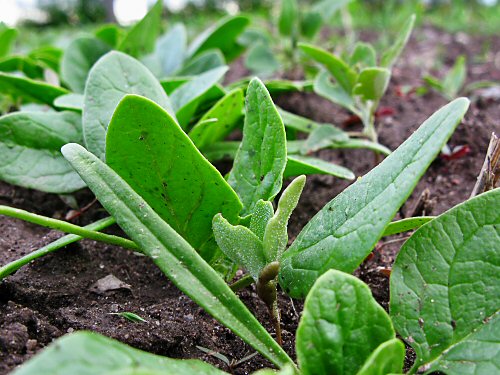
When you look back at last May on this tiny farm, overall, the state of the field isn’t all that different, BUT, the really cool nights for much of the month have slowed growth noticeably. Compare the first planting of spinach today, to the near ready crop of a week earlier last season. It’s the same for mesclun, beets, and chard. Snap beans are taking forever to germinate. And so forth. We’ll definitely be going to market at least a week later with the first field spinach and lettuce. Oh well, with all of the different crops going, bad weather for some benefiting others, it’ll overall catch up and more or less even out, I’m sure. It just about always does…