
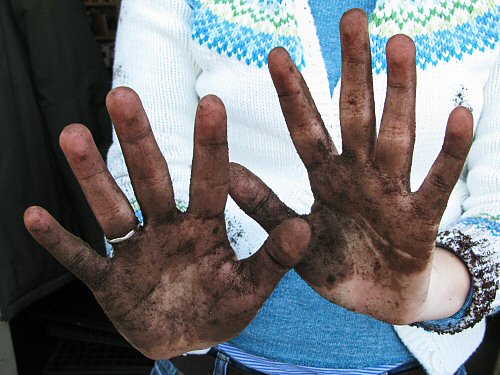
Finally, today seemed like the right time to start the main wave of seedlings! Lynn dropped by to look around, stir up some seed starting mix, and add to the dirty hands collection. This particular dirt isn’t all that dirt-y, it’s actually only peat moss, from the half-and-half perlite-plus-peat mix we’re using this year. Starting now, today and over the next few days: broccoli, cauliflower, kale, Brussels sprouts, cabbage, more onion, leek, pepper and eggplant. And off we go…
Month: March 2009
Abandoned bee village
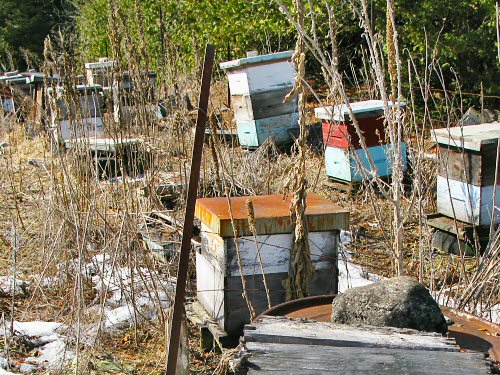
There’s an apparently abandoned bee village on the edge of the tree-enclosed clearing just beyond the main field (the clearing is past the fence, covered in snow, in this pic). There is a backstory here, still to be fully figured out, but the basic fact of the moment is a forlorn, ghost town-looking double row of hives, maybe 15 in all. I don’t know anything about beekeeping, so I did a little research. These seem to be the standard Langstroth hive design, used all over the world. From the photos I saw, the set-up here looks pretty normal, except for the tilting, the worn out paint, and the solidly rusted electric fence that surrounds them. Sorting this out is something new to do this spring. Our future in bees…
More seedlings appear
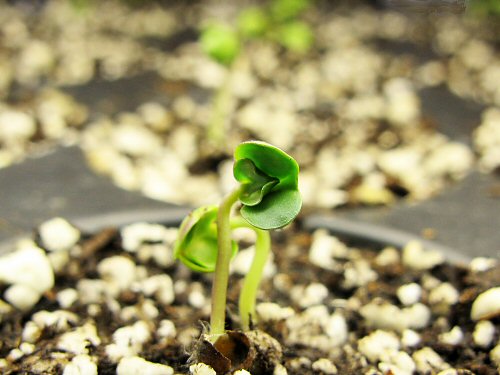
The brassicas—cabbage, broccoli, cauliflower, kale, and so much more—are satisfying at seeding time because they usually come up quick. This tray of Early Dividend broccoli is popping only three days after seeding. I don’t take notes about days to germination, except occasionally here on the blog, but I’m surely watching, especially with older seed. So far this year, with the seedling room usually around 65-68°F (18-20°C), the trays covered with clear plastic, using new seed, it’s been brassicas in 3 days, onions starting around 5. Where brassicas usually come up all at once, over a couple of days, onions can take a week to emerge right across a tray… Details! They’re everywhere! Some seem useful, some seem not.
Tiny farm moving – Part 3
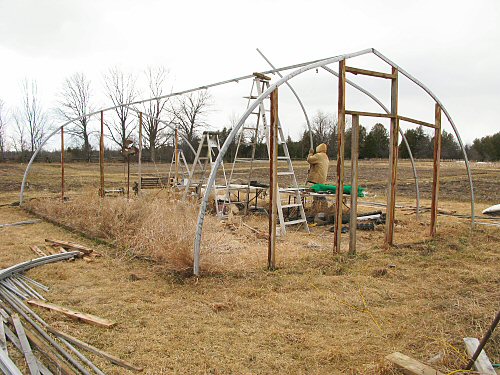
Headed to the old farm to pick up the greenhouse. It’s only been a month since the main move, but the return to a place where I spent practically every day of the last six years felt strange. Inside the farmhouse, it was just a familiar space, but rounding the corner into the barnyard, surrounded by all the old red buildings—barn, goat barn, drive shed—and then, walking into the field, that was different.
I guess this is the first real attachment to LAND that I’ve experienced. It was definitely unusual, not at all emotional, just a really strong, quiet sensation, a deep familiarity maybe describes it. I suppose the memories of all that thinking, observing, and working, tying together place and weather and ground conditions and seasons coming and going in one long, continuous arc, couldn’t help but leave their own type of mark. So that was interesting! :)
Bob had already started dismantling the farm stand, but that was so solidly put together, with thick, rough-cut cedar, heavy old fence boards, and 3″ nails (if you ever expect to move the things you build, for a few dollars more, consider screws!), that’s gonna be for another day. On to the hoophouse teardown…
The hoophouse is all screwed together, so taking it apart was easy. I’d considered lining up some extra hands for removing the plastic—there was a breeze, gusting to 4-5 mph (6-8kmph)—but Bob thought we’d be fine. And we were: the plastic skinned off amazingly easily, without catching the wind at all, and it didn’t disintegrate or tear…it will live again.
Around five hours later, and it’s all in pieces, ready to load up and take down the road. Going up and coming down are exactly the same, so I decided to take step-by-step pictures when we put it up again at the new farm…
Seeding as we go…
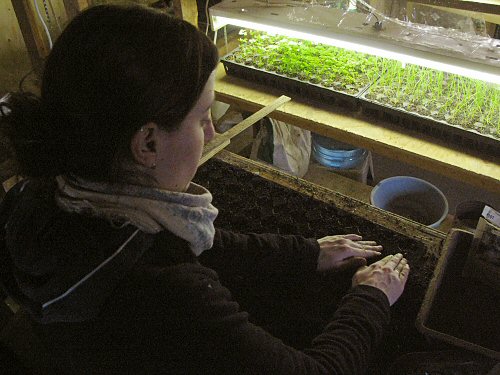
It’s spring! The ground is clear, hasn’t snowed in a while, but it’s still cold, and the tiny farming action remains mainly indoors. We’re steadily filling up the racks (here, Lynn populates a plug sheet with Red Russian kale; under the lights, parsley and onion). I’m spreading things out a lot more than usual, instead of starting a whole lot on one day. We’ll see what difference a few days or a couple of weeks make to the various veg… It likely won’t be much, but some interesting things could happen if we get really drastic week-to-week weather changes around transplant time, like we did last year. An experiment!
New eggplant (and peppers)

Today I peeled back the plastic on Vittoria, the first eggplant to show up for the season. So far, seeded a week ago, there’s Dusky and Vittoria eggplant, and Ace, North Star and Gypsy peppers, and they’re all just beginning to poke up. These seedlings are ahead, with a little more than a day’s growth.
Peppers and eggplant tend to germinate unevenly, at least in my particular lighting set-up, usually appearing first in the rows directly under the lights, and then making their way to the outer edges of the trays. I’m not sure if it’s the slight differences in light, or in heat from the lamps, that a couple of inches make, but it seems pretty clear that it’s one or the other, or both. Sensitive little guys. There’s a spread of up to a week between first up and mostly germinated… Adding to the unevenness, some varieties come up faster than others.
Give ’em all a few weeks, though, and they all usually even out, either indoors, or in the field…
Useful details? Maybe! :)
Fresh at last!
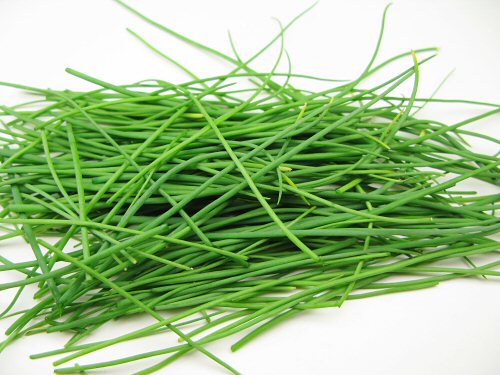
It’s a start. Whenever they reach 3-4″ (7.5-10cm), I trim back the onions to about 1″ (2.5cm), and now they’re thick enough to collect and EAT! I don’t have the greenhouse up yet, so didn’t start lettuce REALLY early, so it’s not a whole seedling trimmings salad like last year… But these baby greens are great: tender, with a delicate onion flavor and just a bit of bite. Taste-wise, they’re easily over-powered by stronger, heavier foods. We tried them on burgers and in a salad, but they’re best more on their own. My favorite: quite finely snipped and sprinkled on a boiled (farm) egg, with only salt and pepper. Tastes like the garden!