
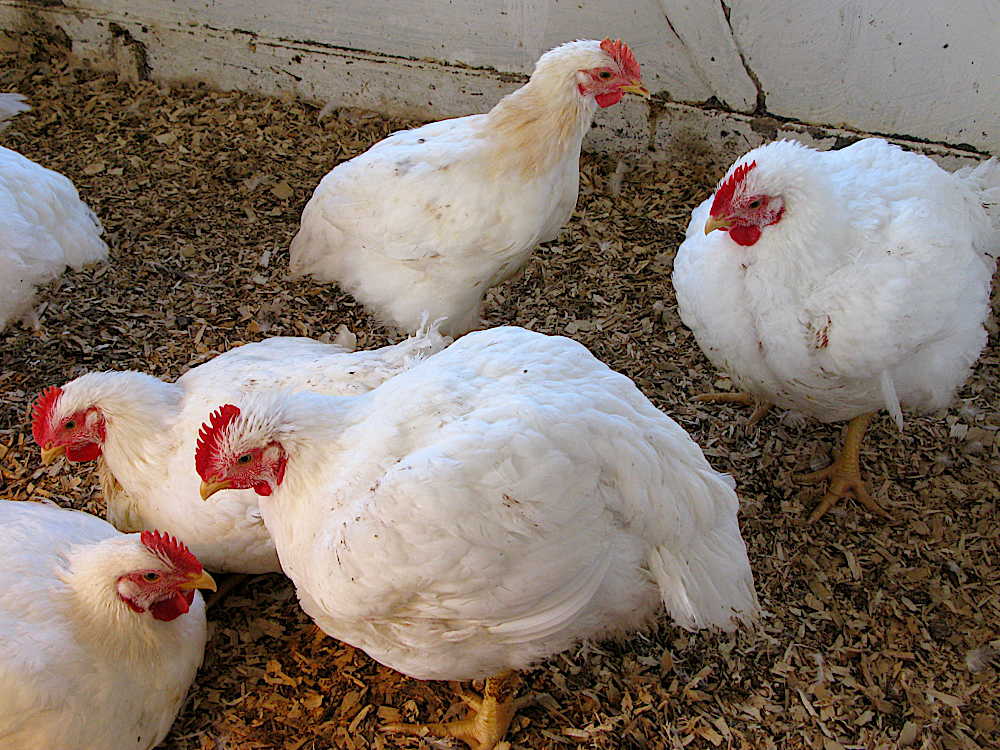
At this point, it’s safe to say that I’m no fan of White Rock Cornish X chickens. Without a doubt, they convert feed to meat incredibly…efficiently—compare the lone Frey’s Special Dual Purpose at the top center of the pic, surrounded by hulking, waddling White Rocks two and three times its size. What they gain in meat, they lose in basic chicken-ness… This first flock of mine are lumbering birds, with no taste for the outdoors, no built-in scratching skills, they’re definitely not up for dust baths or foraging through tall grass. They sit around, eat like crazy, drink, and, here and there, just kinda spontaneously DIE. I’ve learned a lot from this first go-round with meat birds, and I haven’t entirely rejected the White Rocks—I’m saving my final…evaluation for after they’re off to the slaughter in 2-3 weeks. More to follow…
Animals
Free-range chicken
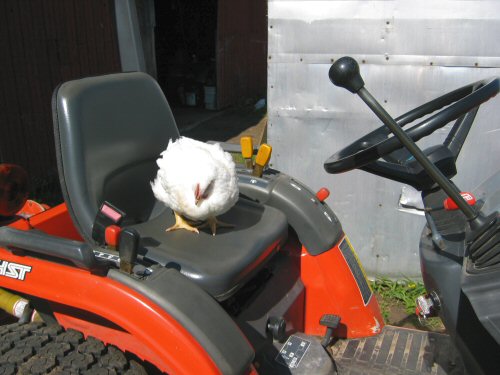
Guest post by Shannon: This is our pet chicken who is named Colonel Saunders. He almost died in the chicken house a couple days ago so we rescued him. He’s very dramatic and plays dead (but not on demand). He’s very chill and doesn’t give us any problems. Mike thinks the colonel has some brain damage due to a recent stroke but I think he’s smart. He gets to live on his own, with lots of space, we feed him whenever he asks (by tapping incessantly on his food dish), and he hangs out with us while we work. I dyed his top feathers yellow with dandelion flowers so we could tell him apart from the rest.
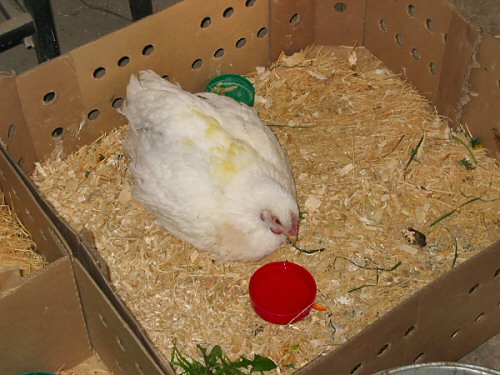
Chickens just wanna eat…
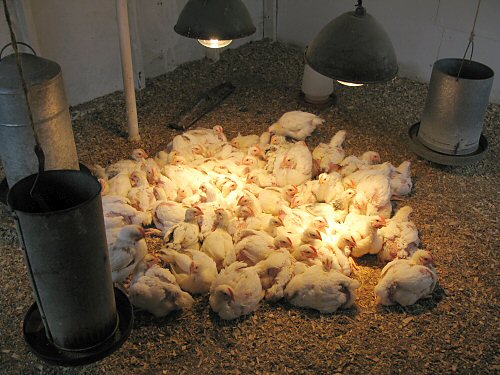
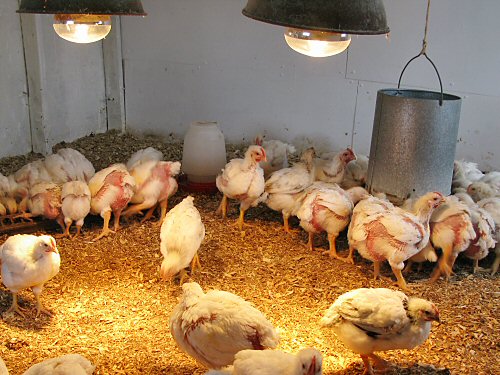
The chickens are blowing up! At least, the White Rock Cornish X super-converting chickens are, turning feed into meat at a startling rate. The 10 or so Frey’s Special Dual Purpose are sleek and speedy, and all their feathers are in, but I guess that’s not what a truly modern meat bird is supposed to be like. Most of the White Rocks are double the size of the Frey’s. When I think of the chickens these last few days, it’s a vision of pink, partially-feathered butts in the air, circled round the feeder… Oh well, we’ll see what happens when we get them outside and cut back a bit on FOOD…
Meanwhile, despite entirely different sizes, speeds and eating habits, they’re still all getting along. My first chicken adventure continues…
Chicken check-in
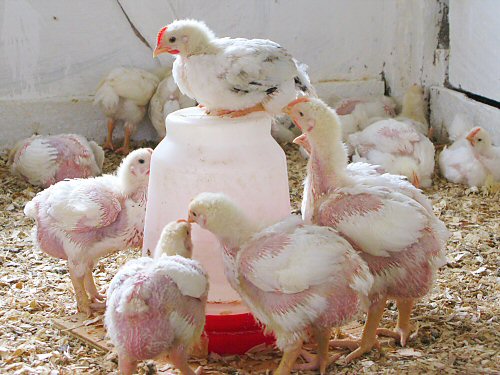
A week after their arrival, the chickens at three weeks old are doing fine. They settled in no problem, eat like maniacs, drink a lot, and I guess they’re too young to fight, ’cause they’re all getting along. I’ve been cycling through music—a radio is always on in the chickenhouse, to scare off PREDATORS—started with a couple of days of country, then a stretch of classical (they go a little crazy during big, building crescendoes), and now it’s rock (“’80s, ’90s and whatever”…a weird-format local FM station). So far, behavior seems pretty much the same no matter what’s playing—the experiment continues, maybe they want custom mix tapes. And they’re growing. They started off about the same size, but there are definitely some big guys now amongst the White Rock Cornish X, and the Frey’s Special are all at the smaller end, faster-feathering, too (there’s one on top of the waterer). They’re all getting along, but Bob noticed a red pecking spot on one of the White Rocks, so I’m gonna be watching the blending of the breeds: I read that sometimes the WRs get pecked (attacked?) because they’re slower to feather than others… The gang (the posse, the flock!) does keep busy, exploring corners and cracks, piling up and napping in sunlit patches, zipping around, drinking a lot, and of course, eating…
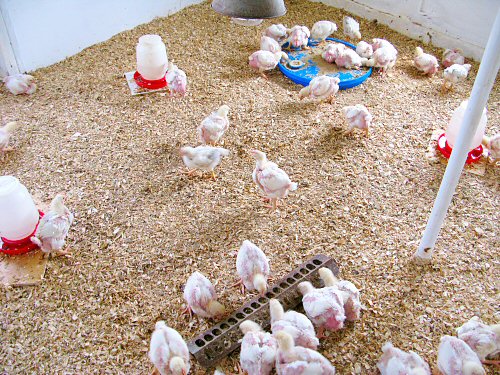
Definitely a lot of eating…
Chickens arrive!
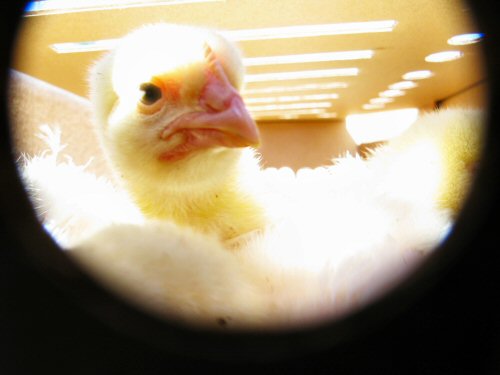
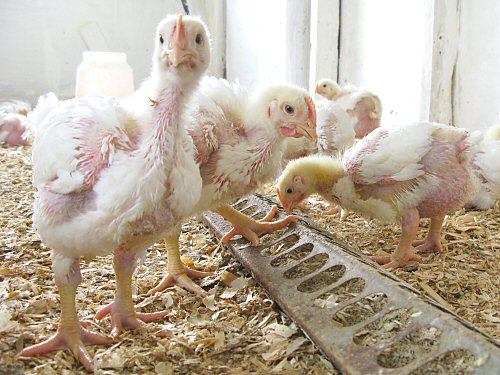
That was fun! Picked up the CHICKENS, wood shavings, and starter feed mix at the feed store. On this beautiful, sunny day, the airy, skylighted boxes looked like a deluxe place to be for a traveling chicken. Back on the farm, wood shavings were spread and waterers filled, and then the two-week old chicks were let loose. I lifted around 20 out by hand, a start on getting to know the guys. There are 50 in all (though I forgot to do the official count while unpacking), 40 White Rock Cornish X and 10 Frey’s Special Dual Purpose cockerels, all healthy, energetic, pretty much same-sized and apparently happy, running around like maniacs, jamming themselves into intense corner huddles, and PECKING AWAY at the feed and everything else in sight…
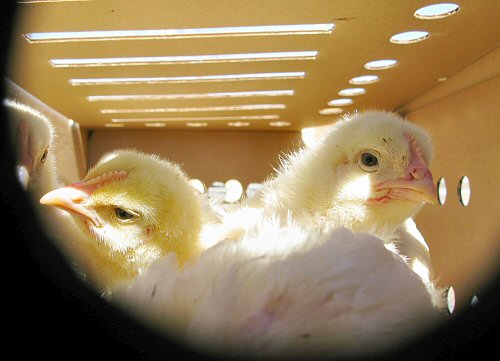
Yes, right from the airhole view, they’re definitely entertainment! I could watch ’em for hours (and, sorta, did…could’ve been tilling…). Chickens…
Submerged garlic and root-diving voles

For all of the melt-off’s magical moments—garlic tips emerging and big puddles that look like tiny seas—there are mild melt-off concerns as well. About one third of the garlic beds have been fully submerged for nearly two days now, and may stay that way for 2-3-4 more, especially if it rains tomorrow as promised. (This area usually doesn’t get flooded with runoff, but I should’ve paid attention to the natural gully and not rotated the garlic there, just in case.) I doubt being underwater for a while will affect the garlic, but I don’t know for sure… How long garlic can hold its breath is another thing I’ll soon find out! And elsewhere, I discovered the handiwork of VOLES (it had to be them) in the herb patch. Under cover of snow, they’d neatly excavated 25′ feet of parsley roots, methodically working their way down the double row. These aren’t tunnels, just holes that go down about a hand’s length. Interesting. Another first. And no loss. But could this be population explosion year in the local vole cycle? Last year’s spring lettuce raids in the greenhouse were nothing compared to organized action like this… Good thing they don’t like garlic!
Liming the Chickenhouse
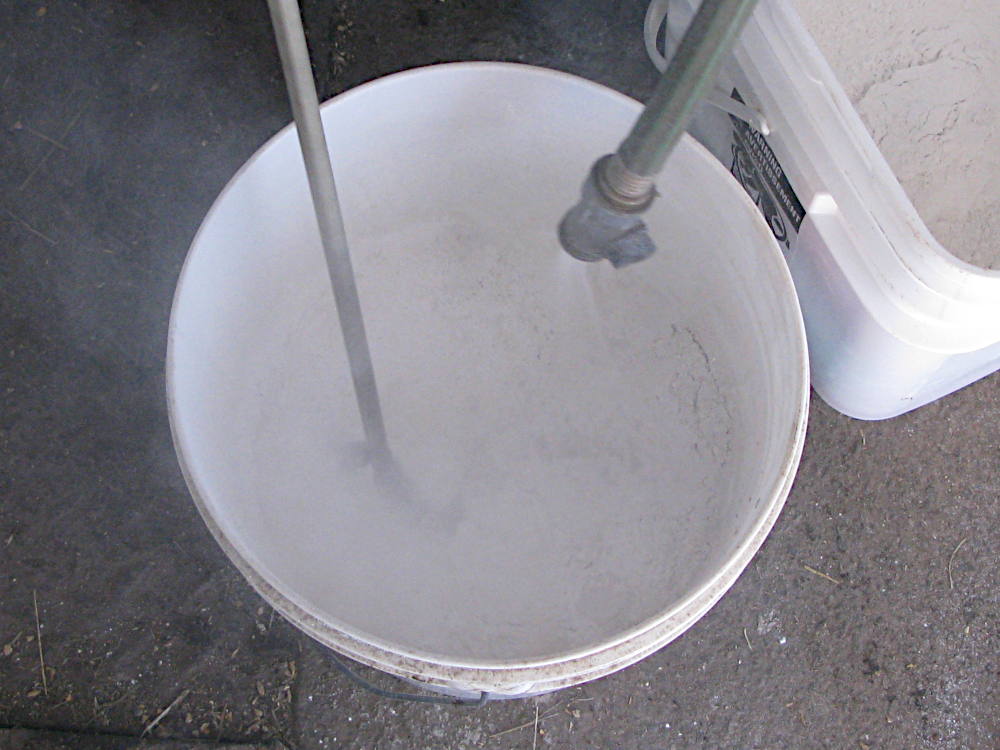
Whitewashed the meat bird half of the Chickenhouse today, using the traditional purist blend of nothing but hydrated lime and water. This is an old school farming standard from Bob, completely new to me.
The lime is a very fine powder that comes in bags. Mixing was easy. A power drill mixing attachment churned it to a thickness a bit lighter than regular paint, and then on it went with big brushes.
The lime is a bit caustic, so wearing a mask when mixing, and gloves and goggles to avoid splatter, is a good idea, although I didn’t this time around (and I did take care not to inhale clouds of lime dust!).
Afterwards (it’s follow Bob’s lead), I did some reading and, not surprisingly, was quite amazed: yet another simple, inexpensive, effective approach that’s been complicated (in this case, into the costly world of high tech paints and sealants).
Classic lime whitewash disinfects, repels insects, and preserves by sealing surfaces and wicking up water. It dries to an opaque white that beautifully reflects light to brighten up dim spaces.
It’s also safe for animals (which, yes, includes us humans, lime can even be used in chicken litter to keep it dry).
There are lots of applications, interior and exterior, for wood and masonry. It’s not as permanent as oil or latex paint, will rub off a bit, and needs to be refreshed every year to keep it in top shape.
It’s also INEXPENSIVE: a 50lb (22.5kg) bag was about $7, and you can mix up at least 15-20 gallons from that, the way we used it. That means you could whitewash an entire small building, inside and out, for maybe $20! For big jobs, a sprayer would make it real easy.
You can tint it, and there are also various recipes that include alum, salt and other additives that may improve adhesion, but the tried-and-true basic is just lime and water.
And you need hydrated lime (calcium hydroxide), NOT dolomitic lime nor calcium carbonate, aka garden lime (both are recommended for raising pH in garden soil). We got ours from the feed store.
I’m not sure how popular this sort of whitewashing is these days, but it’s certainly still used, and a few decades ago, this was a standard type of paint. Anyhow, it looks and sounds great, and we’ll see how the chickens like it!
WHICH LIME? Use hydrated lime (calcium hydroxide Ca(OH)2 also called builder’s lime, mason’s lime, slaked lime, or high-calcium hydrated lime). NOT agricultural/garden/barn lime (crushed limestone, calcium carbonate, CaCO3), dolomitic lime/dolomite (magnesium-calcium carbonate, roughly CaMg(CO3)2), hydraulic lime (variable composition, often containing silicates and aluminates), or quicklime/burnt lime/caustic lime (calcium oxide, CaO—dangerous to handle, boils over explosively, causes chemical burns).