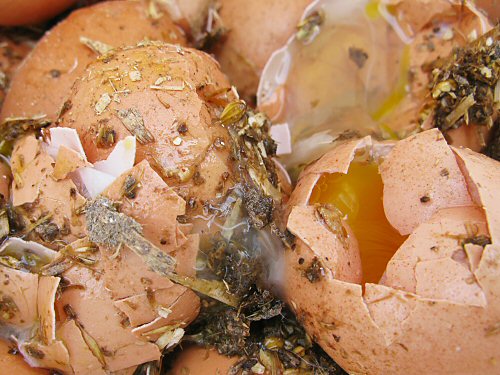
Today, a bit of an egg disaster, around 20 eggs down, by far the biggest single egg loss in my brief egg-collecting career. The girls choose to do most of their laying in one nest box (there are six in a row), so there’re usually around a couple of dozen eggs in there, conveniently waiting for pick-up. This time, there were only 8 or 10, all slimy with egg white and coated with shavings and droppings, with tiny bits of eggshell thoroughly mixed into the rest of the litter. What I think happened was, one of the eggs somehow broke, the girls jammed into the egg-packed nest in a feeding frenzy, their jostling and mad pecking broke some more, increasing the frenzy and the breaking, and so forth. As I was cleaning up the rest, one egg slipped and cracked, and half a dozen chickens went crazy slurping it up. Man, do they love eating eggs… I tossed the rest into a bucket (whereI later took the pic)… I don’t expect this to be a new regular thing, as the girls don’t seem to be interested in actually trying to break eggs…though I’m sure they could learn.
Farm lab (research!)
Chickens in snow
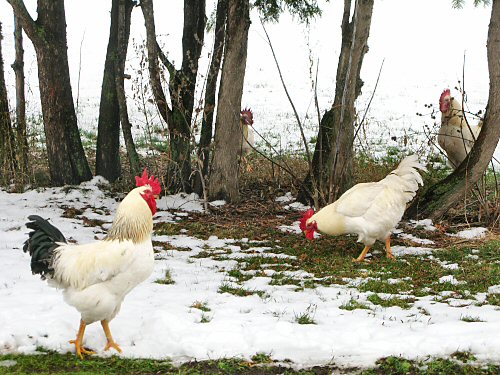
These chickens like snow! The eight remaining roosters have been out and about in some fairly wild weather, making their way through 6″ (15cm) blankets of snow, gusting winds and absolutely freezing cold. They always have the option of heading out of the little door in their half of the chickenhouse, or not. I’ve only kept it closed in the morning a couple of times, when the weather was ridiculously nasty. They’ve only stayed inside once by choice, on not such a bad day, which was a bit of a mystery (maybe snow had built up at their doorway that I didn’t notice). They still roam all over—chicken tracks just about everywhere in the barnyard snow—but tend to hang out on exposed ground, like around the small stand of trees in front of the farmhouse. So far, no frostbite and no frozen feet falling off. They’re pretty tough birds…
Hardy berry
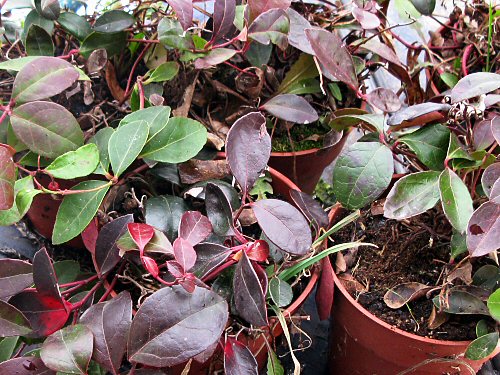
These guys are pretty impressive in the low maintenance department, definitely the toughest, hardiest potted plants I’ve known. They arrived out of the blue last January, about 20 of them. After a bit of coddling under the fluorescent lights along with the spring seedlings, I set them outside in front of the Milkhouse, and there they’ve sat, untended, in 4″ (10cm) plastic pots, for the last seven months. In recent weeks, they’ve been basically frozen solid in their pots for much of the time. And here they are, leaves glossy, setting a couple of berries… Cool!
What are they? Wintergreen (Gaultheria procumbens), aka teaberry, a small, creeping evergreen shrub with minty, wintergreen-tasting berries (the leaves and stems can be made into a medicinal tea, and the plant also produce wintergreen oil, used as a flavoring). They’re healthy, but they’ve only set a couple of berries amongst the remaining six plants (I gave away the rest). Hmmm… I’m comfortable with the many varieties I grow of 40 or so veggies and herbs, I’m still getting used to several varieties of a dozen types of cut flower, and I’m working on ID-ing ALL of the various grasses and weeds around here. WINTERGREEN is barely on the map… So many names, so much to know…! UPDATE: Case in point… Thanks to comments below, these guys were properly identified, I’d thought they were winterberry… I’ve corrected the post!
Chickens at work
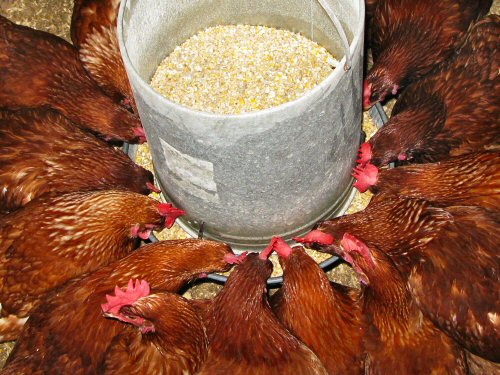
The Shaver Red Sex-Link laying hens are doing fine in the fairly chilly chickenhouse, eating up a storm, looking and sounding healthy and happy, and producing away. They’ve been in artificial light days for the last couple of months, about 16 hours made up of daylight extended by a 60W bulb on a timer that’s on till 11pm. I’m curious whether at least some of the girls would really stop producing for the winter if the light dropped below 15 hours for even a single day. I don’t actually want to see it happen, but what if there’s a power failure? Hmmm… Kerosene lamp? In any case, fall egg production has so far stayed steady at about 20-23 a day for the 25 girls… Chickens are easy, you don’t have to know a lot to raise them casually, but there is a lot you could know. And of course, the more you know, the less you need! My winter chicken reading is Storey’s Guide to Raising Chickens.
Veggies in snow
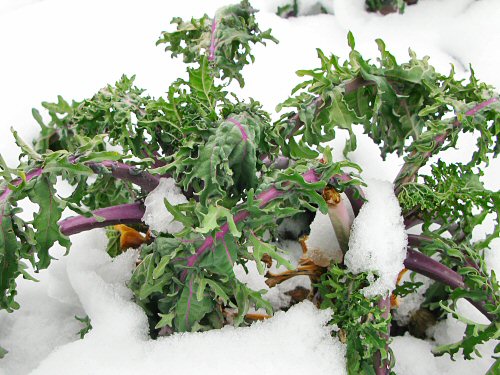
Every season there’ve been hardy veggies left to the cold and snow, and this season, it’s a record quantity, with nearly 2,000′ (610m) of broccoli, cauliflower, cabbage, and kale that mostly started sizing up just as the farmers’ market finished at the end of October. It seems like a waste, but it’s only a typical garden gamble on the weather (I was trying for an extra, really late crop). The risk was clear back in August, and we didn’t get enough sun to push things along a tiny bit quicker. We did harvest a lot of the Red Russian flat-leaf kale (above), for a good four weeks, and one round of 1-2 lb (450-900g) cabbage (a nice size for a meal for one or two). And there’s been a lot of personal-use picking in November. The rest is a giant farm lab experiment, more exploration of the snow-on-veggies effect…
More than the snow, the many nights of extreme cold (-15°C/5°F) that came with it this year really blasted these guys, wilting them and burning leaves and buds. So, none of the crops are too firm or pretty, BUT, they’re still alive: for the most part, there’s good color and texture. The kale, always super-hardy, did the best from a let’s eat some perspective, with good texture and great taste. The broccoli, while a little wilty on the stems and burned on the buds, also tasted great, fresh and flavorful. The cauliflower did the worst, the heads really damaged by the freezing and thawing, too mushy for me to bother with a taste. (Eating raw was fine, but how would this all cook up? We may see…) We’d already reaped most of the filled-out cabbage, so the rest aren’t going to go anywhere from here…
What’s all this odd information worth? Not much, I guess, I’m not planning on deliberately planting for snow harvests. But checking things out is always fun, no experience goes to waste, and there is at least one advantage to knowing there’s still good eating out there: the laying hens will be feasting on a fabulous greens buffet for a while!
It’s really cold
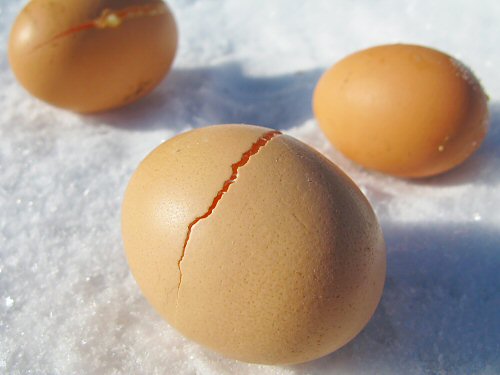
It’s taken a couple of days of this pretty intense cold snap for me to realize it’s yet another whimsical display of the crazy weather we’ve been having for the last six years or so. It’s not that overnight temperatures around -14°C (7°F) are unusual for southern Canada, just not in November. This time last year, there was a ton of snow, but without the unreasonable deep freeze. The winter before, I posted here in mid-January that “winter’s a no-show”—I was still digging carrots! Interesting… Inspired by the cold, I decided to see what it would do to chicken eggs and left a couple out overnight (there was a kinda practical purpose, it’s pretty cold in the chickenhouse). Of course, they froze as hard as hockey pucks. And cracked..
Root love
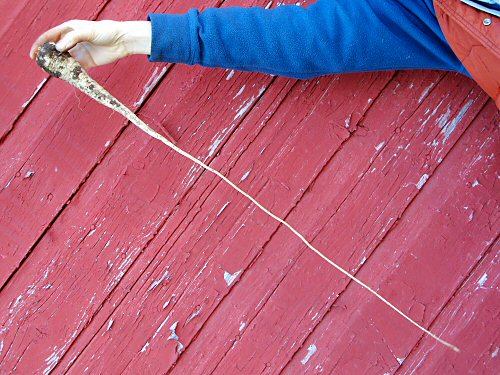
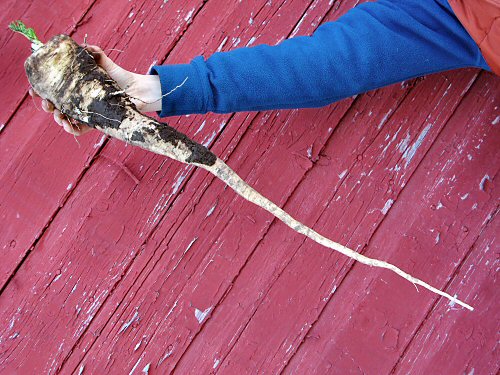
About the last thing anyone is likely ever to see first-hand is the amazing root structure of plants! I’ve been fascinated by the massive size and complexity of ROOTS since I first saw a sketch of a full root system, and way more so after browsing the wealth of technical drawings of garden veggie roots in the fantastic and fully-online Root Development of Vegetable Crops. Root systems can be VAST, but they’re incredibly difficult to actually see since the mostly fine filaments that tunnel everywhere simply break off when you dig up a plant. Today’s parsnip harvest yielded a couple of unusual, still very partial root specimens that only begin to illustrate what’s going on down there. Who knows how just a few managed to come up with so much intact… For parsnips, according to RDoVC, after a season’s growth, “at the 8-foot level roots were common and a maximum penetration of 9 feet was determined.” In the top 10″ (25cm) of the soil, lateral roots extended up to 3′ (90cm). Pretty cool, huh?! (Thanks to hand-and-arm model Lynn.)