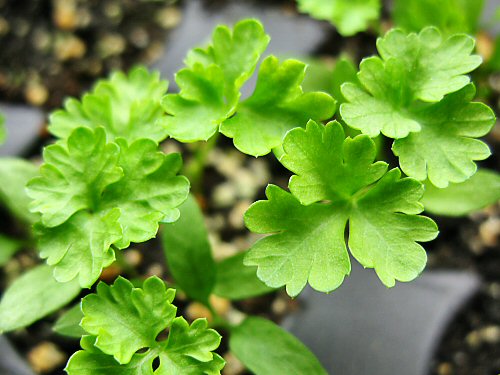
Three weeks old, and the parsley is already well past its seed leaf stage, where everyone pretty much looks the same, and is busy expressing its true nature. On the left, Green Pearl, a curly variety, starting to pucker and…curl. On the right, Hilmar, of the generally stronger-tasting flat-leaf type. Curly, straight, plants, people…we’re all bobbing around in the same big boat! (I’m still WAITING, holding back for a few more days before starting the next wave of seedlings… :)
Farm lab (research!)
Lead bean, Part 2
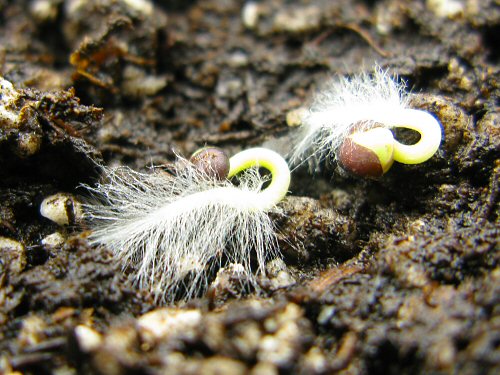
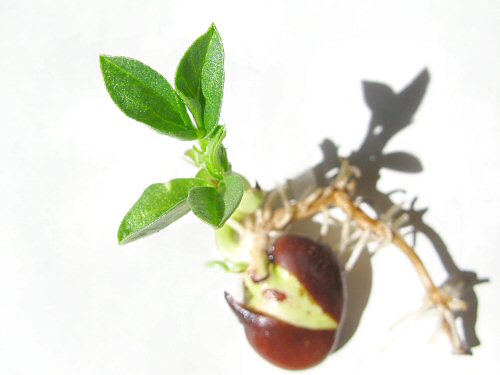
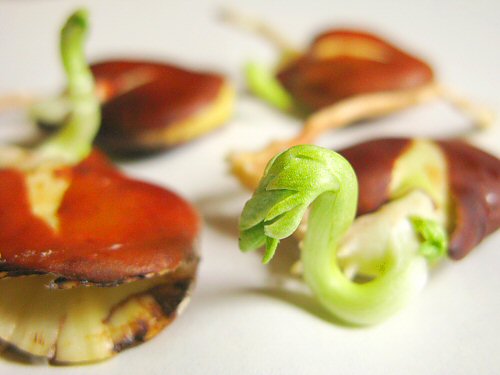
I ended up putting the sprouted fava beans in a pan of water, instead of discarding them after the mini-germination test, and put the pan on a south-facing windowsill. A few days ago, a little natural selection happened: the pan got knocked to the floor, and the kinda brittle main root snapped on three of them, leaving only the biggest, healthiest one in one piece. I put it back in the pan… Amazing what a plant can do, in a few days, with nothing but water and some sun. Tiny hydroponics!
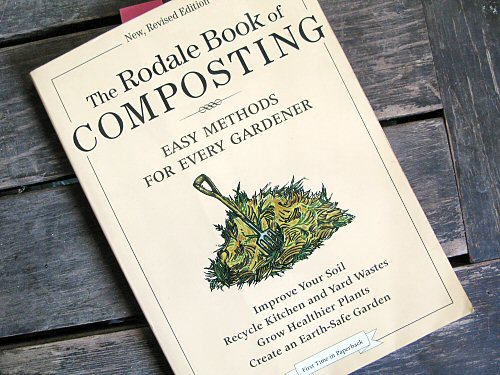
Hitting the books: Composting!
Winters on the tiny farm have always been a time for research and a bit of book learning. My first two seasons were crazy for reading, especially the winter before Year 1, when I had four months to pick up enough, from zero knowledge, using books and the Net, to map out the initial one-acre plot, order seed, get some gear, and “pass” the initial organic certification inspection, in order to start the market garden that spring. That was fun!
Over the last six years, though, a curious thing happened. My original urge to find out how everything worked, to soak up endless technical detail, full of labels and scientific explanations, died down quite a bit—often I’d rather watch a squash decay than read about it…
It seemed more fun to find specific, practical solutions on the farm: how to fix this or improve that. At the same time, I’ve become more and more aware of the growing process as a whole (and really, how relatively little I have to do with it…), not so concerned about its parts. It’s a little hard to explain, though real easy to feel. Maybe it’s just…a phase!
MEANWHILE, this year, Year 7, is a bit of a shake-up. Compared to the old farm, the new farm is pretty bare-bones. One big change: I don’t have the tons of well-aged, almost completely composted cow manure that was available there.
Every year, I made manure-based compost in 50′ (15m) windrows, incorporating crop residue and culled veggies, turning it with the tiny tractor, checking it out, but it wasn’t CRITICAL to fertility. A fall spreading of fine, on-farm, composted manure always did the trick!
Now, with no on-farm animals yet (chickens to come first!), and no prospect of generating huge amounts of manure, compost that relies more on plant sources will be my new friend. Composting and green manure are on my mind.
New necessities require…new learning! So along with everything else over the last 2-3 months, there’s been a more intense hitting of the books, thinking over, chatting, scouring the Net. It’s not exactly like starting over, but it’s definitely…FRESH. I’m excited. More as it happens!

Fava beans test OK
It’s that time of year again when obsession with seedlings somehow takes hold for a short while. I wonder if I’ll ever get over it, that almost overpowering early spring feeling that you don’t want to waste even a SINGLE seedling. Here, I germination tested a few Witkiem fava beans (broad beans) from an overlooked four-year-old supply. Bean seed viability is often rated at three years, but I didn’t doubt that these were fine, they looked and felt great. I tested some anyhow: wrapped them in a paper towel, misted them with water, popped them in a clear ziploc plastic bag, put them in a warm spot. That was about three weeks ago. Sure enough, a week later, the not-so-little white radicles were poking out of all of these big beans. Excellent! So I put them back in the bag and kinda forgot about them, moved them and all. Today, they were unpacked, and even without any light for at least a week, the seedlings were lustily struggling to break free. Now the kinda obsessive part is, I FEEL BAD ABOUT THROWING THEM OUT! This is pretty crazy. There is no good reason to pot them in February and have ’em hanging around for months until it’s warm and dried out enough to transplant. After two-three months in a pot, they’ll be useless as proper transplants, anyhow. Meanwhile, in a couple of weeks, there’ll start to be so many seedlings around here, and this keep-’em-all urge I’m having now will be gone without a trace. So I stuck ’em in some water, just for now… I thought this beginning of the season hang-on-to-every-seedling thing would wear off after a few years, but apparently not yet. Maybe I don’t take this business of tiny farming seriously enough! :)
North field in snow
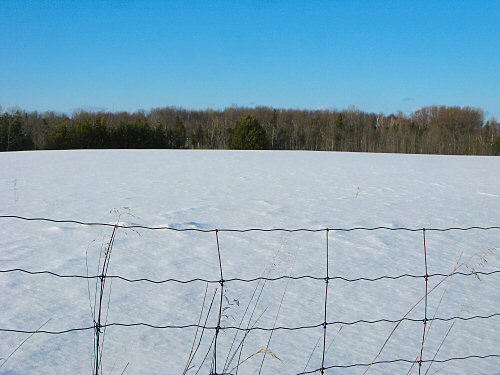
The North Field—I think that’s what I’ve taken to calling it; there’s also the South Field and the South Slope—somewhere around two acres including the sloping perimeter, is the main market garden at the new farm. It looks suitably inscrutable under more than a foot of unbroken snow: what does the soil under there have in store? My look-around in November didn’t turn up anything immediately alarming, and that’s mainly what I looked for, things that could make farming these fields really tough. The few handfuls of soil I dug up were a nice clay-loam similar to the old farm. I didn’t find any super-invasive and tenacious quack grass, and the equally troublesome Canada thistle showed up only here and there in the strips beside the fences and paths. So far, so good, but that’s only the most obvious stuff. On the list of a million things to do over the next three months to get ready for the May plant-out, beginning to know the soil and the lay of the land is way up there. We’ll soon find out. For now, I have to wait…
Another snow day
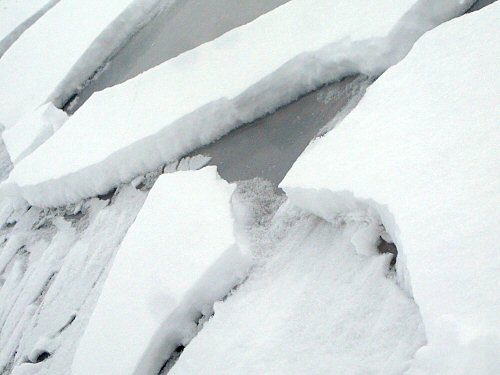
More snow. A few inches, I guess. I don’t pay attention any more, unless there’s too much snow to get out the door… I trudged out into the field, snow up to my knees, to check the greenhouse. It’s doing fine as usual, fully inflated (it has two layers of plastic, with a fan blowing air between) and shedding snow with ease. The greenhouse (and the veggie stand behind it) won’t be moved to the new farm until the snow clears and it’s easy to get at, hopefully sometime in March. I hope dismantling it doesn’t make it fall apart. The plastic is rated for four years, which means the UV resistance should be giving out any time now. I suppose the plastic will start to disintegrate. I don’t really know what happens when greenhouse plastic expires. Guess I’ll find out. Until then, I expect it to last forever! :)
Chickens love eggs
Today, a bit of an egg disaster, around 20 eggs down, by far the biggest single egg loss in my brief egg-collecting career. The girls choose to do most of their laying in one nest box (there are six in a row), so there’re usually around a couple of dozen eggs in there, conveniently waiting for pick-up. This time, there were only 8 or 10, all slimy with egg white and coated with shavings and droppings, with tiny bits of eggshell thoroughly mixed into the rest of the litter. What I think happened was, one of the eggs somehow broke, the girls jammed into the egg-packed nest in a feeding frenzy, their jostling and mad pecking broke some more, increasing the frenzy and the breaking, and so forth. As I was cleaning up the rest, one egg slipped and cracked, and half a dozen chickens went crazy slurping it up. Man, do they love eating eggs… I tossed the rest into a bucket (whereI later took the pic)… I don’t expect this to be a new regular thing, as the girls don’t seem to be interested in actually trying to break eggs…though I’m sure they could learn.