
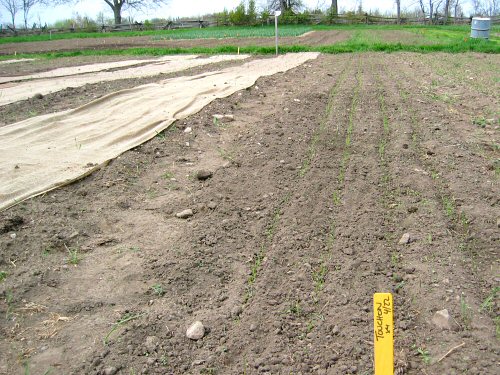
The carrot germination experiment worked like a…charm! They were coming up pretty good three days ago, conditions looked great under there (moist, airy, seedlings nice and green), so I left the burlap on a while longer to push the germination rate a bit more, and that worked as well. This bed just had a 10-minute clean-up of some grass and dandelion, and I test cultivated a few feet at this end for smaller weeds getting started. With the moist soil, it’s all easy. Now it’s off with the rest of the covers and time for a little irrigated rain (since Ma Nature is presently not obliging). Excellent!
Fieldwork
Potatoes and people
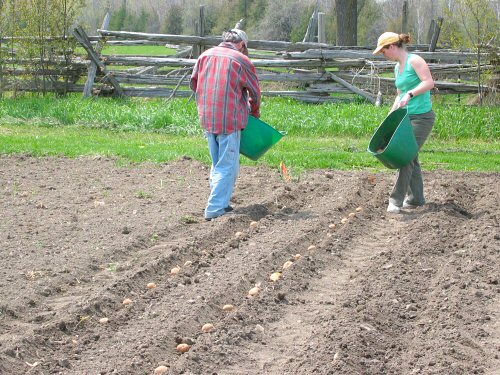
Finishing off the potato planting. Sherry is a second year CSA member, Brian a regular customer at the farmers’ market. They both approached me to get into the field for a bit, and it fit with the People Year on this tiny farm. It’s fun and it’s tricky. Each little step away from the ultra simple model of just me and the field brings on more considerations along with whatever the improvement—in this case, the basic pleasure of sharing work that’s fun to do!
For the main fieldwork jobs, I want to provide compensation. Of course, with cheap supermarket produce prices setting the standard, farm work is…real low paying. I’ve given it some thought in the last few weeks, and it doesn’t make sense to me to run a small farm based mainly on volunteer work, it doesn’t sound all that…sustainable. Still, volunteering is common with small organic farms (and I signed up for WWOOF this year). Anyhow, my plan so far is to divide work into the absolutely necessary and the not so critical. For example, maintaining the herb and flower beds in pristine condition is not something I’d do, basic care is what I have time for, but it’d be great to have volunteers do that. Things like timely seeding, cultivation and harvest are…central. These, I really want to pay for if I can’t do it myself. I’m working it out. How it unfolds this year will be interesting!! (I guess that’s what BIG farm families were for! :)
Let’s take a look
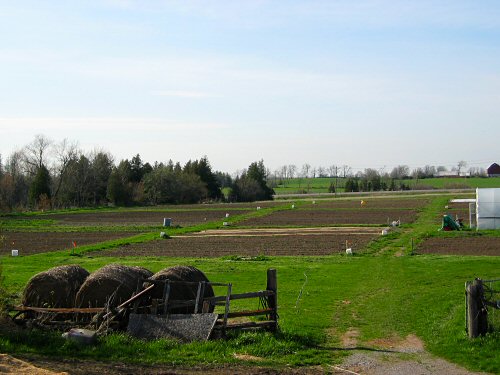
The latest View. The weather’s been warm and sunny for the past few days, but the nights mainly cold, often drifting down to zero C and a bit below. No rain, and the ground’s getting dry. Finally got round to cutting the grass (no more soaked feet in the morning). The white pails all about are for the spring cleaning of rocks pushed up over winter. Nothing green in the way of crops to see from up here, but just about everything seeded so far has emerged. Overall, nice!
Potatoes go in
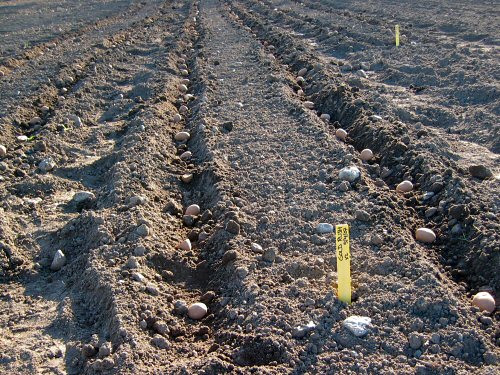
Gold Rush potatoes, ready to be buried. Potatoes are yet another work in progress, as I experiment with simpler, better ways to grow ’em at my particular hand-tended scale. This year’s seeding method: use hoe to make shallow trenches, drop potatoes every 18″ or so (more spaced this time than the usual 12″), walk down each trench stepping them in with ball of foot, fill in trench. Quite relaxing! The selection this year is basic, the usual: Gold Rush, Norland, Yukon Gold, 300 pounds (136 kg) in all.
O, the luxury!
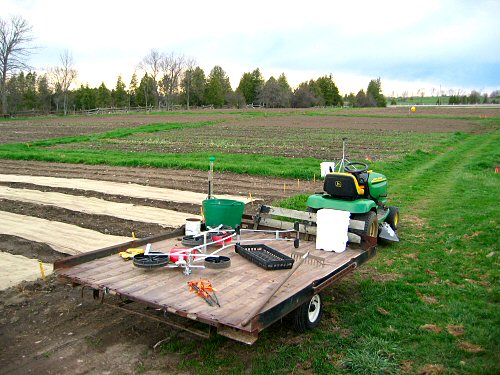
No sooner fixed than in the field! This combo of little riding mower and old snowmobile trailer is possibly my favorite tiny farming tool, a decadent* alternative to walking up and down the garden plot.
Around here, you can walk miles in a day, especially if you forget things and have to go back—although, walking around, taking different routes each time to check stuff out, is one of the big pleasures, too… What a simple life. :)
Anyhow, after trying a couple of different garden utility belts, overalls with 50 pockets, and a pull-along garden cart, nothing has come close to being able to toss all the stuff you need onto the trailer and go.
I use it whenever there’s too much to carry. Here, I’ve just finished the second seeding of mesclun and spinach, four beds each (on the trailer: Earthway seeders with plates in the coffee can, my most used rake, measuring tape and stakes for marking new beds, a pail for rocks, and seed in the green trug; the empty trays just happen to be there).
Up until I took this pic, it was a gloriously sunny day, after three days or so of cloud and drizzle (which added up to 20cm of rain). Little luxuries.
*The mower is actually pretty energy efficient: it uses maybe 30 gallons (114 l) of gas in an entire season, and that includes mowing paths and hauling harvests.
Field at night
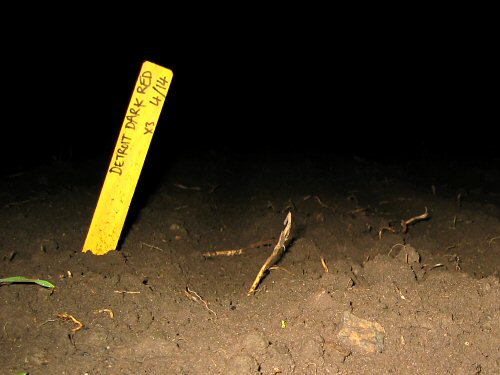
Nights are warming up now, so it looks like I won’t be cruising through the near pitch black field much longer, checking temperature in the greenhouse. There’s not much to see or do out there after dark.
Carrot science
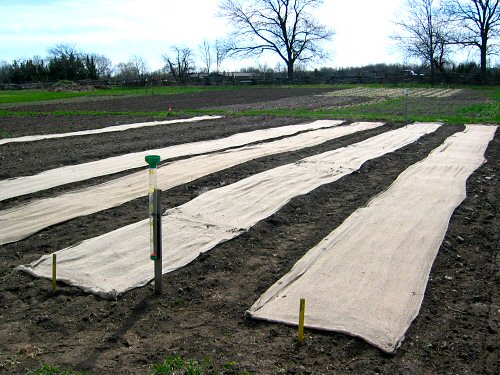
Welcome to my carrot lab! Carrots have been my biggest early spring headache. In cool weather, they take forever to germinate, 2 or 3 weeks, and by that time, the chance of weed competition is pretty good, and just about anything growing around the tiny seedlings makes excruciatingly time-consuming surgical hand weeding a necessity. What to do? Last year, I tried IRT (plastic) mulch over the bed. This worked great, heating up the soil, speeding germination to 7 days, and keeping weeds down. Problem was, miss the germination window (when a good number have emerged) by a few hours or a day, and the seedlings got toasted in the heat. Too delicate a balance. So, a new approach, something I’d read about. It involves a double layer of (untreated!) burlap. Simple. The burlap acts as a mulch to retain moisture and increase soil temperature, and it also allows in water and some light. What could be easier?!?! Now, all it has to do is WORK! (Update: it worked like a charm…)