
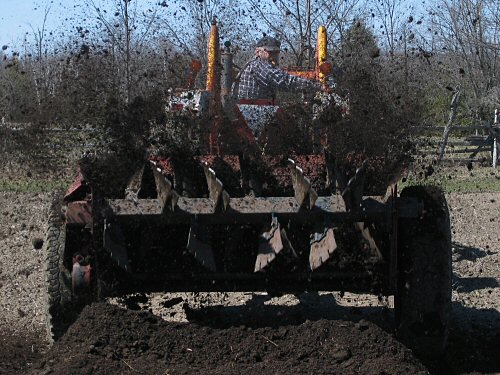
Last of the big machine work! Bob using the spreader to drop off a pile of compost for distribution by shovel (shot two days ago). There is something really satisfying in this crazy world about technology that is straightforward, like a giant fan-blade device for tossing manure far and wide! Today, I finished rototilling the new section, ending the main tractor work. From here, most of the fieldwork is done by hand—the biggest machine is the little Kubota. Later on in the day, it rained, only 5mm but enough to save hours of watering-in newly seeded beds. Time to start keeping track of the rain…
Fieldwork
Garlic, now!
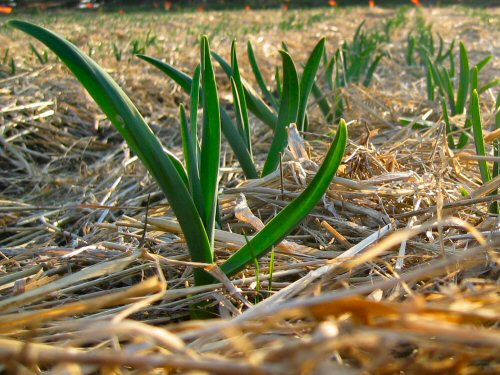
Garlic is shooting up once again. Although we’re only five days into a nice warm weather stretch, this year’s crop of Music seems to be at almost the same place as last year’s garlic in the all-mild April of 2006. You can see it growing by the day. Elsewhere in the field, things are moving ahead faster and with more on the go than ever before, with Conall (the all-new organic grower) picking up new field skills practically by the hour. Let’s see how things continue to shape up!
Get it in, get it done!
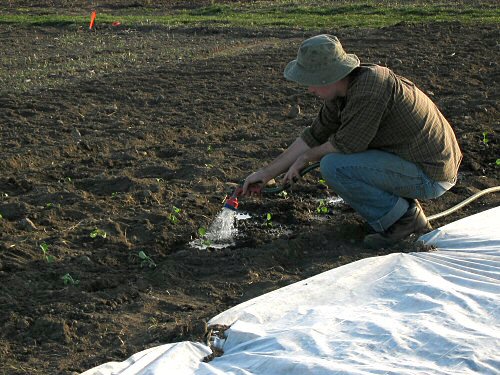
Conall, the all-new organic grower, starting from scratch as our first full-season, full-timer, waters in transplants. Today we set out three more beds of brassicas—so far, there’s cauliflower, broccoli, Brussels sprouts, bok choi—prepared beds for a dozen more crops, set up the irrigation pump for the season, cleaned out the winter storage area of the barn, turned the composting windrow….and more. Still, it’s the rush-to-get-it-in-get-it-done time of the year, and the days never seem long enough (although, they’re getting longer!!).
First field transplant of the year
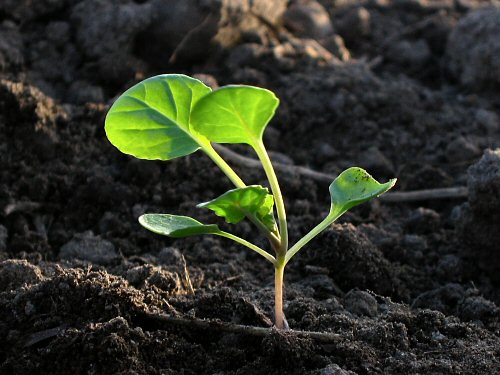
This little Jade Cross Brussels sprouts seedling, only four weeks old, is first into the open field. The weather remains pretty well perfect, warm and sunny, and we’re steadily chipping away at the list of crops waiting to be started right away. Today, besides the Brussels sprouts, the first three beds of mesclun, and a whole lot of bed preparation!
Gardener of all I survey…
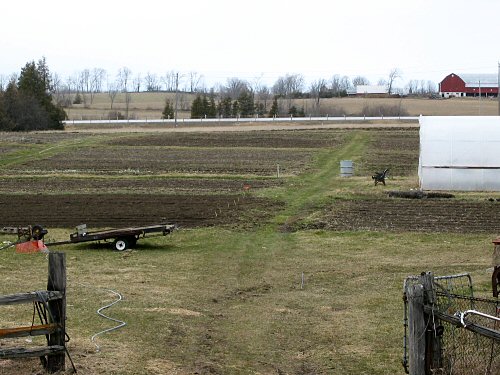
The View from the top of the gangway that leads into the upper level of the barn. Once things get growing, I go up here every day to survey the scene. Today, it pretty much sums up the spring so far, mainly damp, grey and gloomy (see Mar.16, Feb.18). Without sun, the grass has hardly started to green up. You can just make out the yellow markers in the very first section on the left where yesterday I got in beds of spinach (Bloomsdale, Spargo), beets (Scarlet Supreme, Detroit Dark Red) and radish (Rebel, French Breakfast). That felt good!
Breaking new ground
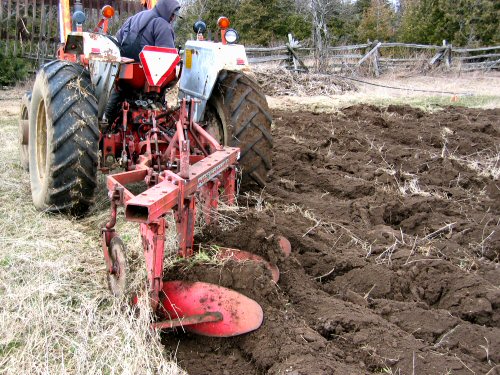
Added a new section to the garden plot today, with a helping hand from Bob, his tractor and a moldboard plow. The moldboard turns the top few inches almost completely over. It’s very effective for breaking up sod, and it’s also sort of an old school approach. Apparently, some farms moldboard once or twice a season, but as a regular practice, it’s not great for the soil and has somewhat fallen from favor in recent years. Here, it’s a one-time plowing that gets the job done!
The rhubarb debacle
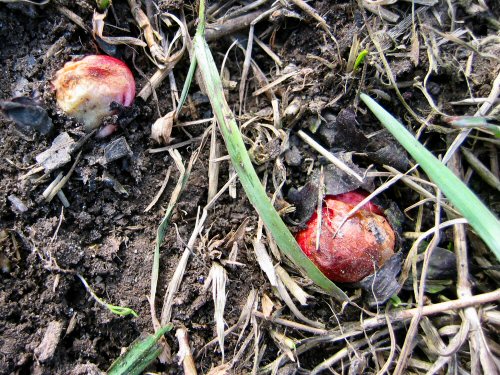
Debacle may be a little strong, the future of my newly established rhubarb patch is not absolutely dire, but it’s not looking perky just yet. I’ve so far managed to spot only half a dozen of the 50 odd transplants I set out last year in spring. I’d ambitiously dug up part of an ancient patch in the house garden (it needed thinning anyway), divided out a ton of roots, and planted at least 50 on 3′ centers (hopefully, I’ll be able to count ’em in a couple more weeks) in a permanent spot in the garden field. I can’t quite remember what I was thinking: eventually, rhubarb for an entire village?! Problem became the low priority of rhubarb in the busy year, upkeep of the patch got away from me, and it grew over quite heavily with grass and other weedy items. Also, fewer, denser plantings might’ve been a better idea. But rhubarb is tough, I dunno if it can be smothered by mere other plants… We’ll soon see!