
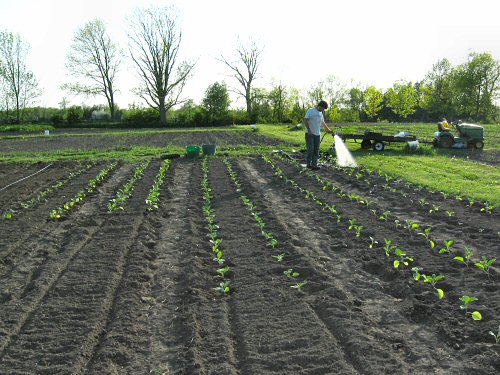
Towards the end of the day, Conall waters in newly transplanted eggplant and peppers. Over the last week, focus has moved almost entirely to the open field. The seedling room is empty, the last of the seedlings are now in the greenhouse, and the push is on to get things in the ground as quickly as we can. My juggling of HELP is on-going. Word-of-mouth recruiting has gone surprisingly well, there’s quite a list of willing workers, and it’s tempting to call in a whole crew to transplant all at once. On the practical side, having to explain and coordinate takes a lot of time, I don’t yet have a System that works for several people in the garden at once, so I’m going along more carefully, working with Conall and at most one or two others per day. And one can’t forget the budget. In any case, everything should be in over the next 10 days. Think fast, take it slow!
Fieldwork
Set to explode
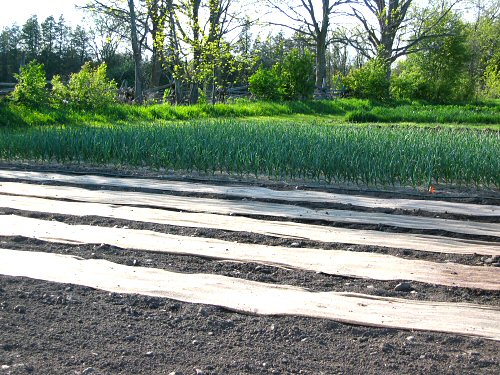
There are many particularly exciting points during the growing season, and this is one of ’em! We’re on the third plantings for some crops, things are emerging everywhere, and some plantings are just getting ready to put on serious growth towards maturity and harvest. In other words, the field is getting ready to explode with veggies. This happens several times during the year, in different sections, with different plantings and crops, but the first time is right across the field and always a thrill. For me, it still seems like kind of a miracle when all those tiny seeds and plans and energy actually turn into…the new Veggie Garden! Here, green onions (in the faint furrows) and carrots under burlap are recent second plantings (yesterday), and the garlic is starting to shoot up on the way to tasty garlic scapes in June…
Evening harvest
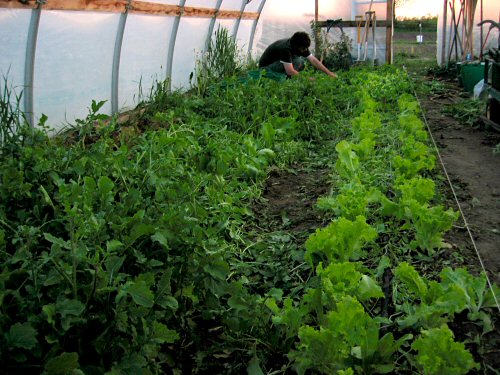
In the greenhouse, harvesting in the first and last couple of hours of the day is the only way to ensure tasty salad greens. Daytime harvest is near futile, as the leaves go limp and require serious rehydration. In the chilly evening weather, plants perk up, and it’s all right as rain! Here, cutting greens in the evening before market means clearing the arugula that bolted during the week and rapidly buried the lettuce. Out of arugula chaos comes delicious, garden-fresh salad mix! (On the tomato front, yesterday’s field transplants did well, only a few leaf burns where they touched the cover, this despite quite a hard frost. That’s good.)
Tomatoes go in
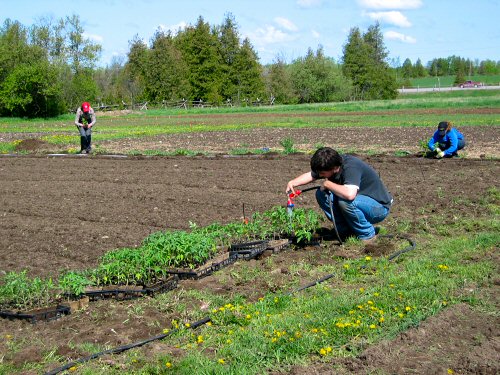
The first of the tender, warm season transplants—tomatoes—hit the field today! About 175 seedlings went in: Juliet, Striped German, Stupice, Emerald Evergreen, Mule Team, Yellow Stuffer. On the transplant team: Conall, Sherry and, new to the season’s crew, Jo. Compared to doing transplants alone or with one other person (my experience so far), this was quite the operation. Teamwork!
Juggling the weather and part-timer scheduling, I took a bit of a risk transplanting today, with patchy frost forecast for tonight. Still, the plants have been through highs and lows in the greenhouse, row cover will help, and tomatoes have…never let me down. I’ll be up at dawn to see how it went. Everything’s a gamble!
More hands on deck
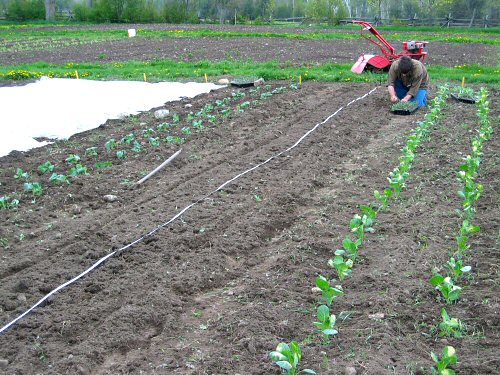
Conall, the all-new organic grower, is back after being unexpectedly called away two and a half weeks ago. That happened after we’d worked together for seven days straight. For me, making the transition from essentially solo tiny farming to having regular help was that quick. Having everything bouncing around in your head, with little need to explain it, is a luxury and efficiency of sorts. On the other hand, if you have people who you can sync with, sharing the gardening in an ongoing way seems like even more fun. And you can grow MORE STUFF with LESS WEEDS!! :) It’s a really welcome return. FREAK FROST: Three nights ago, according to the min/max thermometer, the temperature bottomed at a little below 0°C (and there was no reported cold snap or hard killing frost), but some of the brassicas (Brussels sprouts—see the whitish spots on the leaves on the right of the pic, bok choi, cauliflower) and two out of three varieties of peas got fairly toasted, burnt by the cold. Many of the pea leaves were totally killed off. I only noticed the extent of the brassica damage when we took off the row cover today. This is something I’ve never seen, and Bob, with 40 years of farming, hadn’t either, especially with peas, which can grow in the snow. The additionally odd thing is that some varieties (one of the peas, broccoli) weren’t affected at all. These are all plants that can normally take an overnight freezing and bounce back no problem—temperatures around zero should be nothing. Weird. My random theory: a very rapid temperature drop, many degrees in a few minutes, that didn’t give the plants enough time to adjust…? Anyhow, everything’s recovering just fine! The crazy weather effects continue…
Gardens within gardens
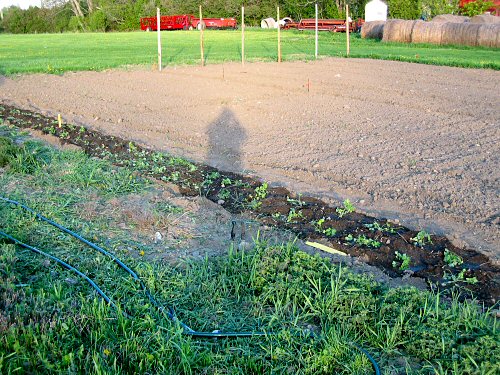
One part of this year’s plan is to expand the herb area from a few beds into a real little herb garden AND to create a home veggie garden. Here is the starting point (along with my shadow). At the bottom of the photo in the overgrowth are sections of sage, oregano and thyme, all doing fine after overwintering with no cover whatsoever, other than the snow. They need to be cleaned up and I’m going to move some. Next, I finally transplanted the parsley from plug sheets started in February, two varieties, Plain Italian flat leaf and Green River curly. The open area is waiting for warmer nights—over the next couple of weeks, I’ll transplant dill, basil, and see if cilantro can survive the jump from tray to field, and direct seed a bunch of others. I haven’t quite figured out where cutting flowers will go, maybe some here as well. And then, in the top corner, marked by 6′ stakes for trellis netting, I’m doing a home veggie garden, 20’x25′, with a little bit of everything, a tinier version of the big garden… It’s a little crazy as far as making work, but the idea is to have a demo for farm stand customers who want to start their own gardens. The more veggie gardens the merrier! :)
Flea beetles
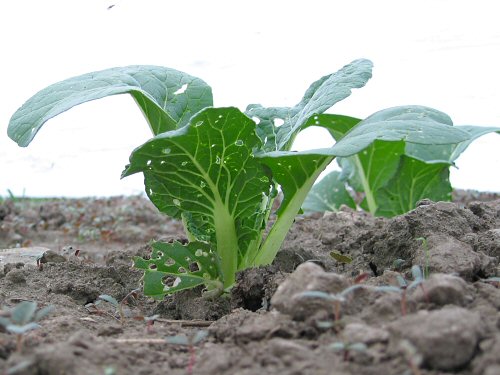
All of the brassicas, except for radishes, start out under floating row cover. It’s the only way they’ll survive the flea beetles. Around here, the FBs are a clear and present menace to the cabbage family. They chew little holes in tender baby leaves until nothing but stems and dried out leaf skeletons remain. It’s awful. I could use organic sprays, like rotenone or pyrethrin, but although they’re “approved” and from natural sources (other plants), it seems to me a slippery slope, or at least habit-forming. I haven’t sprayed so far. I did try a garlic blender concoction as a repellent once, but it was like cooking for the FBs, they hopped off and hopped back on once the spraying stopped: salad dressing! Anyhow, this is bok choi (pak choi). FBs eventually managed to get under the edges and do a bit of damage, but that’ll be outgrown, bok choi grows fast (as do radishes). Once the leaves get a bit more substantial, the FBs can’t as easily chomp on ’em. Cauliflower and broccoli, under this same 14′ wide sheet of row cover, are untouched. FBs REALLY like bok choi!