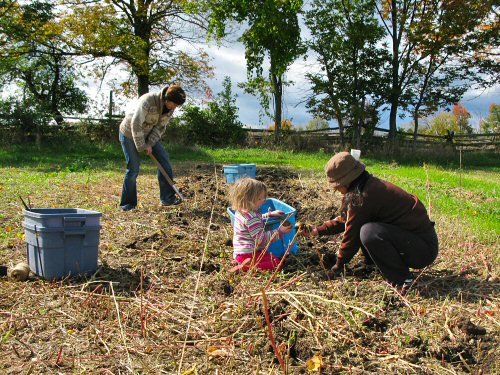
There’s still about 1,000′ of potatoes to dig, a few Yukon Gold, lots of Kennebec, and maybe a bed of Chieftain. This time around, it’s a bit of an unconventional approach. Some beds were kinda…weedy, so a week back, I mowed them all down. Now, the trick is to find the rows. Once a couple of plants are located, I run twine between stakes at either end to mark the row for easier digging. Michele and Toshiko were today’s crew, with young Violet checking things out. Simple fieldwork for a pleasantly cool fall day…
Veggies
Sweet potato harvest
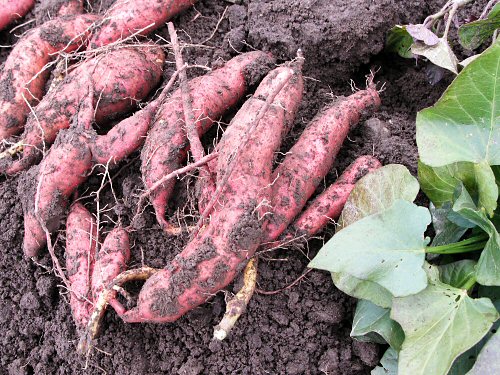
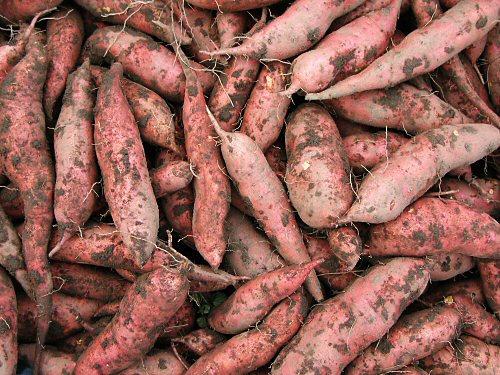
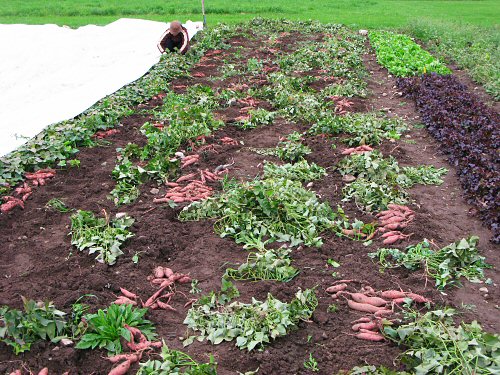
From planting back in mid-June, it’s been 3-1/2 months to the sweet potato harvest. The variety, Beauregard, is listed as 80-100 days to maturity, although, like potatoes, you can dig them up anytime, as soon as the tubers have formed. The vines are frost-sensitive, and the tubers shouldn’t be left in the ground if the tops are frost-killed, so I’ve been gambling with the first frost timing in order to let them grow for as long as possible. Today seemed like a good time to start. This has indeed been a really easy, pest- and disease-free crop, requiring only a little weeding until the vines filled in. Harvesting turned out to be equally easy. After digging up a few plants to see how the tubers grow, Lynn, Toshiko and I set up a quick hand-harvesting system: remove the vine, loosen the soil with a digging fork, scrabble around for the taters.
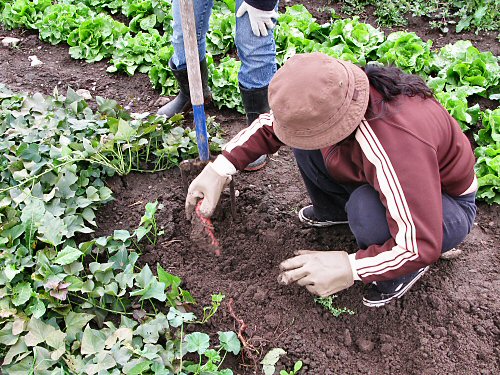
The soil had quite a lot of moisture from recent rains, so we had to spend a little extra time brushing off clumps of clayey earth. We left them for a couple of hours to dry in the breeze, then collected them in bins and brought them into the Milkhouse. By the book, sweet potatoes could use 10-14 days of curing at 80-85°F (25-28°C) . In part, this allows some of the starch to convert to sugar, making them…sweeter. That sort of HEAT isn’t available around here right now, but for this first time around, and too small a quantity for really long-term storage, I’m not too concerned. I baked some a couple of days ago, and they already taste good. Let’s see what a week or two indoors does for ’em!
This week’s share
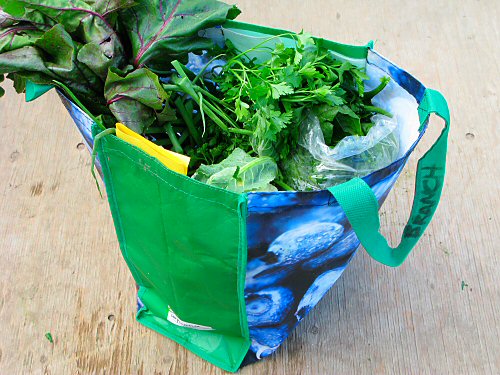
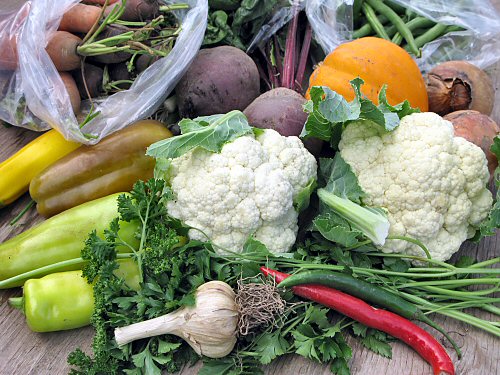
Another rather nice fall CSA share this week! Thanks to no killing frost so far, we’re still picking beans (Jade), peppers (Gypsy, Ace, Cayenne Long Slim), and zucchini (Golden Dawn III). There’s also winter squash (Table Gold acorn), cauliflower (Minuteman), onions (Stuttgarter), beets (Scarlet Supreme), carrots (Nelson, Purple Haze), spinach (Spargo, Bloomsdale), parsley (Green River curly, Plain Italian flat), and garlic (Music). Plus a newsletter. Monday shares are left at a drop-off spot, with shareholders’ names printed on the handles…
Winter squash season
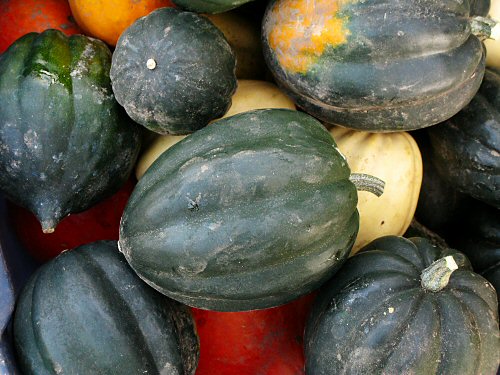
At our farmers’ market, winter squash is the final course on the year’s harvest menu. From here on in, it’s mainly squash, pumpkins, root crops like carrots, potatoes and beets, and…cabbage. Most of the growers at market start bringing their squash in on the same day, like, today, by the trailer load. We harvested about half of our small, assorted crop—a few bushels in all—around 10 days ago, and left the rest to maybe eke out a little more growth until the first killing frost. For today’s market we took in a selection of acorn squash: green Table Ace, yellow-orange Table Gold, and white Cream of the Crop…
Friday harvests get quicker!
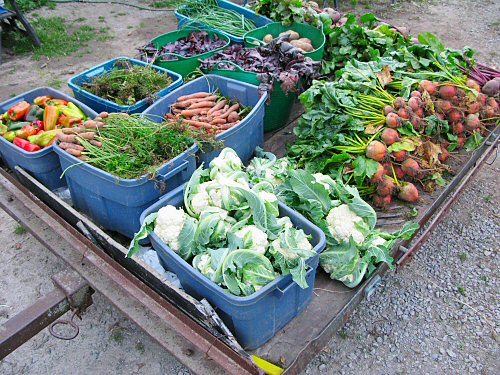
Friday harvests are getting quicker as the season winds down. This has happened at least for the last couple of years. Where earlier in the season, we finish around 8-9pm, we’re now mostly wrapped up by 5 or 6, and sometimes with less people than during the summer. I’m not quite sure why this happens. Probably, a big part of is that everyone out there in the field is now experienced and comfortably fast. Also, many of the crops in the weekly veg line-up are pre-harvested: garlic and onions first, and now, winter squash, pumpkins, potatoes and the new sweet potatoes. Still, it’s a pretty big harvest, and quantities are the same now as earlier in the year. Then there’s the shortening days—it’s starting to get dark around 7:30 pm now, down from 9:30 in late June-early July—and CHILLY WEATHER that likely speed us up! Anyhow, this is the most time I’ve spent wondering why—whatever the reasons, getting done quick is good! The trailer-load in the pic is about half of the day’s field haul, and there’s also the pre-harvested stuff. In this week’s harvest, in no particular order: carrots (2 varieties), cauliflower, beets (3 varieties), sweet peppers (several varieties), hot peppers (several varieties), green onions, spinach (2 varieties), summer squash (3 varieties), beans, tomato (several varieties), parsley, basil, all from the field, plus, pre-harvested, garlic, potatoes, winter squash (several varieties) and onions (2 varieties).
Beautifying the good garlic
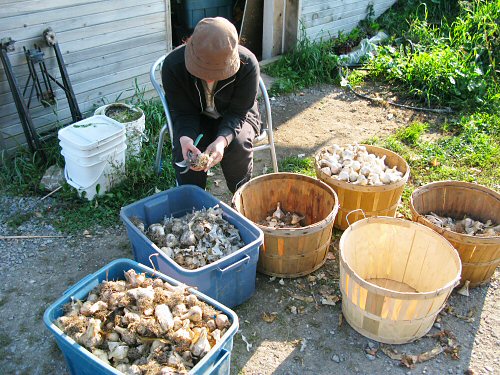
Toshiko, WWOOFing from Osaka, Japan, via Vancouver, where she’d been studying English for the last few months, is our last guest in the field of the year. She arrived last Friday night, and stays until a week from this Sunday, two weeks in all. A couple of years ago, she volunteered on larger farms in Australia, where whole days were spent on one task, like picking a single crop. This is Toshiko’s first taste of really tiny farming, where there’s something different to do every couple of hours. At this point in the season, fieldwork consists mainly of harvest and post-harvest things to do, also, maintaining row cover in case of frost. Here, she does a final, thorough sort through the garlic, separating the good from the damaged bulbs, and trimming the roots of the good stuff.
Pumpkins and pigweed
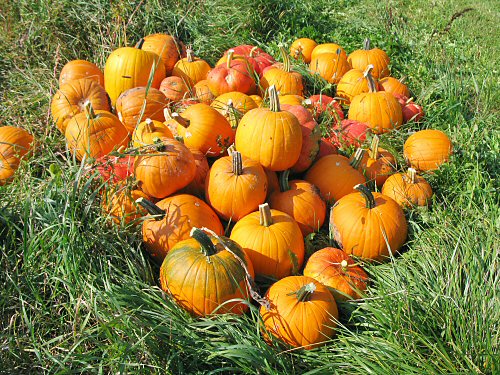
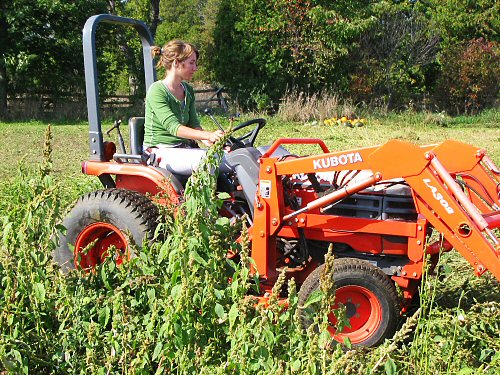
Today, the pumpkins came in, wrested from a jungle of pigweed gone wild. Every year, a few of the 40 50’x50′ sections that make up the 2.5 acre garden get a little overrun with one weed or another (usually, pigweed). This year’s pumpkin patch was a good example, with pigweed growing unchecked for a good six weeks—no time made to weed, not IMPORTANT enough a crop—until today, when Raechelle used the belly-mounted 52″ mower deck on the Kubota compact tractor to mow it down!
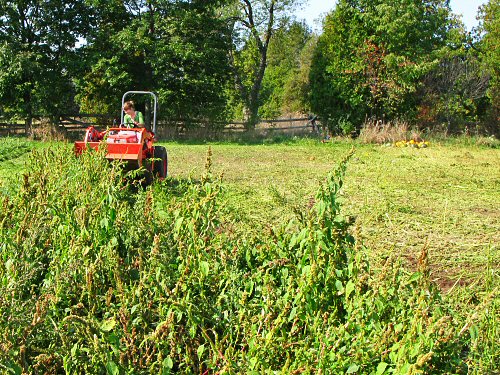
Of course, this is exactly what you DON’T EVER DO in a garden: allow weeds to flourish and go to seed, then mow them down, broadcasting seed everywhere… Oh, well. The alternative, pulling the pigweed by hand, then carting it off, we also do when necessary—see the Pigweed Mountain—but once in a while, I go for the instant gratification of seeing a section clean and clear in an hour or two. The millions of pigweed seeds, ensuring healthy future generations for years to come, will be dealt with…later. (As long as we weed on time next time around, how bad can it get?! :) Anyhow, it’s all part of the grand experiment! Guest pumpkin photo by Lynn.